


Scientists create 'hot ice' that may explain Uranus and Neptune's strange magnetic fields
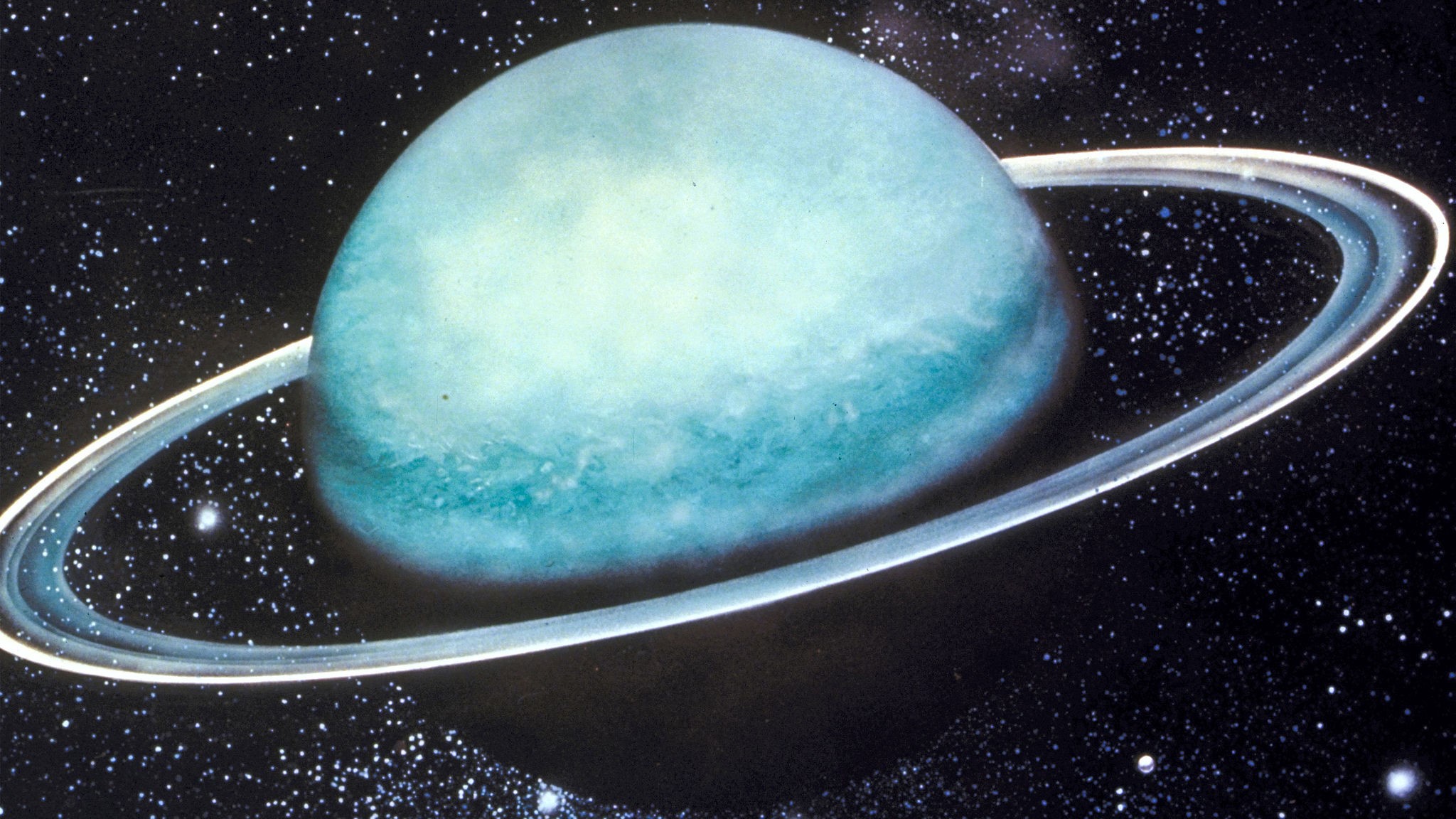
An illustration of the Uranus. (Photo: VCG)
Scientists have created a bizarre form of ice that is hotter than lava yet remains solid – a material that may help explain why Uranus and Neptune have such strange magnetic fields.
The material is called superionic ice. It is not like the ice in your freezer. Under extreme pressure and heat, water can enter a strange state in which oxygen atoms form a solid framework while hydrogen nuclei move through it like a liquid. That makes the ice electrically conductive.
Researchers in France have now revealed a new detail about how its atoms are arranged, according to a recent report by Science and Technology Daily.
To study it, the team squeezed a tiny water sample to more than 2 million times Earth's atmospheric pressure and heated it to over 1,500 degrees Celsius. At that point, water would normally be a superheated gas, but the enormous pressure keeps it solid.
The researchers found that the oxygen atoms settled into a previously unknown crystal structure, a discovery that helps explain how this exotic ice behaves.
That matters because Uranus and Neptune are magnetic oddballs. Unlike Earth, whose magnetic field is roughly centered and aligned with its rotation, the ice giants' magnetic fields are sharply tilted and offset.
Scientists have long suspected that a layer of electrically conducting superionic ice inside these planets could be responsible. If so, the strange magnetic fields observed in the 1980s by the Voyager 2 spacecraft, operated by the National Aeronautics and Space Administration (NASA), would make much more sense.
Superionic ice was predicted decades ago and only confirmed experimentally in 2018. The new work adds another piece to the puzzle, showing that water – so ordinary on Earth – can become something almost alien under the right conditions. It may also help scientists better understand the interiors of some of the most mysterious worlds in the solar system.