


Japan poll: 57% say Takaichi should step up efforts to improve ties with China
A majority of Japanese respondents believe Prime Minister Sanae Takaichi should make greater efforts to improve relations with China, according to a nationwide telephone poll conducted by Japanese newspaper The Asahi Shimbun on September 26 and 27.
The poll found that 57% of respondents said Takaichi should step up efforts to improve Japan-China relations. Bilateral relations have remained strained since Takaichi made erroneous remarks concerning China's Taiwan region in November last year, when she said "a contingency involving Taiwan" could constitute a "survival-threatening situation" for Japan, potentially allowing the country to exercise its right to collective self-defense.
Even among supporters of the Takaichi Cabinet, 51% said the government should make greater efforts to improve ties with China, compared with 44% who said there was no need to do so.
Among those who did not support the Cabinet, 69% called for greater efforts to improve Japan-China relations, while 25% said such efforts were unnecessary.
The poll also showed a more cautious assessment of Takaichi's summit with US President Donald Trump this September. About 44% of respondents said they viewed the meeting positively, while 38% did not. By comparison, 67% gave a positive assessment of Takaichi's first summit with Trump shortly after she took office in October last year.
Japanese scholars have also raised concerns about Japan's current diplomatic position amid signs of increased dialogue between China and the United States.
Shin Kawashima, a professor at the University of Tokyo, told J-CAST News that if Japan-US-China relations were viewed as a triangle, dialogue between China and the US was becoming increasingly active. Although Japan and the US maintain an alliance, he said, Japan-China relations had become a "blank space."
Hitoshi Tanaka, a former Japanese vice foreign minister, said that if the current situation continued, it would amount to a failure of Japanese diplomacy. He also attributed the deterioration in Japan-China relations to Takaichi herself.
Some Japanese internet users have likewise questioned why Japan is not making greater efforts to improve ties with China at a time when Washington is seeking to improve its relations with Beijing.
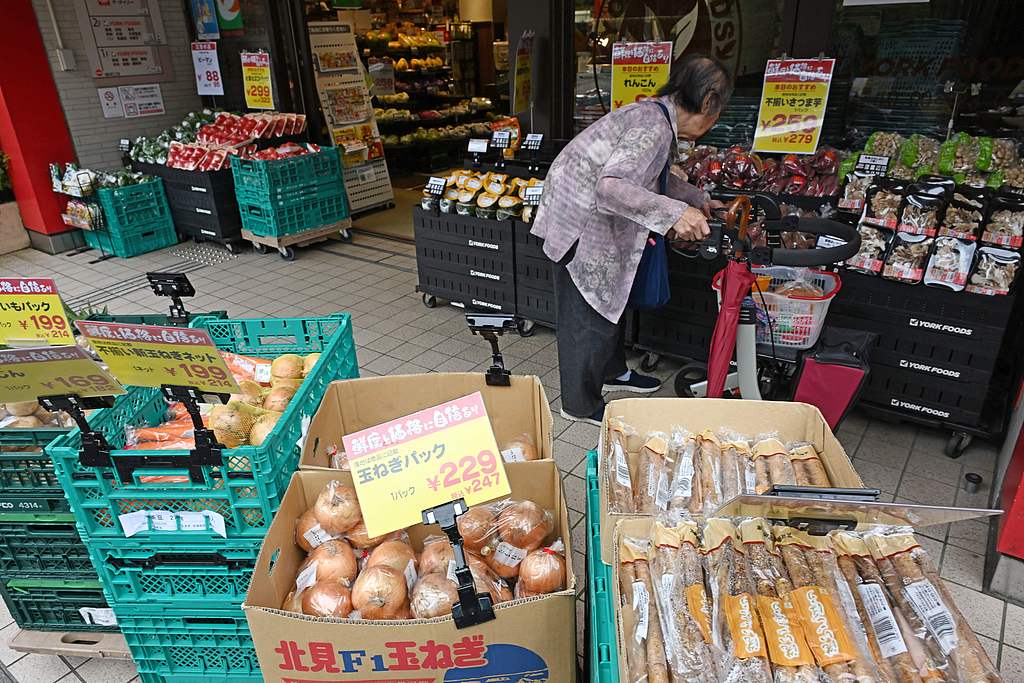
A morning shopper checks out vegetables at a shop in Tokyo. /VCG
Takaichi's inflation response draws scrutiny
The current Japanese government's economic strategy centers on what Takaichi has described as "responsible, proactive fiscal policy," with measures including a temporary cut in the food consumption tax, expanded industrial subsidies and higher defense spending.
The policy push comes as Japan continues to face sustained price pressures. The country's core consumer prices, excluding fresh food, rose 1.7% year-on-year in August, marking the 60th consecutive month of year-on-year growth.
Against this backdrop, public dissatisfaction with the government's response to rising prices has grown. According to the Asahi Shimbun poll, only 28% approved of Takaichi's inflation measures, down from 34% in the previous survey, while disapproval rose from 51% to 59%.
The government has proposed cutting the consumption tax on food items to 1% for two years starting in April 2027, while providing cash benefits to low- and middle-income workers and others.
Public opinion on the plan was divided, with 44% approving and 47% disapproving.
The main concern was how the government would finance the tax cut. According to the poll, 76% of respondents believe the government's failure to disclose the revenue sources needed to fund the measure was a problem. Of them, 41% described it as "highly problematic," while 35% called it "somewhat problematic."
The concern was also shared by supporters of the government, with 67% of Cabinet supporters and 66% of LDP supporters saying the lack of disclosed funding sources was a problem.