


Why are two fighter jets – delivered three-years late – causing such excitement within the DPP? : Hai Feng
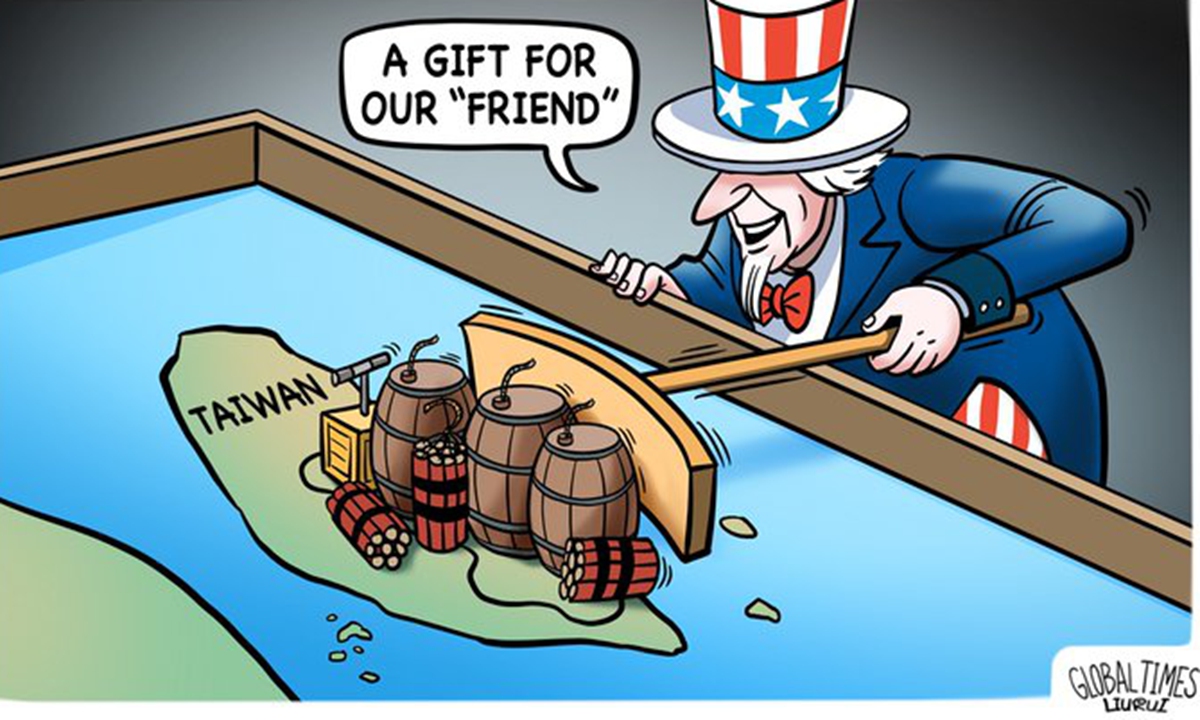
US Taiwan arms sales Illustration: Liu Rui/GT
On October 2, two F-16V fighter jets – originally scheduled for delivery three years ago – arrived at the Chihhang Air Base in Taitung, Taiwan region.
The arrival of the new fighter jets in Taiwan acted like a shot of adrenaline for the DPP, sending the party into a state of high excitement. However, clear-eyed observers on the island have pointed out the stark reality: Despite paying a staggering sum of over NT$240 billion ($7.54 billion) for 66 fighter jets, and after numerous twists and turns, a mere two aircraft have actually arrived.
Why has such a delayed, exorbitantly expensive, and limited initial delivery been packaged by the DPP authorities as a "major achievement" worthy of grand celebration?
The answer may well be that, for the DPP, these two fighter jets have long since ceased to be about so-called "defense" and have become, entirely, a long-awaited political performance.
Arrival of two fighter jets in Taiwan cannot mask three-year delayAccording to reports by Taiwan media, Taiwan procured 66 F-16V fighter jets from the US under the "Phoenix Rising" (Fengxiang) project, with deliveries originally scheduled to begin in 2023 and conclude by the end of 2026. However, it was not until October 2026 that the first two jets finally arrived. Reports also cite assessments from Taiwan indicating that the delivery of the full batch of 66 aircraft could be delayed until as late as the end of 2028.
Even more strange is the fact that the two fighter jets remained in Hawaii for over a month before flying to Taiwan. Was it a technical issue, a supply chain problem, or something else? The Taiwan public remains in the dark.
The arms procurement project, initially touted as a means to enhance defense capabilities, has instead been characterized by delivery delays, high costs, and a lack of transparency regarding progress.
For Taiwan society, what exactly has been gained in exchange for such an exorbitant expenditure of taxpayers' money? What is the actual value of the so-called compensation measures? Who bears the costs resulting from the delay?
The delayed arrival of merely two fighter jets can hardly be hailed as a "major victory."
Why is the DPP so fervent?The reason the DPP authorities are displaying such high-pitched excitement is that they need to repackage a long-overdue arms delivery as a so-called "achievement in Taiwan island-US relations."
In recent years, the DPP has persistently instilled the concept in Taiwan society that continued arms purchases from the US would guarantee greater security for the island. This sense of urgency to find a cover-up has been heightened by the DPP's alarm over the rising prevalence of "abandoning Taiwan" and "doubting the US" sentiments, particularly as China and the US have sought greater strategic stability in their relationship.
Under this narrative, the arrival of two F-16Vs in Taiwan has been imbued with political significance that transcends the hardware itself.
They are cited as proof of continued US support for Taiwan island and used to argue that the DPP’s strategy of "seeking independence by relying on the US" remains viable.
The problem, however, is that while propaganda can alter news headlines, it cannot change the reality of "delayed delivery with reduced scale," let alone erase the inevitable fate of becoming a mere pawn when “seeking independence through reliance on external forces.”
In arms procurement deals, Taiwan is forced to swallow the loss in silenceThe DPP authorities are spending a massive amount of money in the hope of acquiring a comprehensive set of capabilities, including the aircraft themselves, spare parts, weapon systems, software, maintenance and support, and personnel training.
However, based on currently disclosed information, there appears to be no clear provision for liability regarding the delivery delays. The limited compensation Taiwan has managed to secure consists primarily of non-cash arrangements, such as extended warranties, additional spare parts, and technical services.
This raises a practical issue: If the seller can initially deliver only a small fraction of the order without bearing clear liability for compensation – while the buyer continues to shoulder the costs associated with tied-up budgets, delayed training, and the disruption of operational readiness – then what kind of transaction is this?
Furthermore, public opinion on the island has raised questions regarding whether the electronic warfare systems, navigation systems, and associated weaponry for the initial batch of fighter jets are fully in place; Taiwan's “defense” authorities need to provide a professional, transparent, and verifiable explanation.
Against the backdrop of incomplete deliveries, the arrival of two fighter jets in Taiwan appears to be merely a symbolic gesture, devoid of any practical significance.
No amount of arms spending can alter the balance of power between the two sides of the Taiwan StraitsThe DPP authorities are continuously ramping up arms purchases from the US, attempting to create a political illusion of "seeking independence through force" and "resisting reunification through force." However, the quantity of weapons does not equate to actual combat capability, nor do external arms sales equate to genuine security.
Faced with the formidable, integrated, and modernized military might of the People's Liberation Army, the piecemeal weaponry procured by the Taiwan authorities from abroad cannot alter the overall balance of power between the two sides of the Taiwan Straits. Spending vast sums of public money on arms every year cannot change the political foundation of the Taiwan question, let alone halt the historical process of the motherland's reunification.
So-called arms purchases essentially pin the safety and future of the residents of Taiwan on the commercial transactions and strategic calculations of external forces. US arms manufacturers prioritize their own interests; certain US politicians seek to consolidate their influence; and the DPP authorities use these deals to hype up a political narrative of "external support."
It is Taiwan society that ultimately bears the cost. The residents of Taiwan must shoulder the burden of exorbitant military spending, delivery delays, equipment maintenance, and the price of escalating regional tensions, all while facing the risk of being pushed to the forefront of military confrontation.
For Taiwan, increased arms purchases do not equate to peace.
Placing orders with the US will not bring about ‘defense autonomy’If the so-called "defense autonomy" repeatedly hyped by the DPP amounts to nothing more than constantly purchasing from the US and waiting indefinitely for delivery – while leaving Taiwan society to bear the consequences – then such "autonomy" is entirely a false proposition.
True security can only be built upon clear strategic judgment, stable social development, a comprehensive industrial base, and the avoidance of escalating conflict. Blind reliance on external forces can neither substitute for Taiwan’s own governance capabilities nor resolve the fundamental issues between the two sides of the Taiwan Straits.
The arrival of two F-16V jets in Taiwan may be newsworthy, but it should not serve as a fig leaf for the DPP authorities to evade issues. This belated and scaled-back delivery cannot be repackaged as "support for Taiwan," nor can it alter the future trajectory of cross-Straits relations.
The more the DPP authorities cheer for the arrival of two belated fighter jets, the more they expose their anxiety over relying on foreign weaponry to sustain a false narrative. Faced with the formidable military might of the PLA and the disparity in overall strength between the two sides of the Taiwan Straits, no amount of foreign arms purchases can alter the big picture, let alone prop up the fantasy of "seeking independence through force."
The true path to safeguarding the well-being of Taiwan compatriots lies in reducing confrontation, steering clear of the risk of war, and guiding cross-Straits relations back to the correct track of peaceful development.
Weapons may be delivered, but fantasies will not thereby become reality; arms purchases may generate hype, but they cannot change the inevitable trend toward reunification.