


Tokyo expresses 'regret,' lodges protest over a US Marine killing in Okinawa. Then what?
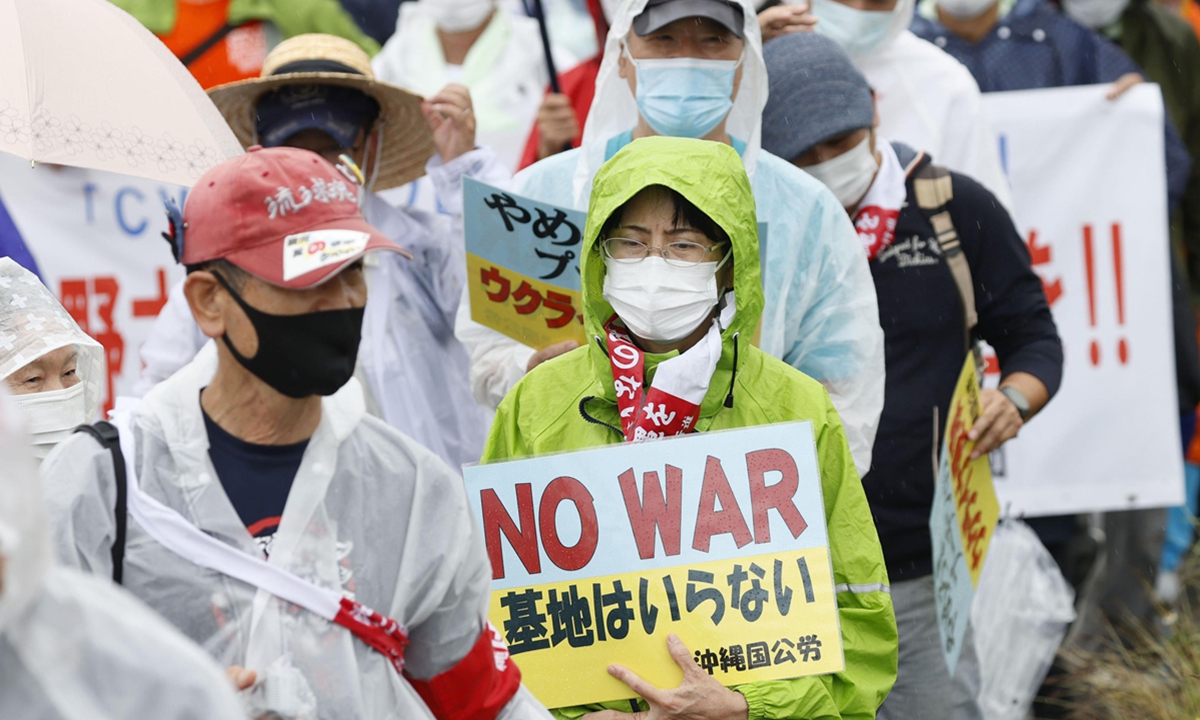
People hold a march calling for the burden on Okinawa from hosting US forces to be lifted in Okinawa on May 14, 2022. (Photo: VCG)
A US service member causes a tragedy on Japanese soil. Japan expresses "regret," lodges a "strong protest," and demands measures to "prevent a recurrence." The US says it will fully cooperate with the investigation. The language is strong. The tone is grave. And then what?
The bases remain. Military aircraft keep taking off and landing. The military buildup continues. When the next case comes, Tokyo will go through much the same script. This time, the victim is 39-year-old Anna Yagi, who died in a hotel in Naha, Okinawa. Next time, who will it be?
A US Marine was arrested Sunday on suspicion of murder and robbery after Yagi's body was discovered in a hotel room in Okinawa. Reports cited police as saying that Yagi had "died from suffocation after being strangled." The case prompted outrage across Japan, and the Japanese government was compelled to put on a show of anger.
The Japanese government quickly started an almost predictable crisis-response routine: Foreign Minister Toshimitsu Motegi summoned the US ambassador; Defense Minister Shinjiro Koizumi lodged a protest with the commander of US Forces Japan; and Prime Minister Sanae Takaichi expressed regret on social media and demanded that the US military tighten discipline on October 4. A day later, before her policy speech in the House of Representatives, she said it again: the crime was "extremely regrettable." Japan had lodged a strong protest, she added, and demanded full cooperation, stricter discipline, and measures to prevent a recurrence.
The question is: What actually changes when Japan repeats the same words again and again? Take a look at the numbers.
According to police figures cited in reports, Okinawa police cleared 6,235 criminal cases involving US service members, base employees, and their relatives from 1972 to 2023. Of these, 586 were serious offenses, including murder, robbery, and sexual assault.
In 2024, a US serviceman was sentenced to five years for kidnapping and raping a Japanese schoolgirl. The Japanese side stressed the need to take measures to prevent a recurrence. Yet similar cases followed.
A total of 101 criminal charges were filed against US military personnel and others connected to the US military in Okinawa Prefecture in 2025, according to prefectural police. It was the first time in 22 years - since 2003 - that the tentative figure had surpassed 100.
The promise is always the same: tighten discipline, prevent a recurrence. Yet the crimes are not. What, then, do the promises mean?
Perhaps the most disturbing thing is not whether any one protest was strong enough. It is how familiar the sequence has become. The same pattern repeats again and again.
For Tokyo, the US-Japan alliance is a so-called national security imperative. For Washington, it is a regional strategy. For ordinary people in Okinawa, it is first of all the place where they live. For years, they have experienced the alliance as noise, accidents, crime, military bases, and the constant worry of not knowing what will happen next.
On October 4, Okinawa's newly elected governor, Genta Koja, told reporters that the fact that this kind of event has happened again leaves us no choice but to conclude that the US military's efforts in maintaining discipline, educating personnel, and other such measures are completely ineffective.
On October 5, Japanese media quoted former upper house member Keiko Itokazu as saying that Okinawans, especially women, should not have to keep bearing this grief and pain. She said that each time, the Japanese government and the US military have claimed to impose stricter discipline and provide proper education for service members. "Is this the result of the so-called education?" she asked, warning that if the bases expand and the number of US troops grows, the harm is likely to grow.
In Western foreign-policy discourse, "ally" is a common word. It suggests equality, respect, and mutual support. But who is kept safe? Who carries the risk? Who decides where that risk falls? And who is allowed to say no? Those are the questions that word should bring into the open.
That is also why a criminal case can eventually become a political mirror. In that mirror, there is certainly the individual responsibility of the US service member involved. But there is also Japan's own choice.
Some observers have therefore argued that Japan's protests are largely for show. Okinawa is home to more than 40 US military bases, about 70 percent of all the US bases in Japan. In recent years, despite sustained local opposition, Tokyo has continued to expand both its own military presence and the US footprint there. Step by step, the prefecture is being turned into a forward bastion.
The US-Japan Status of Forces Agreement was signed in 1960. Under Article 17, the US has primary jurisdiction when service members commit crimes in the performance of official duty. Whether an act is deemed to have been committed in the performance of official duty is largely determined by the US side.
On August 20, 2026, the governors of 15 prefectures with US bases petitioned Tokyo for a fundamental revision of the agreement. But so far, public reporting has shown no commitment to revise it.
Repeated crimes by US military personnel have been met with the same promises and little visible change. Many cases involving US military personnel in Japan have gone unresolved. That is part of the situation Okinawa lives with today. The contradiction is familiar. The number of crimes remains high. The bases have not moved. Protest has become a form of diplomatic theater.
It raises a hard question: is Tokyo trying to solve Okinawa's problem, or only to manage Okinawa's anger about it?
A woman is dead in a hotel in Naha. Her name was Anna Yagi. Her death is likely, sooner or later, to be overtaken by the next case involving US personnel and become another line in Okinawa's long record of such harm.
The Japanese government will probably issue another statement of "strong protest." Sometimes, this is what being an ally looks like.