


Three years on, Gaza faces heavy losses and an uncertain future
October 7 marks three years since the conflict began. Gaza is now devastated, with rubble strewn across much of the territory. Nearly 74,000 Palestinians have been killed and more than 174,000 injured, while around 90% of Gaza's civilian infrastructure has been destroyed. Israel has also taken direct control of about 30% of the territory through ongoing military operations and occupation.
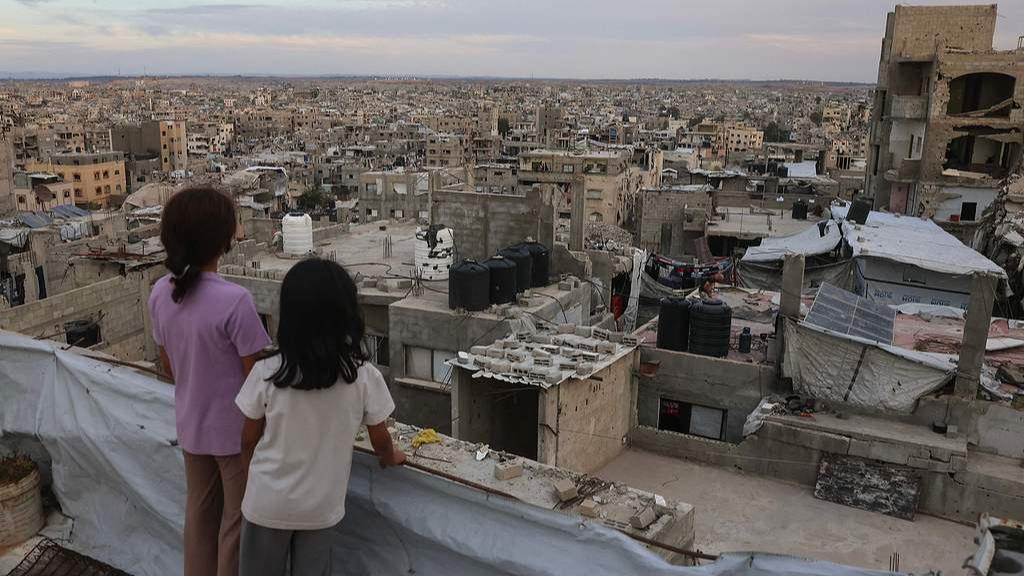
Palestinian children stand on the roof of a building at the Jabalia refugee camp in the northern Gaza Strip, October 5, 2026. (Photo: VCG)
According to the latest 2026 report of United Nations Conference on Trade and Development(UNCTD)on assistance to the Palestinian people, following the outbreak of the Gaza conflict in October 2023, Palestinian GDP shrank significantly in 2024 and grew 4.3% on a low base in 2025, but still 20% below its 2022 level. Across the occupied Palestinian territories, hundreds of thousands of jobs have been lost, resulting in an estimated total loss of labor income of $2.8 billion, approximately 92% of local economic entities have been damaged or destroyed.
Many of the businesses that once created jobs, produced goods, and provided services no longer exist. Agriculture was particularly hard hit. Only 1.5% of agricultural land is still accessible and undamaged. Many families have lost the land they depend on for survival, and local food supplies are becoming increasingly reliant on external aid. The unemployment rate in Gaza stands at 78%. More than half of Gaza's hospitals and primary care clinics are unable to function properly, while 93% of school facilities require complete reconstruction.
Uncertain future
In the past three years, a brief ceasefire has not eased the situation or brought about a turning point. On October 8, 2025, under the pressure and mediation of Egypt, Qatar, Türkiye, the United States and other parties, Israel and Hamas agreed to the first phase of the ceasefire in Gaza proposed by the United States. The main content of the agreement are: both sides cease military operations; the Israeli army withdraws to the outskirts of Gaza, and declares the end of the conflict; the release of Israeli detainees and Palestinian prisoners; humanitarian aid supplies enter the Gaza Strip on a large scale.
Although Hamas and Israel have accepted the ceasefire agreement, they have different understandings of its content and implementation procedures. However, since then, both sides have not achieved a true ceasefire, and Israel continues to strike Hamas militants. Palestinian casualties continue to rise.
In the past year, both the Israeli and Palestinian sides, as well as relevant parties involved in mediation, have put forward different plans and ideas regarding the governance and security arrangements for Gaza. Israel vigorously excludes the post-war security arrangements and governance of Gaza that involve Hamas. The United States advocates for the establishment of an international organization led by the United States to take over and govern Gaza. The Palestinian National Authority insists on leading the post-war governance of Gaza. Under pressure, Hamas has stated that it can accept not participating in the management of Gaza.
The United States is a country with significant influence over Israel, but the US led "rebuilding Gaza" plan has not brought hope to the people of Gaza. In January 2026, US President Trump and representatives from multiple countries signed a document in Davos, Switzerland, launching the so-called "Peace Committee." At the signing ceremony, Jared Kushner, who served as a member of the organization's founding executive committee, unveiled a "blueprint" for the future of Gaza, stating that the Gaza Strip will develop residential areas, tourist resorts, industrial areas, and agricultural areas, showcasing the vision of "prosperity" after Gaza's reconstruction.
However, the international community generally believes that the United States' initiative to promote the reconstruction of Gaza ignores the essence of the humanitarian disaster that Gaza is facing. The focus is not on forcing both sides of the conflict to fulfill the ceasefire agreement, but on treating the reconstruction of Gaza as a real estate development project, selling the so-called illusory "prosperity" of post-war Gaza to the people of Gaza. This is an inverted approach that is difficult to win the hearts of the people of Gaza and attract real investment in international infrastructure and funds.
In a word, Gaza’s future depends on such following factors. First, Israel's true intentions towards Gaza: permanent occupation and annexation, or allowing autonomy led by Palestinian themselves? Secondly, Palestinians should reach a compromise internally and demonstrate its authoritative position externally with a unified voice. Thirdly, it’s also very important to eliminate interference from all aspects and increase international humanitarian attention and assistance to Gaza.