


Gaza after three years: Why stopping the war is easier than ending it
Three years after the Hamas attack on Israel and the ensuing war in Gaza, fighting has largely subsided under a fragile ceasefire. But the hardest questions – who controls the enclave, whether Hamas will disarm, and how Israel will lift restrictions on Palestinian life – remain unresolved.
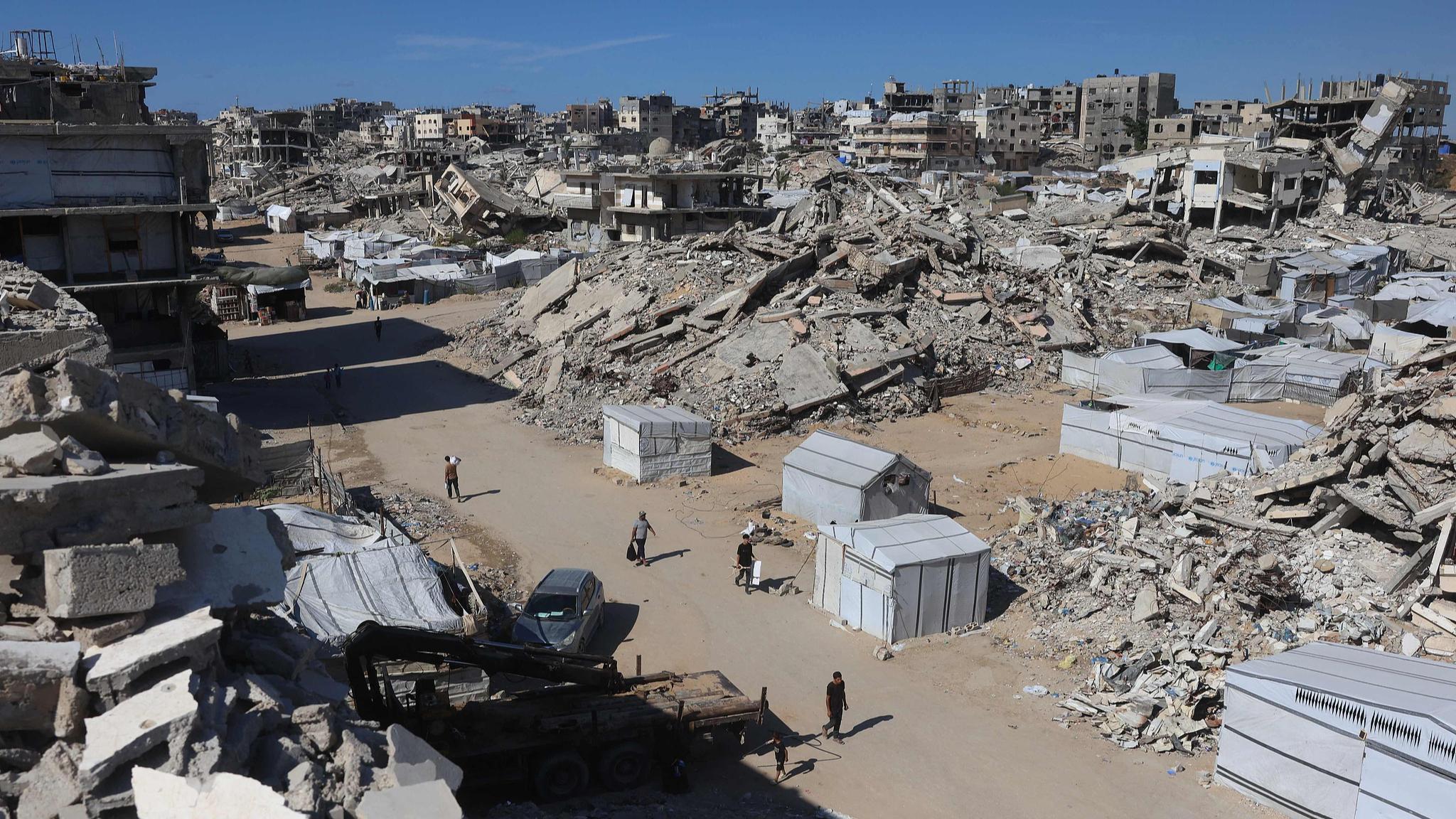
Palestinians walk past destroyed buildings and makeshift shelters at the Jabalia refugee camp in the northern Gaza Strip on October 5, 2026. (Photo: VCG)
The October 2025 ceasefire was the biggest diplomatic breakthrough since the war began, securing the release of the remaining Israeli hostages and sharply reducing fighting. It did not settle the dispute over Gaza's future, and sporadic violence has continued.
At the heart of the impasse is a clash of strategic objectives. Israel has made dismantling Hamas' military capabilities a core condition for ending the war, arguing that leaving the group armed would keep the threat alive.
Hamas, which has survived as both an armed and political force, has demanded an end to Israeli military operations and a full withdrawal before any deal on its weapons.
That leaves a sequencing problem: Israel wants guarantees Hamas cannot rebuild before giving up control of territory, while Hamas has little incentive to surrender its main leverage without guarantees that Israel will withdraw and not resume the war.
The day after remains unresolved
A US-backed roadmap announced in July seeks to bridge the gap by linking a phased Israeli withdrawal with Hamas' disarmament, an international stabilization force and a Palestinian technocratic administration.
But agreeing to a framework has proved easier than implementing one.
The question is not only who controls Gaza militarily, but who governs it. Hamas has retained influence and reportedly collected taxes and paid salaries in parts of Gaza, while Israel has sought to prevent the group from returning to power. That leaves no clear political authority capable of taking over.
Reconstruction adds another dilemma. Gaza's devastated infrastructure needs massive investment, but donors need a credible security and governing structure before committing.
Israeli control and Gaza's humanitarian crisis
Three years of war have displaced much of the population and destroyed homes, hospitals and other infrastructure. People there remain in a vulnerable state, in part because Israel controls or restricts access to large parts of Gaza, limiting where displaced Palestinians can return and where aid agencies can operate.
UN figures show about 65% of Gaza's land is inaccessible or severely restricted, leaving humanitarian agencies to work in the remaining 35% – already overcrowded. Aid groups report delays and denials affecting personnel and supplies, while shortages of fuel and spare parts hamper water, sanitation and health services.
Israel says the restrictions are necessary to prevent Hamas rebuilding its military capabilities and to protect Israeli security. For Palestinians, the continued loss of access to land and basic services has prolonged displacement and hardship, making the trust needed for a political transition harder to build.
The result is a humanitarian response that remains heavily dependent on Israel for access to territory, personnel and supplies, adding another layer of difficulty to efforts to establish effective postwar governance.
Mediation without enforcement
The US, Egypt, Qatar and others have repeatedly brokered ceasefires and hostage deals, but have struggled to impose a mechanism that resolves the underlying disputes.
The proposed international stabilization force and Palestinian transitional administration face obstacles beyond troops and funding. Israel's consent and cooperation are also critical, as the force would have to operate alongside Israeli forces and its deployment is tied to a phased Israeli withdrawal.
The proposed international stabilization force and Palestinian transitional administration face obstacles beyond securing troops and funding. Israel's consent and cooperation are critical: although its security cabinet approved the legal framework for the force in July, each foreign contingent still requires Israeli approval, and the force has yet to deploy.
The wider regional picture has complicated that effort further. The US-Israel conflict with Iran in 2026 shifted diplomatic attention toward a broader confrontation, while regional governments focused on containing its fallout.
Yet Gaza remains central to Middle East politics. In Israel, the legacy of October 7 and the Gaza war is shaping the upcoming election, with families of victims and former military figures entering politics.
Prime Minister Benjamin Netanyahu has rejected key elements of the latest roadmap, while far-right members of his coalition oppose an Israeli withdrawal.
Three years on, the fundamental problem is not a shortage of ceasefire proposals. It is the absence of agreement on what follows them.
Israel wants guarantees that Gaza cannot again become a base for attacks. Palestinians want an end to military control and a credible political future. Hamas' future role sits at the center of those competing demands.
Until security, disarmament, governance and reconstruction can be addressed as parts of the same political arrangement, a ceasefire risks being not the end of the conflict, but another pause before the next crisis.