


From Northern Myanmar to the world, an anti-fraud dragnet is tightening
A sceenshot of The Demise of Telecom Fraud in Northern Myanmar. (Source: CCTV)
Following its broadcast, the three-part documentary The Demise of Telecom Fraud in Northern Myanmar has caught widespread attention both in China and abroad. This reaction reflects a universal aversion to telecom fraud across the international community and a shared expectation for joint decisive action.
Telecom fraud is a global scourge. According to a report by the United Nations Office on Drugs and Crime, economic losses incurred by fraud in East and Southeast Asia, Australia, and other regions reached a staggering $88.3 billion to $114.1 billion in 2025 alone - a figure that even exceeds the GDP of several countries. Perpetrators of telecom fraud have long dug in abroad, directing operations remotely. Meanwhile, funds move in seconds, digital trails are obfuscated through layers of disguise, and victims span multiple nations.
Authorities shut down one fraud compound today only to see a new one spring up on another hill tomorrow, or arrest a few ringleaders here while a fresh batch of "agents" emerges elsewhere. This proves a stark reality: without cross-border cooperation - encompassing intelligence sharing, joint arrests, judicial collaboration, and repatriation - anti-fraud efforts are reduced to an endless game of "whack-a-mole," where stamping out one fire only sparks another elsewhere.
How to join forces to sever the tentacles of telecom fraud has become a question that is imperative for the international community to answer. The solution demonstrated by China in this battle is to advance international cooperation through concrete action. As revealed in the third episode of the documentary Weaving the Sky Net, Chinese and Myanmar police, leveraging long-standing law enforcement and security cooperation mechanisms, carried out their first joint enforcement operation in Muse town in Myanmar, apprehending 807 telecom fraud suspects in a single sweep and eradicating the final, most stubborn "nail" that had long resisted the special crackdown.
Meanwhile, the ministerial-level coordination mechanism established by China, Myanmar, and Thailand in early 2025 launched joint purges against gambling and fraud syndicates in Myanmar's Myawaddy town, carrying out 10 consecutive joint repatriation operations that led to the total demolition of more than 630 buildings in the infamous KK Park.
For China, tightening this anti-fraud dragnet is both an essential requirement for safeguarding the property security of its own people and a concrete practice of fulfilling its responsibilities as a major country to build a community with a shared future for humanity. At the law enforcement level, China has repeatedly launched joint crackdown operations with Myanmar, Laos, Cambodia, Vietnam, and other countries. At the institutional level, China and its neighboring countries have successively established trilateral coordination mechanisms among China, Myanmar, and Thailand, as well as the Lancang-Mekong law enforcement and security cooperation mechanism.
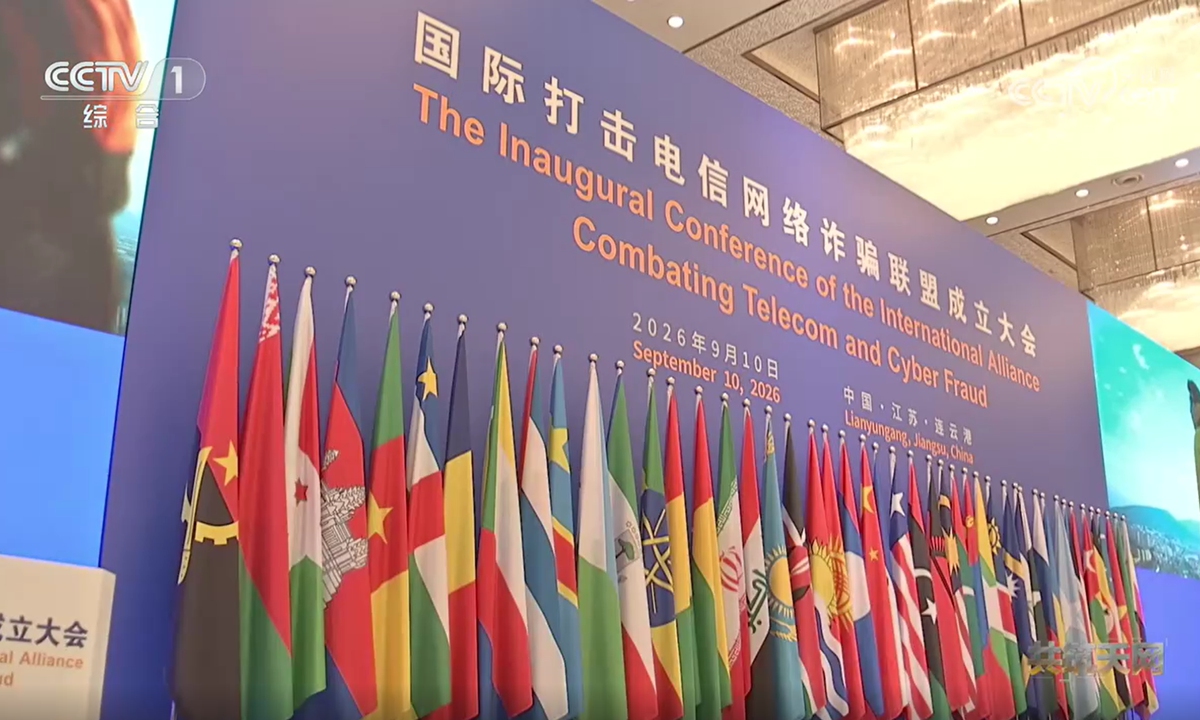
Furthermore, China has helped neighboring nations build law enforcement capacity through material assistance and technical support. Not long ago, the International Alliance Combating Telecom and Cyber Fraud was established in Lianyungang, East China's Jiangsu Province, where representatives from 46 founding countries, 34 observer countries, the United Nations, Interpol, and other bodies issued a joint declaration. This marks a pivotal shift in global anti-fraud efforts - coordinated and advanced by China - from a fragmented "sweeping snow from one's own doorstep" approach to "jointly weaving an integrated global network."
Combating telecom fraud is no overnight task, and in the fight against fraud, there are no bystanders. Facing telecom fraud that constantly shifts and mutates, only through broader consensus, more pragmatic measures, and a tighter network can the chain of evil be broken and the peace and well-being of millions of households safeguarded.