


Amid shifting public opinion, will the UK rejoin the European Union?
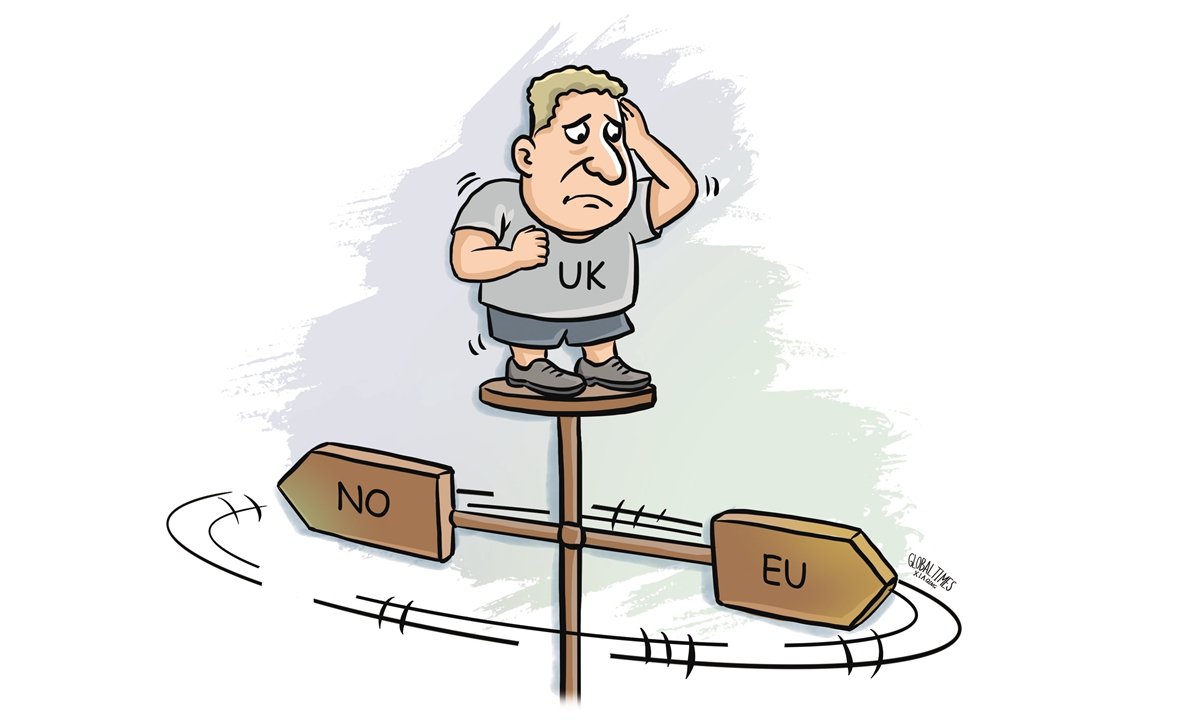
UK's choice: EU or not? Illustration: Liu Rui/GT
At the recent Labour Party's annual conference, Andy Burnham, who has been British prime minister for just over two months, publicly criticized Brexit, arguing that Brexit had weakened Britain's control over its economy and immigration and had ultimately "done more harm than good." Burnham said he would use the upcoming UK-EU summit as an opportunity to outline different options for Britain's long-term relationship with the EU and seek to build a consensus. Possible options include maintaining the current framework for UK-EU relations, forming a customs union, rejoining the single market or pursuing full EU membership.
Although Burnham stopped short of explicitly calling for Britain to rejoin the EU immediately, his remarks left considerable room for interpretation. Speculation about Britain's possible return to the bloc quickly spread around the world, generating a stir reminiscent of the shock caused by the Brexit referendum a decade ago. Will Britain rejoin the EU?
The first question to clarify is why Burnham has avoided explicitly calling for Britain to rejoin the EU, instead remaining ambiguous about his position, often stopping short of making a definitive statement and presenting multiple options for public speculation. Clearly, Burnham is testing public opinion by putting the issue of rejoining the EU on the table and gauging reactions from different sectors.
Looking at British society, Burnham and the Labour Party evidently believe there is still considerable political mileage to be gained from raising the prospect of Britain rejoining the EU. Leading polling organization YouGov has regularly surveyed public opinion on whether Brexit was right or wrong since the 2016 referendum. By June 2026, 57 percent believed Brexit was wrong, compared with 30 percent who thought it was right. Another YouGov poll published on October 2, 2026 found that 44 percent of respondents believed Britain was "very/fairly likely" to rejoin the EU within the next 10 years, while 37 percent considered it "very/fairly unlikely."
The Burnham administration is eager to capitalize on this public opinion sentiment. Burnham is the first British prime minister since the 2016 Brexit referendum to have openly criticized Brexit as a mistake. Perhaps mindful of the fact that Britain has had seven prime ministers in just 10 years, Burnham has chosen to break publicly with his predecessors, who maintained that Brexit was the right decision, in the hope of distinguishing himself through a different stance on a major policy issue. But Burnham's apparent belief in rejoining the EU will face formidable obstacles in British society.
First, the result of the 2016 Brexit referendum remains a powerful constraint and a major obstacle to Britain's possible return to the EU. Although current polls indicate that a majority of Britons believe Brexit was a mistake and would like the country to rejoin the bloc, the 2016 referendum result remains a political red line that cannot easily be crossed. If Britain were to hold another referendum on EU membership a decade after Brexit, there would be no guarantee that another referendum on leaving the bloc would not follow just a few years after rejoining. Such repeated entries and exits would not only damage the EU but also seriously undermine the authority of the Westminster Parliament and ultimately deepen divisions within Britain.
Second, the EU is less attractive today than it was in the 1960s and 1970s, prompting British politicians to carefully reconsider the necessity of rejoining. As a champion of globalization, the EU has not only been unable to reverse the global trend toward deglobalization but has itself increasingly embraced protectionism, using its powerful institutional mechanisms to pursue reindustrialization. Britain, which advocates free trade, may find it difficult to adapt to an increasingly protectionist EU. In effect, the UK and the EU have embarked on two divergent paths.
Finally, the EU may impose more stringent conditions on Britain's readmission, potentially deterring the UK from pursuing membership. Before Brexit, Britain enjoyed special exemptions as a major EU member state. It was not required to join the eurozone or the Schengen Area and had secured a number of opt-outs in justice and home affairs.
If Britain were to apply for EU membership again, the bloc would undoubtedly welcome the move in principle, as it would provide an important opportunity to demonstrate the EU's influence and further advance European integration. But to guard against the possibility of Britain leaving the bloc again, the EU would need to establish safeguards. From the EU's perspective, removing the special exemptions Britain enjoyed during its previous membership would be a necessary step. Full compliance with the EU's four freedoms, namely the free movement of goods, services, capital, and people, would become a key condition in negotiations with Britain.
A decade after the Brexit referendum, British society may be reassessing the decision it made in 2016, but there is still a long way to go before a genuine political consensus on rejoining the EU can emerge.