


Major Saudi airports suffer new strikes from Houthis
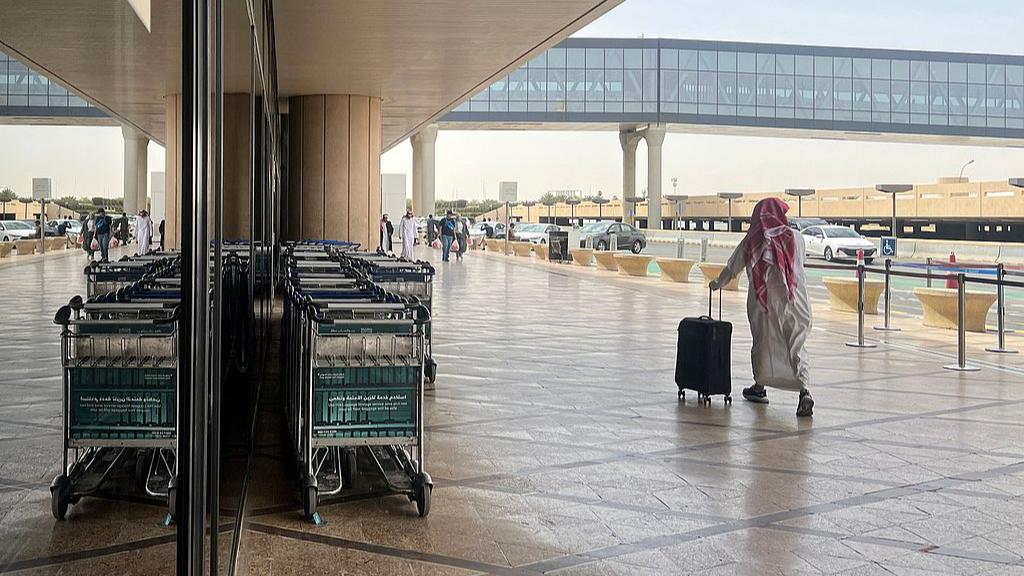
A file photo of a traveller rolling his suitcase at the departure terminal of King Khalid International Airport in Riyadh, Saudi Arabia, April 2, 2026. (Photo: VCG)
Fighting between Yemen's Houthis and the Saudi-led coalition showed no sign of easing on Sunday as fresh attacks hit major airports in Saudi Arabia.
While the Houthi group claimed new missile and drone operations against Saudi airports and energy facilities, the coalition vowed a firm response.
Saudi Arabia's General Authority of Civil Aviation (GACA) said on Sunday that a new attack on King Khalid International Airport in the Saudi capital Riyadh caused injuries. Earlier in the day, the Saudi-led coalition said an unknown projectile had struck a passenger terminal at the airport, and a fire resulting from the attack was being handled at the site.
In a later statement, GACA said King Fahd International Airport near Dammam in the Eastern Province was attacked on Sunday evening, and damage assessments and safety inspections of the airport facilities were underway.
The Houthi group claimed it had carried out four missile and drone operations against airports and energy facilities across Saudi Arabia over the past 24 hours. It said the attacks are responses to intensified airstrikes across Houthi-held areas in Yemen by Saudi-led coalition.
Houthi military spokesperson Yahya Sarea said the operations targeted King Khalid International Airport, King Fahd International Airport, and two facilities operated by Saudi energy giant Aramco.
In a separate statement, Sarea warned that Saudi airports and airspace, except for the airports in the Islamic holy cities of Mecca and Medina, remained "exposed to targeting" and constituted an area of operations for the group's forces.
Sarea claimed Saudi warplanes had carried out 124 strikes over the previous 24 hours targeting the capital Sanaa and the provinces of Taiz, Marib, Al-Jawf, Hajjah, Hodeidah and Saada.
Houthi-run al-Masirah TV also reported earlier on Sunday that a Saudi airstrike hit Sanaa International Airport in Yemen's Houthi-held capital, with no immediate information on casualties or damage at the airport.
A Yemeni military official said that Saudi warplanes had launched intensive strikes on Houthi-controlled areas in the southwestern province of Taiz, where fighting between government forces and the group has intensified.
International society condemns attacks on civilian infrastructure
The escalating conflict has drawn growing international concern, particularly after a Houthi attack on King Khalid International Airport on Saturday killed 12 people and injured 309 others.
"I am deeply shocked by and strongly condemn Saturday's lethal attack by the Houthis on King Khalid International Airport in Riyadh," said UN Secretary-General Antonio Guterres, adding that attacks on civilians and civilian infrastructure violate international law and "must cease immediately."
The United Arab Emirates, Sudan, Egypt, Türkiye, Israel, Iraq, Syria, Palestine, Bahrain and the Arab League also condemned Saturday's attack.
Iran's Foreign Minister Seyed Abbas Araghchi on Sunday voiced his country's readiness to help initiate dialogue between Saudi Arabia and Yemen and prepare the ground for achieving a political solution to the ongoing conflict. He made the remarks in a phone call with his Saudi counterpart Prince Faisal bin Farhan bin Abdullah Al Saud.
Araghchi expressed grave concern over the escalation of tensions, saying insistence on pursuing military approaches and turning a blind eye to political solutions solely further complicate the status quo. He stressed that there is no military solution to the crises in West Asia.
Yemen has been mired in conflict since late 2014, when the Houthis seized the capital Sanaa and much of the country's north. A Saudi-led coalition intervened in 2015 in support of the internationally recognized Yemeni government, now based in the southern port city of Aden.
The renewed fighting marked a major escalation after a UN-brokered truce in 2022 largely halted major hostilities.
(With input from Xinhua)