


Explainer: How are Houthi attacks disrupting civil aviation?
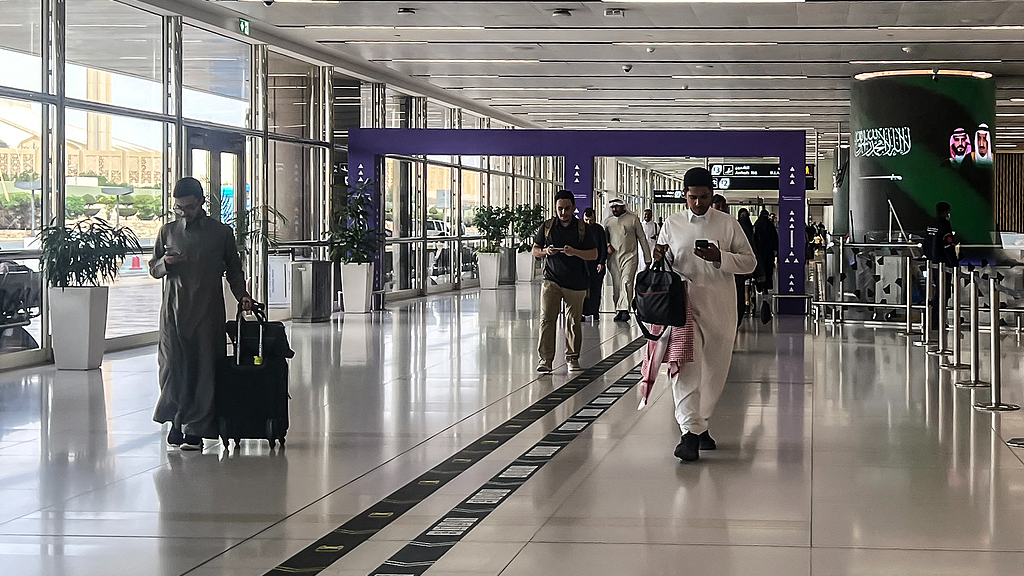
A file photo shows travelers walking through the departure terminal of King Khalid International Airport in Riyadh, Saudi Arabia, April 2, 2026. (Photo: VCG)
A series of Houthi attacks has disrupted commercial aviation in Saudi Arabia, forcing airlines to cancel flights, suspend services and reassess the risks of operating in the kingdom's airspace.
The attacks have raised questions about the scale of the damage to Saudi Arabia's airports, how airlines are responding to the security risks and what the disruptions mean for international air travel.
WHAT HAPPENED TO SAUDI AIRPORTS
The Houthis have intensified their attacks on Saudi Arabia's airports over the past week, launching repeated strikes on facilities in Riyadh, Abha, Jazan and Najran.
On Oct. 6, authorities reported that attacks targeting King Abdullah bin Abdulaziz International Airport in Jazan and Najran International Airport had injured three people.
The following day, strikes on Abha International Airport in southwestern Saudi Arabia and King Khalid International Airport in Riyadh killed three people and injured 36 others.
The attacks continued on Oct. 8, when two strikes targeting King Khalid International Airport killed three Saudi citizens, including airline captain Hamoud Ali Alkalthami, and injured people of several other nationalities.
The violence escalated on Oct. 10, when an attack on King Khalid International Airport killed 12 people and injured 309 others. The dead included Saudi nationals and citizens of Bangladesh, the United States, Egypt, Jordan, Palestine, Syria and Sudan.
On Oct. 11, another attack targeting the Riyadh airport killed a Pakistani resident and injured 11 others.
"This level of sustained intense attack on civil aviation is unprecedented," said Mark Zee, founder of OPSGROUP, a membership-based organization that provides aviation safety advice.
"I think this requires us to rethink how we view the current risk picture, and tread very carefully," he told Reuters.
HOW ARE AIRLINES RESPONDING
The attacks on Saudi Arabia's airports have raised concerns over aviation safety and disrupted airline operations.
Following the attacks, operations at King Khalid International Airport, Saudi Arabia's second-busiest airport, were suspended. A Notice to Airmen issued on Monday showed the airport will stay closed until 2100 GMT on Oct. 17.
The disruption has also forced airlines across Europe and Asia to suspend services. The U.S. Federal Aviation Administration has advised U.S. carriers to exercise caution when flying to or over Saudi Arabia.
Meanwhile, the European Union Aviation Safety Agency, in a bulletin effective through Nov. 16, advised airlines not to operate at any flight levels within a designated area along the boundary of the Jeddah Flight Information Region.
OPSGROUP has also advised airlines to avoid the southern aviation corridor over the Middle East and take a route from Europe to Asia over Central Asia.
Several airlines have announced suspensions or schedule changes. Lufthansa has suspended flights to Riyadh up to and including Nov. 18, while Air France-KLM has announced that it will not operate flights to Riyadh and Dammam until and including Oct. 31.
Etihad Airways cancelled flights between Abu Dhabi and Riyadh, Jeddah and Dammam due to "regional disruption," with all flights between Abu Dhabi and Riyadh cancelled until Oct. 19. Qatar Airways also announced the temporary suspension of flights to and from Riyadh and Dammam due to the "current situation."
The impact has also extended to planned services. Delta Air Lines said it will delay the planned launch of its nonstop service between Atlanta and Riyadh, initially due to start on Oct. 23, until March 2027.
WHAT ARE THE IMPACTS
The disruption could have repercussions beyond flight cancellations, affecting international connections, airline operating costs and travel plans across the region and beyond.
For travelers, the most immediate consequences are cancellations, delays, missed connections and uncertainty over when suspended services will resume. Passengers traveling through affected airports may face additional complications even when their final destinations remain accessible by other routes.
For airlines, rerouting flights to avoid areas considered unsafe can lengthen journeys, increase fuel consumption, and complicate aircraft and crew planning, particularly on busy routes linking Europe and Asia.
For the wider aviation industry, the situation highlights the vulnerability of international air travel to security threats affecting key airports and airspace corridors.
A sustained return to normal operations will depend on whether the threat subsides and airlines and regulators determine that flights can operate safely.