


China-Botswana ties 'shine like diamonds' as partnership enters new chapter
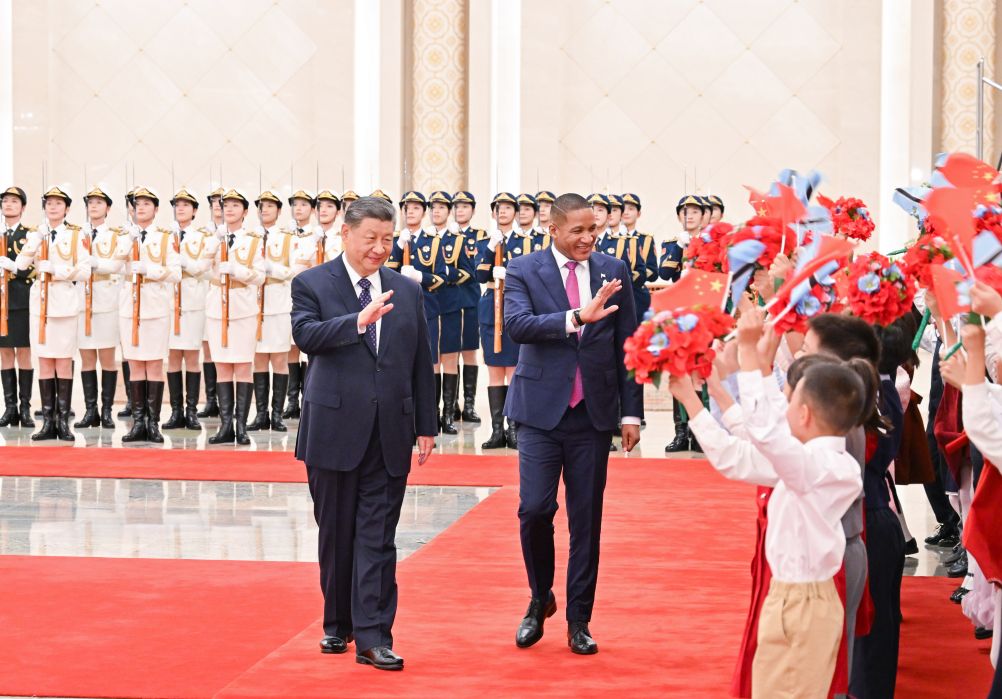
Chinese President Xi Jinping holds a welcome ceremony for Botswana's President Duma Gideon Boko in the Northern Hall of the Great Hall of the People prior to their talks in Beijing, capital of China, October 13, 2026. (Photo: Xinhua)
For decades, diamonds have shone as the glittering emblem of Botswana. For China and Botswana, the precious stone offers a fitting metaphor for a friendship that has endured across decades.
Chinese President Xi Jinping invoked that image during his meeting with Botswana's President Duma Gideon Boko in Beijing, saying the two countries' friendship should "shine bright and endure like diamonds."
As both sides look toward a new stage of cooperation and their shared journey toward modernization, the enduring value of their partnership lies in both the opportunities diamonds represent and the possibilities beyond.
A stronger strategic partnership
During their meeting on Tuesday, Xi and Boko agreed to elevate bilateral ties to a comprehensive strategic cooperative partnership.
Xi called for deeper economic and trade cooperation, urging both sides to seize opportunities under China's zero-tariff policy for African countries with diplomatic ties with China. He also highlighted potential cooperation in the digital economy, agriculture and education.
Boko welcomed greater Chinese investment and closer cooperation in industry, agriculture, mining, innovation and digital transformation. The two leaders witnessed the signing of cooperation documents covering areas like the Belt and Road Initiative, green mining, health and human resources.
Wang Yiwei, a professor at the School of International Studies at Renmin University of China, described the development as a milestone in bilateral ties. He said the expanded partnership creates room for cooperation beyond traditional trade and resource development while reflecting the potential for mutually beneficial cooperation between China and African countries based on their respective national conditions.
Diamonds: Turning resource wealth into lasting value
Diamonds have long been a cornerstone of Botswana's economy, accounting for about 80% of the country's exports between 2012 and 2023, according to the International Monetary Fund. But the country's experience in the diamond industry also highlights a broader question facing resource-rich African economies: how can mineral wealth translate into greater industrial value and more sustainable development?
During his talks with Boko in Beijing, Xi outlined a four-point proposition for China-Botswana and China-Africa mining cooperation: respecting African countries' ownership of their resources, pursuing mutual benefit, promoting high-quality development and fostering a fair and open environment. China also stands ready to share its mining development experience and green technologies to support African countries in pursuing development paths suited to their national conditions, Xi said.
For Botswana, the opportunity lies in building on its diamond industry while strengthening local value creation and capabilities so that its natural resources contribute more to long-term, sustainable economic development.
Zhu Weidong, a researcher at the Institute of West Asian and African Studies of the Chinese Academy of Social Sciences, said such cooperation can help African countries address constraints in mining development, including shortages of capital and technology. By combining China's development experience with local conditions, cooperation can also help resource-rich countries move toward more value-added and sustainable models of mineral development, bringing greater benefits to local communities.
A step in that direction came on September 15, when representatives from Botswana, Namibia and South Africa, alongside Chinese and international industry participants, signed the Beijing Declaration on Natural Diamonds and Sustainable Development. The declaration outlines commitments to support African diamond-producing countries, strengthen local value creation, develop skills and promote more sustainable industry practices.
Economic diversification: Broadening trade and investment
Heavy reliance on diamond exports leaves Botswana vulnerable to fluctuations in global demand and prices. As the country seeks to diversify its economy, China is an important partner in expanding trade, attracting investment and developing new industries.
Speaking at the Botswana-China High-Level Trade and Investment Forum in Beijing on October 15, Boko called for closer business ties and greater Chinese investment. He said China's development experience had broadened his perspective on the opportunities available to Botswana, particularly in infrastructure, technology and biomedical innovation. He also highlighted Botswana's potential as a gateway to wider African markets.
Zhang Yongpeng, a senior research fellow at the Institute of West Asian and African Studies of the Chinese Academy of Social Sciences, said the visit offers an opportunity to translate expanded market access into broader economic cooperation. He pointed to the potential for Botswana to increase exports of local products to China and attract Chinese investment in mineral processing, new energy and other sectors, which could support the country's economic diversification.
Renewable energy and digital infrastructure: Building capacity for the future
Reliable power and robust digital infrastructure are becoming increasingly important to Botswana's development, creating new avenues for cooperation with China.
A 100-megawatt solar power plant in Jwaneng, southern Botswana, built by China Harbor Engineering Company as part of a Chinese-Botswana consortium, began operations in late April 2026. The project is expected to cut carbon emissions by 240,000 tonnes a year and help ease electricity shortages. It has also supported local employment and provided training opportunities for young electrical engineering graduates, linking energy development with local skills building.
Cooperation is also extending into the digital economy. The Digital Delta Data Center, built by China Jiangxi International Economic and Technical Cooperation Co., Ltd., is Botswana's first national-level data center. By providing infrastructure for data storage, processing and transmission, it can support government services and businesses as they expand their use of digital technologies.
Healthcare: A partnership built over decades
Healthcare has long been another important area of cooperation between China and Botswana. Before meeting Xi in Beijing, Boko visited east China's Fujian Province on October 12, where he met with provincial officials to discuss expanding cooperation in trade, investment, healthcare, biomedicine and cultural exchanges.
Healthcare has been a longstanding part of the relationship between Fujian and Botswana. Since 1981, Fujian has dispatched 17 medical teams comprising 556 medical personnel to Botswana. They have handled more than 3 million patient visits and performed over 130,000 operations, according to Fujian authorities.
Cooperation is also extending into digital healthcare. In January 2026, medical experts in Fujian and Botswana held an online consultation, demonstrating how technology can facilitate professional exchanges across geographical boundaries.
From diamonds to new avenues for growth, China and Botswana are building on a friendship that has stood the test of time. As their partnership enters a new chapter, the hope is that this enduring bond will continue to shine – not only in the strength of their friendship but also in the opportunities it creates for generations to come.