


Why Netanyahu unveils new national security doctrine ahead of Israel's election
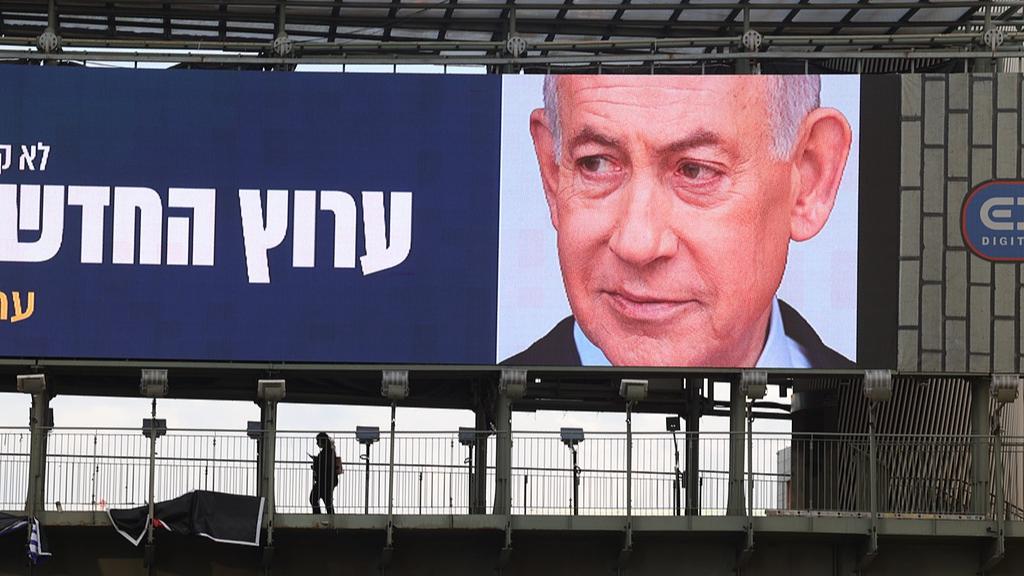
An election billboard featuring Israeli Prime Minister Benjamin Netanyahu is displayed in Ramat Gan, near Tel Aviv, Israel, on October 18, 2026. (Photo: VCG)
Israeli Prime Minister Benjamin Netanyahu announced a new three-page national security doctrine on Sunday, shifting the country's defense strategy from containment and defense toward proactive prevention and the early neutralization of threats. The move comes just days before Israel's parliamentary election on October 27, amid renewed tensions with Iran.
On the same day, US President Donald Trump published an open letter to the Israeli public on social media, expressing his full support for Netanyahu's reelection bid. The endorsement comes after months of apparent friction between Washington and Tel Aviv over Iran, raising questions about the two leaders' political calculations and the potential implications for regional stability.
Israel's new doctrine calls for striking threats before they materialize, establishing military buffer zones along Israel's borders where necessary, reducing reliance on foreign military supplies and reinforcing Israel's identity as the nation-state of the Jewish people.
Li Zixin, a Middle East expert at the China Institute of International Studies, said the new doctrine lowers the threshold for Israel to take military action. By making preemption a standing principle, Israel could launch strikes based on its assessment that a threat is developing rather than waiting for an imminent threat. This could increase the risk of unilateral Israeli action against Iran, Li said.
Qin Tian, deputy director of the Institute of Middle East Studies at the China Institutes of Contemporary International Relations, said the timing of the announcement was more significant than the content itself. With Netanyahu seeking reelection, the move is aimed largely at highlighting the results of Israel's military campaigns over the past several years and convincing voters that his hardline security policy is working.
Like Li, Qin warned that the shift toward preemptive action could further fuel regional tensions and increase the risk of conflicts breaking out on multiple fronts.
Why is Trump backing Netanyahu?
In his open letter, Trump claimed that Iran had suffered major military and economic losses and warned that the United States and Israel would soon complete their operations unless Tehran changed its course. He also suggested that if Israel had a leader other than Netanyahu, Washington would have to step in and "finish the job" against Iran itself.
Netanyahu subsequently thanked Trump for supporting his reelection bid and said the two leaders would continue working together to accomplish their mission.
Qin said the renewed US-Israeli alignment is driven mainly by domestic political interests and shared concerns over Iran.
Both countries are entering important electoral periods, making mutual political support useful to both leaders. Netanyahu needs US backing to strengthen his reelection campaign, while Trump can benefit politically from maintaining the longstanding pro-Israel position in US politics, Qin said.
At the same time, Washington could consider further military action against Iran after the US midterm elections, Qin said. Israel has remained a strong supporter of a hardline approach toward Tehran, while Netanyahu has signaled that Israel would be willing to join potential US military action. Their positions on Iran have therefore moved closer again, Qin said.
Iran warns against further military action
The latest developments come amid continued tensions between the United States, Israel and Iran.
The US and Israel launched coordinated military strikes against Iran on February 28, triggering Iranian missile and drone attacks against Israel and US bases in the region, as well as the closure of the Strait of Hormuz.
A 60-day memorandum of understanding signed in June later collapsed after renewed military exchanges. The sides have since traded fresh threats, with no active ceasefire in place.
On October 18, Iranian President Masoud Pezeshkian said Iran would not yield to the unreasonable demands and bullying of “aggressive” countries.
Mohsen Rezaei, secretary of Iran's Supreme National Security Council, said threats from the US and Israel would not change the situation on the battlefield, adding that Iran was prepared to respond to any new military action. He also said that Iran has a "new operational plan" if the US resumes attacks and that the new plan "will not follow the rules with which they are familiar."
Iran's new defense minister, Mehrdad Akhlaghi Ketabchi, also issued a direct warning to Washington, saying Iran would respond forcefully if the United States launched another attack.
"If the American enemy commits another miscalculation, the response from the proud Iranian nation and the warriors of Islam will be both surprising and extensive," he said.
With Israel lowering the threshold for preemptive action and Washington and Tel Aviv again aligning over Iran, the risk of renewed escalation across the Middle East is rising.