


Global turmoil and street unrest in Europe underscore the value of China's stability and predictability: Hai Feng
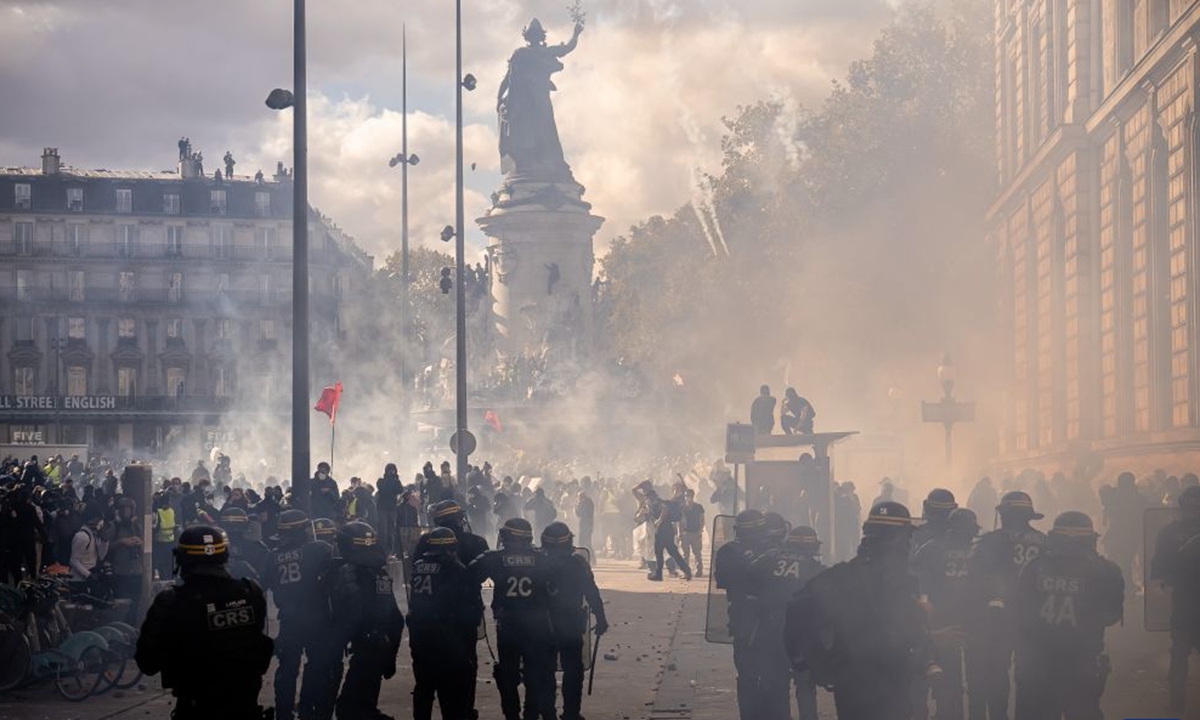
Demonstrators face off with law enforcement officers during a protest in Paris, France, on October 17, 2026. (Photo: Xinhua)
Recently, violent street clashes across Europe have drawn global attention.
Large-scale demonstrations broke out in multiple parts of France on Saturday, with serious incidents of vandalism, arson, looting and clashes between protesters and police. Around 550,000 people took part in demonstrations nationwide, while civil society organizations estimated an even higher turnout. From Paris, Lyon and Marseille to Limoges, numerous shops, public buildings and government institutions sustained serious damage, while large numbers of police officers, firefighters and ordinary citizens were injured. More than 2,000 people were arrested. China's Foreign Ministry and Chinese diplomatic missions in France urged Chinese nationals planning to travel to France to remain alert to potential risks, closely monitor local developments, strengthen safety precautions and avoid areas where demonstrations were taking place.
Public dissatisfaction over inadequate educational resources, rising living costs and deteriorating public services served as an immediate trigger for the demonstrations and unrest. The New York Times published an article "Huge Riots and Anti-Government Protests in France: What to Know." It noted that France is reeling from its largest unrest in years, after anti-government demonstrations devolved into riots and looting that caused nationwide damage and deepened a sense of national reckoning.
France is not alone. As discontent, anxiety and uncertainty grow across Europe, many countries like Italy, Portugal, Belgium and Albania have also witnessed demonstrations and varying degrees of street unrest.
At the same time, China's just-released economic data for the third quarter shows that its gross domestic product (GDP) expanded 4.6 percent year on year in the first three quarters. The country's GDP grew 4.5 percent year on year in the third quarter of 2026, an improvement from the second quarter. The better-than-expected growth has boosted confidence in the Chinese economy. In the first three quarters, China's national economy maintained steady performance despite pressure, with new growth drivers gaining momentum, the economic structure continuing to improve, and development becoming more efficient and higher in quality. During the recent National Day and Mid-Autumn Festival holidays, domestic tourism, consumption and cross-regional travel remained active.
The contrast between street unrest in Europe and social stability in China is striking. Behind these two different scenes lie not only differences in economic cycles and geopolitical influences, but also profound distinctions in governance capacity, social structures and development paths.
The scale and intensity of the recent demonstrations and unrest in France have been shocking. According to a Reuters report on October 17, around 550,000 people had participated in the demonstrations across the country. Organizers estimated the number of protesters at around 800,000. Violent clashes occurred in Paris, Lyon, Marseille, Limoges and other cities. Some shops, public buildings and government institutions were damaged, and a town hall in Limoges with a history of more than a century suffered severe damage after being set on fire. French police arrested more than 2,000 people, while numerous police officers, firefighters and ordinary citizens were injured.
Violence must be condemned and those responsible held accountable in accordance with the law. But the underlying causes of the demonstrations and unrest cannot be ignored. Europe's current turbulence is, in essence, an eruption of multiple contradictions that have accumulated over time.
Rising energy prices have added to the cost-of-living burden across society. Since the outbreak of the Ukraine crisis, Europe's energy landscape has undergone major changes. Fluctuations in energy, transportation and fertilizer prices have continued to feed through to industry and agriculture. More recently, European energy prices have climbed again, further increasing ordinary households' expenses for heating, transportation and food. For low- and middle-income groups in particular, the pressure of rising prices is often felt more directly than the figures reported in macroeconomic indicators.
Fiscal pressures have constrained governments' ability to respond to public demands. Europe has long maintained relatively high levels of social welfare, with education, healthcare, pensions and social security serving as important foundations of social stability. Yet given the current fiscal conditions and debt levels of European countries, governments face difficulty simultaneously expanding welfare provision, increasing defense spending, advancing the energy transition, and covering expenditures related to aid for Ukraine and the reception and resettlement of refugees.
Fiscal austerity may improve government balance sheets, but it can weaken public services. Increasing public spending may ease social tensions, but it can also intensify debt pressures and financial risks. Balancing security, welfare and economic growth is becoming increasingly challenging for European governments.
Declining political trust is steadily narrowing Europe's room for dialogue and compromise. Faced with increasingly complex problems and the demands of diverse interest groups, governments, parliaments, and political parties in many European countries lack effective communication and consultation. Social demands therefore struggle to be translated into consensus through institutional channels. Some political forces treat street protests as electoral tools, while others attribute complex problems to the far left, immigrants, or external actors. The attribution of responsibility is becoming increasingly simplistic even as real-world problems grow ever more complicated. Political polarization has further weakened governments' capacity to advance reform, trapping society in a vicious cycle of "protest-repression-renewed protest."
Europe is also facing the twin challenges of growing social fragmentation and declining industrial competitiveness. Poor immigrant integration, residential segregation, rising identity concerns, and the expansion of far-right forces have made social divisions more visible. Compared with China and the US, Europe's influence in emerging fields such as the internet and artificial intelligence (AI) has continued to diminish, while many traditional industries face mounting pressure from high energy costs, environmental standards, and international competition. Younger generations see fewer opportunities for upward mobility, while older people are increasingly worried about cuts to welfare benefits. Conflicts of interest among different social groups are consequently becoming more intense in Europe.
Europe's current governance difficulties, therefore, cannot simply be attributed to a particular war, ideology, or social group. Street disorder is only the visible manifestation. Beneath it, the energy crisis serves as a trigger, fiscal constraints limit policy choices, declining political trust acts as an "amplifier," and social fragmentation allows localized tensions to spread rapidly.
Amid the severe social turbulence seen in parts of Europe, the stability and predictability of the Chinese economy stand out as all the more valuable. China's economy maintained steady growth in the third quarter, while consumption, tourism, and passenger flows remained active during the National Day Holiday, underscoring the resilience of the country's vast domestic market. More importantly, China possesses a comprehensive industrial system, an expanding domestic market, strong infrastructure capacity, and a relatively consistent macroeconomic policy environment. These conditions have enabled the economy to maintain stability despite external shocks.
China still faces challenges, including insufficient effective demand, adjustment in the real estate sector, pressure on business operations, and structural changes in employment. Yet genuine certainty comes from a clear-eyed understanding of these difficulties, consistent policy implementation, and targeted adjustments in the course of development. While acknowledging positive changes in the economy, China's National Bureau of Statistics has also pointed to problems such as weak domestic demand. This willingness to confront reality is itself an important source of confidence for stabilizing expectations and building public trust.
China's stability is also reflected in its ability to maintain strategic continuity around long-term goals. In the face of global industrial chain restructuring, recurring geopolitical conflicts, and changes in the international economic environment, China has not treated short-term fluctuations as changes in its overall development direction. Instead, it has continued to promote technological innovation, industrial upgrading, the expansion of domestic demand, and coordinated regional development. A stable political environment provides support for long-term investment, complete industrial chains facilitate the smooth economic circulation, and effective social governance provides a foundation for responding to major risks.
For China, valuing stability does not mean rejecting reform, nor does maintaining certainty mean ignoring risks. Stability should continue to be translated into a stronger capacity to improve people's livelihoods, while certainty should be reflected in policy continuity, orderly development, and deeper reform. Only when economic growth is increasingly translated into greater opportunities, higher incomes, and improved public services can stability rest on a more solid social foundation.
Europe's turbulence offers a mirror. The more uncertain the world becomes, the more valuable stability and predictability become. China should cherish its development environment, continue to transform the advantages of stability into momentum for reform, and convert institutional strengths into more effective governance. As global uncertainties intensify, China must maintain its own pace of development and strengthen the confidence of its people in the country's future and their own lives.