


COP17 opens with call to advance multilateralism
The biennial United Nations biodiversity conference opened on Sunday in Yerevan, the capital of Armenia, with countries set to conduct the first global review of collective progress in implementing the Kunming-Montreal Global Biodiversity Framework, adopted under China's presidency.
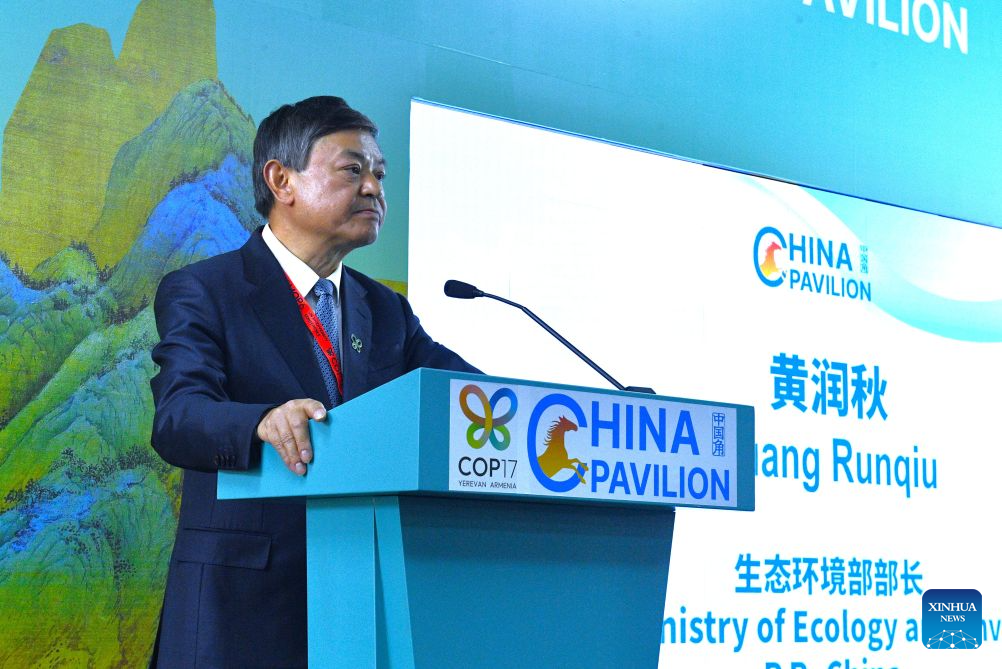
Chinese Minister of Ecology and Environment Huang Runqiu speaks at the opening ceremony of the China Pavilion at the 17th meeting of the Conference of the Parties to the United Nations (UN) Convention on Biological Diversity (COP17) in Yerevan, Armenia, Oct. 19, 2026. (Photo: Xinhua)
The 17th meeting of the Conference of the Parties to the Convention on Biological Diversity, known as COP17, will run through Oct 30 under the theme "Taking Action for Nature".
Armenian Prime Minister Nikol Pashinyan declared the conference open, calling on countries to translate their commitments into concrete actions and measurable results as the 2030 deadline for the framework's targets approaches.
Astrid Schomaker, executive secretary of the Convention on Biological Diversity, expressed hope that COP17 would demonstrate that multilateralism works and that the international community can fulfill its commitments.
She said the assessment of the framework and countries' national reports would help identify implementation gaps and guide efforts to address them.
Adopted at COP15 in late 2022 under China's presidency, the framework sets four long-term goals for 2050 and 23 action-oriented global targets for 2030.
One of its targets is to ensure that by 2030 at least 30 percent of degraded terrestrial, inland water, marine and coastal ecosystems are under effective restoration.
The global review will assess progress toward the framework's goals, identify gaps and help determine priority actions to accelerate implementation.
Addressing the COP17 leaders' summit on Friday, Huang Runqiu, China's minister of ecology and environment, called on the international community to provide developing countries, particularly those in the Global South, with greater financial, technological and capacity-building support.
Huang said China had established ecological conservation red lines, built a protected area system centered on national parks and carried out major biodiversity conservation projects. These measures have enhanced ecosystem diversity, stability and sustainability, while populations of wild plants and animals have continued to grow.
He said China had also worked with other parties to advance implementation of the Kunming-Montreal Global Biodiversity Framework through an implementation initiative and the green Belt and Road Initiative. China had taken the lead in establishing and contributing to the Kunming Biodiversity Fund to help developing countries strengthen their biodiversity conservation capacity.
Noting that implementation of the framework had reached the halfway point, Huang urged the international community to translate global targets into national policies and practical measures.
He called for stronger financial, technological and capacity-building support for developing countries to ensure the framework is implemented comprehensively, in a balanced manner and effectively.
China stands ready to work with all parties to turn global biodiversity goals into concrete action and build a community of all life on Earth, Huang said.