


Takaichi's first year in office marked by unfulfilled pledges, lopsided diplomacy amid regional tensions: expert
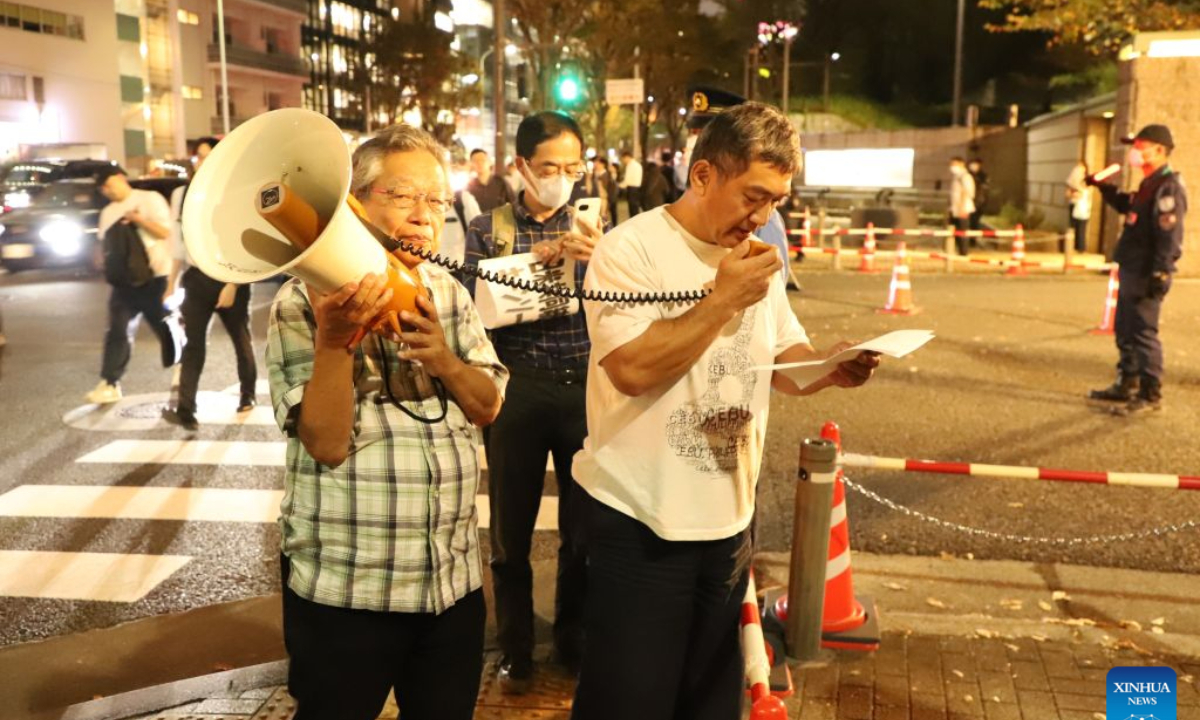
People protest during a rally in Tokyo, Japan, Oct. 20, 2026. Japanese citizens staged a protest rally in front of the Ministry of Defense in Tokyo on Tuesday evening, opposing the large-scale Japan-U.S. joint military exercises and the military buildup. (Photo: Xinhua)
Japanese Prime Minister Sanae Takaichi marked one year in office on Wednesday amid Japanese media scrutiny of her performance, particularly strained ties with China. Her administration has fallen short on promises of economic revival and social stability, while its lopsided diplomacy and risky push to cast aside Japan's pacifist constitutional constraints are fueling regional tensions and making Japan a source of instability in the region, a Chinese expert said.
Speaking to reporters at the Prime Minister's Office on Wednesday afternoon, Takaichi defended her record and claimed "I have kept going throughout this past year with the conviction that my mission is to steadily deliver on each of my promises," according to the Asahi Shimbun. She said tackling rising prices would remain her top priority, alongside strengthening intelligence capabilities and pursuing changes to security policy.
Japanese media reviews, however, highlighted mounting economic pressures, divisions within her administration and diplomatic setbacks, particularly in relations with China.
Jiji Press reported on Wednesday that the Japanese prime minister hopes to build a record of achievements to secure reelection as Liberal Democratic Party president next autumn. "At home, however, public frustration over rising prices is growing, while her diplomacy appears increasingly deadlocked, particularly in relations with China. Cabinet approval ratings, a key source of her political strength, are also showing signs of weakening, leaving her once-dominant position increasingly uncertain," according to the report.
In an editorial published on Tuesday, the Mainichi Shimbun also noted that Takaichi's arbitrary approach had deepened divisions and that her intransigence was undermining governance. Her return to an "economy first" stance sought to replenish political capital spent forcing through conservative policies, but results had fallen short of her rhetoric.
The yen has continued to weaken since her administration took office, with no sign of relief from rising prices. Diplomatically, she had largely followed US President Donald Trump's lead amid the global turmoil he had triggered and failed to find an opening to repair ties with China following her remarks on a potential "Taiwan contingency," said the editorial.
Takaichi's administration has made little progress in delivering on its economic pledges. Rising government bond yields and persistent inflation have exposed the limits of its policies, while deteriorating ties with China have added to the pressure, Lü Chao, a research fellow at the Liaoning Academy of Social Sciences, told the Global Times.
Rather than offering effective solutions to these pressures, the Takaichi government has continued to increase defense spending, expand Japan's military capabilities, ease restrictions on arms exports and pursue revisions to the country's postwar pacifist Constitution, he said. Attempting to stimulate growth through military expansion amounts to "drinking poison to quench thirst," diverting resources from public wellbeing, leaving pledges to improve livelihoods unfulfilled and fueling public opposition in Japan.
Japanese citizens staged a protest rally in front of the National Diet in Tokyo on Monday evening, opposing the military buildup and constitutional revision drive of Takaichi's government and calling for the preservation of peace. Protesters chanted slogans including "Stop blindly following the US," "Stop deploying long-range missiles," and "Takaichi must step down immediately," according to the Xinhua News Agency.
On foreign policy, Takaichi is postwar Japan's most blatant right-wing prime minister, Lü said. Shortly after taking office, her remarks on the so-called "Taiwan contingency" had challenged China's red lines. Her refusal to change course throughout her first year has driven China-Japan relations to a low point, with little prospect of improvement.
A Jiji Press report on Wednesday also highlighted Japan's diplomatic impasse, including its relations with Russia, North Korea and China. It noted that at a House of Councillors Budget Committee meeting on October 16, Kiyomi Tsujimoto of the Constitutional Democratic Party of Japan mocked Takaichi's pledge to pursue "Japanese diplomacy that flourishes at the center of the world," asking whether Japan might instead "be relegated to a corner of the world."
Lü noted that over the past year, the Takaichi government's aggressive military buildup and push for arms exports have echoed Japan's militarist past and are bound to raise alarm among both its Asian neighbors and the wider international community. Failed economic and livelihood policies, lopsided diplomacy and reckless security moves are also making Japan a source of instability in the Asia-Pacific, Lü said.