


Von der Leyen's threat of tougher trade curbs on China is wrong prescription for Europe's industrial woes: experts
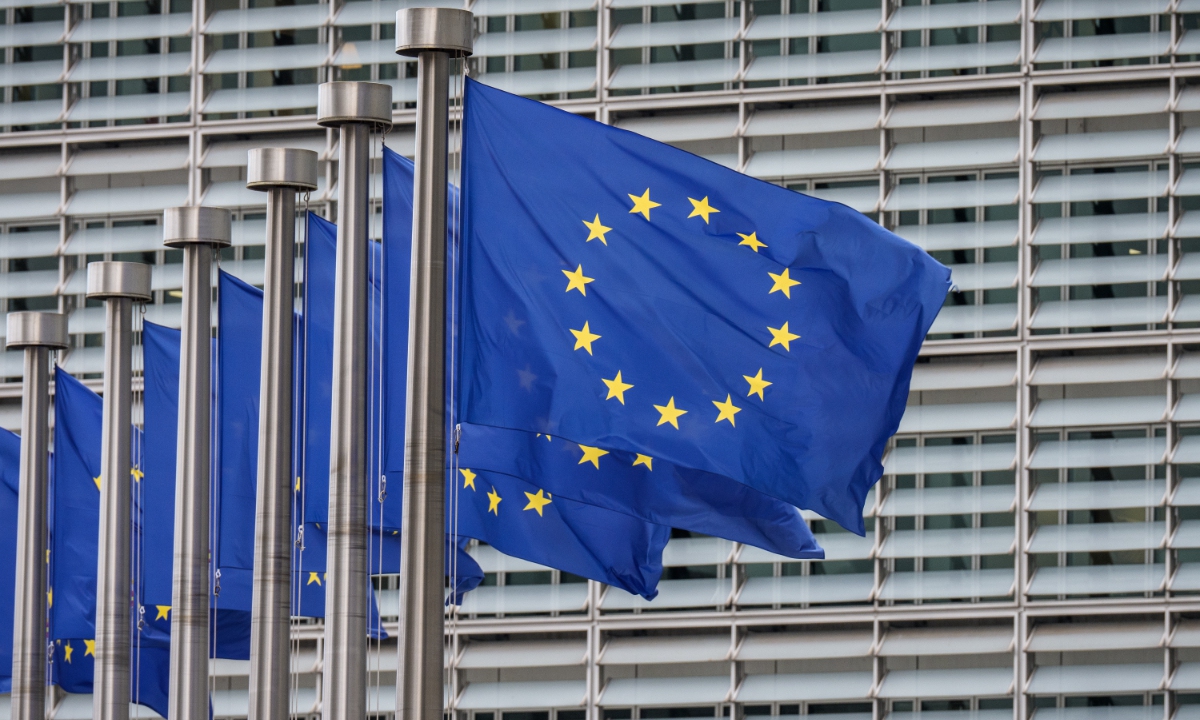
The European Union (EU) flags in front of EU headquarters in Brussels, Belgium. (Photo: VCG)
European Commission (EC) President Ursula von der Leyen's renewed warnings of tougher trade measures against China, despite recent progress in bilateral negotiations, risk undermining hard-won agreements while doing little to address Europe's underlying industrial challenges, Chinese analysts said on Thursday, cautioning that trade pressure cannot substitute for industrial renewal.
In a speech to the European Parliament on Wednesday, von der Leyen said the bloc must be prepared to deploy “trade defense instruments” if dialogue [with China] fails to deliver results, even as she acknowledged progress in recent China-EU economic and trade consultations, according to a news released published on the EC’s website.
She called for swift safeguard measures when import surges threaten European industries, citing growing concerns in the chemicals and machinery sectors. She also announced plans for a DiversifyEU package in December to reduce dependence on single suppliers, alongside a new instrument allowing the bloc to restrict access to its single market more quickly when its interests are threatened.
EU's tougher posture reflects its struggle to adjust to a changing industrial landscape, particularly as Chinese manufacturers have gained ground in electric vehicles and other emerging industries, Wang Yiwei, director of Center for European Studies at Renmin University of China, told the Global Times on Thursday.
Europe is seeking time to rebuild its industrial strength while facing pressure from member states and domestic industries, Wang said. “Trade restrictions may provide temporary relief, but cannot deliver the technological advances or industrial transformation needed for sustained growth.”
The deeper challenge extends beyond individual products to the industrial systems and technologies shaping future manufacturing, which Europe needs to address by rebuilding its own capabilities rather than blaming China for its internal woes, according to Wang.
Von der Leyen’s tougher rhetoric comes less than two weeks after Beijing and Brussels demonstrated that negotiations could deliver tangible results. During talks in Beijing on October 8-9, the two sides reached 16 points of consensus covering trade and investment, export controls, intellectual property and World Trade Organization reform.
Von der Leyen credited EU Trade Commissioner Maros Sefcovic with progress, citing greater predictability in rare-earth export controls and an understanding on Chinese-made hybrid vehicle exports. She nevertheless claimed that progress in one sector could not resolve broader trade imbalances, according to the EC’s release.
However, analysts warned that protectionism offers no lasting solution to Europe's industrial challenges, while continued trade pressure risks undermining the hard-won gains of China-EU negotiations.
The EU's increasingly tough trade rhetoric also reflects its internal political dynamics. With 27 member states pursuing different industrial interests, Brussels faces considerable difficulties coordinating a common response, leaving it under pressure to demonstrate that it is standing up for European industries, Wang said.
Even as the EU takes a harder line on trade, there is also recognition of the risks of escalating tensions with China.
German Chancellor Friedrich Merz on Wednesday backed stronger EU trade defense tools to address so-called unfair competition from China. But he said the bloc did not want to make use of its trade defense toolbox, stressing that the goal was to achieve a new balance in trade rather than trigger a conflict, according to Bloomberg.
The economic costs of greater trade restrictions were highlighted by Mercedes-Benz CEO Ola Källenius, who warned on the same day that protectionist measures could raise production costs and distort global supply chains. While greater restrictions could improve resilience, they would also make production more expensive, he said, cautioning that Europe could not become "an island" cut off from major trading partners.
Wang said Europe's heavy reliance on global markets and supply chains makes trade restrictions particularly costly. “European manufacturers depend on Chinese intermediate goods, while German automakers also produce vehicles in China for export,” he said, warning that such protectionist measures could end up working against Europe's own interests.
Responding to reports that the EU was pursuing a "dual-track" approach of maintaining intensive consultations with China while stepping up restrictions, potentially including the use of its anti-coercion instrument, China's Ministry of Commerce said on October 16 that China-EU economic and trade consultations are intended to properly resolve differences through dialogue and accommodate each other's concerns.
Both sides must demonstrate sincerity in resolving problems, the ministry said, stressing that the EU should not expect to gain benefits through pressure or underestimate China's determination and ability to safeguard its own interests.
Meanwhile, channels for engagement remain open. According to a Euronews report on Wednesday, a delegation of 12 members of the European Parliament's Committee on International Trade will visit China from October 27 to 29 for talks with Chinese officials and lawmakers. Discussions are expected to cover market access, industrial subsidies, supply chains and critical raw materials.
The EU should abandon geopolitical and confrontational thinking and make full use of the opportunities arising from China's innovation-driven development to expand cooperation in green development, new energy and digital industries for mutual benefit and win-win outcomes, Shi Xiaoli, director of the WTO Law Research Center at China University of Political Science and Law, told the Global Times.