


US envoy's push for Seoul to play a proactive regional role while hyping 'China threat' rhetoric aims to shift alliance burden: expert
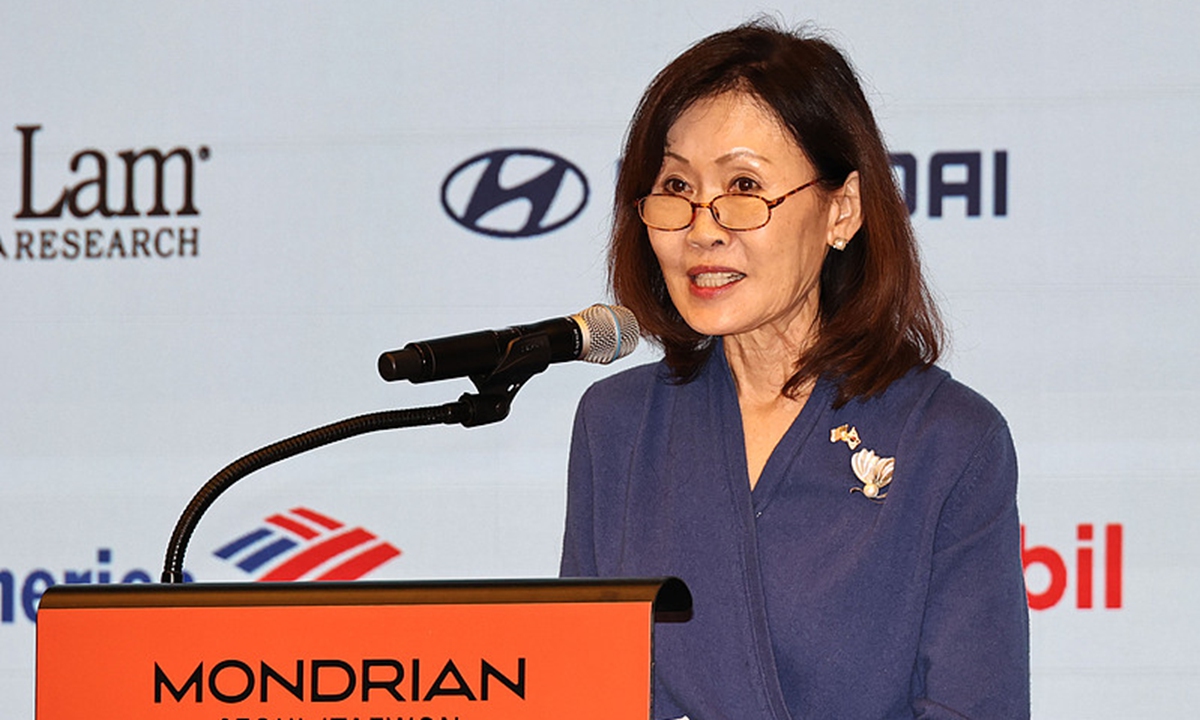
US Ambassador to South Korea Michelle Park Steel delivers a special address at a lunch forum hosted by the American Chamber of Commerce (AMCHAM) in Korea in Seoul to mark the US' 250th anniversary, on October 21, 2026. (Photo: VCG)
The US Ambassador to South Korea on Wednesday highlighted the need for Seoul to play a more proactive role in the so-called Indo-Pacific region, while citing what she described as the threat posed by China in the region. By hyping up China as an adversary, Washington seeks to align South Korea's security strategy more closely with its own self-serving regional agenda, a Chinese expert said.
US Ambassador to South Korea Michelle Park Steel made the allegation during a luncheon hosted by the American Chamber of Commerce (AMCHAM) in Korea in Seoul to mark the US' 250th anniversary, according to South Korean broadcaster KBS on Wednesday.
She said that South Korea is no longer a country that relies solely on US protection, and now is the time for South Korea to exercise leadership in the region.
Hyping China as "the greatest threat in the Indo-Pacific region," she emphasized the need for close cooperation between South Korea and the US, according to Yonhap News Agency.
The current US administration is pushing to transform the US alliance system from one in which the US unilaterally assumes responsibility for protecting its allies' security into one in which allies are also expected to support and serve US security interests, said Yang Xiyu, a senior research fellow at the China Institute of International Studies.
Behind the rhetoric of asking Seoul to "exercise leadership in the region," Yang told the Global Times that the US approach to diplomacy is not simply about getting allies to pay more. Its core objective is to reduce the strategic costs borne by Washington and shift more of the burden onto its allies while maintaining its own global leadership.
Citing the South Korean government's recent push that the wartime operational control of South Korean troops, currently held by the US, should be transferred to Seoul, Yang added that Washington is seeking to shore up the US-South Korea alliance by hyping the so-called "China threat" and portraying China as a common adversary.
However, the core tension lies in Seoul's pursuit of strategic autonomy and Washington's push for greater reciprocity within the alliance. The US seeks to bridge this divide by invoking the so-called "China threat," aiming to keep South Korea aligned with its strategic agenda rather than allowing Seoul to act as a truly independent player on the international stage.
Chinese Foreign Minister Wang Yi said during a meeting with his South Korean counterpart Cho Hyun in August that as permanent good neighbors and long-term cooperation partners, China and South Korea should demonstrate strategic vision, bear in mind the long-term development of the two countries and the fundamental interests of the two peoples, strive to ensure the sound, stable and sustainable growth of bilateral relations, bring more benefits to the two peoples, and make more contributions to regional peace and development.
"It is hoped that the ROK will, proceeding from its own fundamental interests, develop its external relations independently and in parallel without conflict," Wang said.