


FAO honors highlight China's efforts to strengthen global food security
ROME, Oct. 23 (Xinhua) -- As Chinese desertification control pioneer Yin Yuzhen was honored at the headquarters of the Food and Agriculture Organization of the United Nations (FAO) in Rome, her longtime American friend Ronald Sakolsky looked on, his eyes filled with tears.
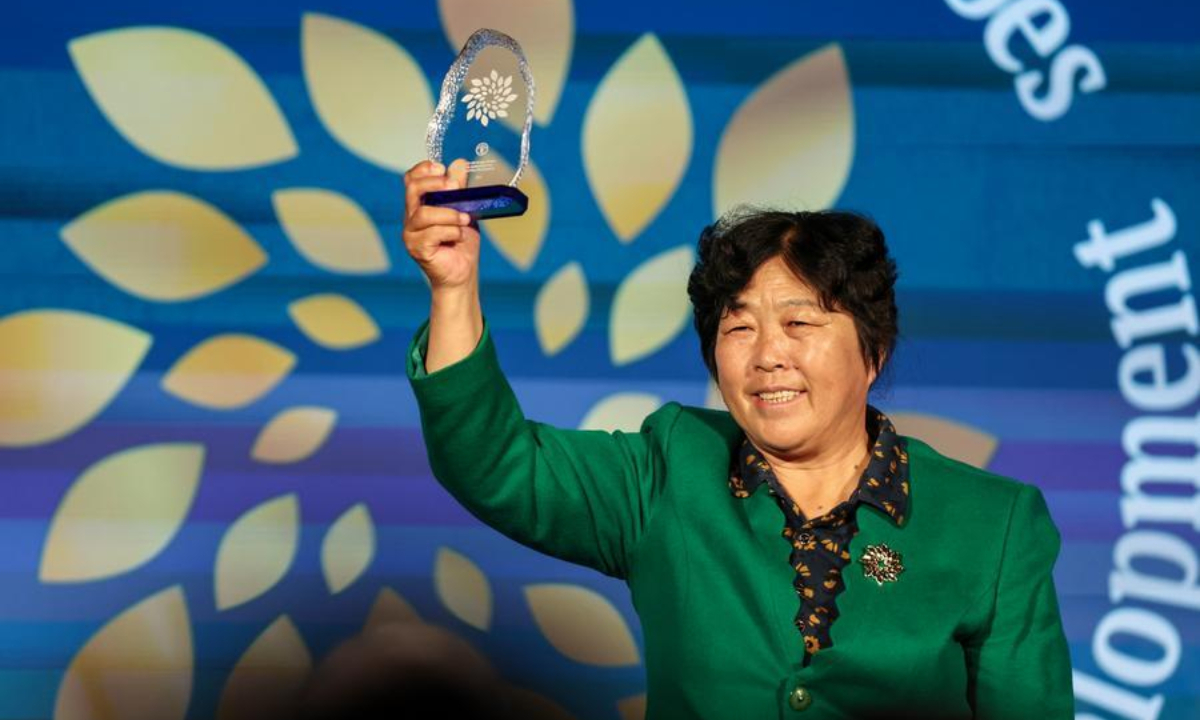
Yin Yuzhen attends a ceremony for Food and Agriculture Organization of the United Nations' (FAO) 100 Women Heroes in Agrifood Systems and Rural Development, in Rome, Italy, Oct. 15, 2026. (Photo: Xinhua)
"Yin deserves everything that she gets. She is the heroine," said Sakolsky, a retired teacher who helped fund her tree-planting efforts more than two decades ago.
At the Oct. 15 ceremony, Yin was named among the FAO's 100 Women Heroes in Agrifood Systems and Rural Development, an initiative marking the International Year of the Woman Farmer 2026.
A day later, a Chinese research institute received an FAO award for its crop-monitoring technology.
Together, the honors highlighted China's broader efforts to strengthen global food security through ecological restoration, technological innovation and international cooperation.
FROM SHIFTING SANDS TO A GREEN LANDSCAPE
The story of Yin and Sakolsky began in 1999, when Sakolsky was teaching in central China's Henan Province. After seeing a TV report about Yin's efforts to hold back the encroaching sands in north China's Inner Mongolia Autonomous Region, he raised 5,000 U.S. dollars to support her afforestation endeavor.
After losing touch for years, the two reunited in Inner Mongolia in August 2026. By then, the seedlings supported by Sakolsky's donation had grown into more than 50,000 trees.
Since planting her first tree in 1986, Yin has helped green over 70,000 mu (around 4,667 hectares) of sandy land, an area roughly the size of 6,500 standard soccer pitches. Today, the area supports a greater variety of crops and plants, including cherries and roses, creating new opportunities for agricultural production and income growth.
"I have spent more than 40 years transforming this desert, and now all kinds of food can grow here," Yin told Xinhua.
Yin's efforts reflect China's broader push to combat desertification, a major part of which is the Three-North Shelterbelt Forest Program, launched in 1978 to restore degraded land and strengthen ecological security in northern China.
For Yin, combating desertification is also essential to agricultural production. "If we cannot control the sand, how can we grow good crops when sandstorms come? How can we improve the soil?" she said.
At the World Food Day ceremony in Rome on Oct. 16, Jordan's Princess Basma bint Ali described Yin's decades-long efforts as "the other face of innovation." She stressed that addressing hunger, climate shocks and inequality required sustained attention and action.
"It must be the steady kind that plants, tends and finally harvests the gains. As did Yin Yuzhen," the princess said.
INNOVATION FOR GLOBAL FOOD SECURITY
Beyond ecological restoration, technological innovation offers another way to strengthen food security, helping countries boost agricultural production, address environmental risks and build more resilient food systems.
On Oct. 16, the Aerospace Information Research Institute of the Chinese Academy of Sciences received the 2026 FAO Achievement Award for its CropWatch, a cloud-based crop-monitoring platform.
Developed by a team led by researcher Wu Bingfang, the platform combines satellite observations with climate and agricultural data to monitor crop conditions, assess production prospects and identify risks such as drought and abnormal rainfall.
Through its open cloud service, CropWatch allows users to conduct their own crop assessments without investing heavily in local computing infrastructure.
According to the research team, the platform has helped more than 40 countries and regions monitor crop conditions, and its bulletins have served users in 173 countries and regions.
CropWatch has also been integrated into the FAO's Hand-in-Hand Geospatial Platform and the Group on Earth Observations Knowledge Hub. It serves as an important channel and an independent source of timely crop monitoring information for users worldwide.
Wu told Xinhua after receiving the award that the recognition affirmed the team's more than three decades of dedication.
"This is not the end, but a milestone on a new journey ahead," he said.
SHARING CHINESE EXPERIENCE FOR FOOD SECURITY
China's contribution extends beyond domestic production to international agricultural cooperation.
In addition to feeding its own population of more than 1.4 billion, China has also provided assistance to countries in need, contributing to global food security.
Zhang Lubiao, China's permanent representative to the FAO, said China would deepen cooperation with the FAO in hybrid rice, water-saving irrigation, digital agriculture and climate-adaptive technologies, among other areas.
Such cooperation is already yielding tangible results in various countries.
Nosipho Jezile, South Africa's permanent representative to the UN food and agriculture agencies, said China's South-South cooperation projects with the FAO had supported rice cultivation, aquaculture, irrigation infrastructure, mechanization and agricultural innovation in African countries.
"These projects have brought tangible increases in output and created employment opportunities," she said.
Food security depends on more than agricultural production. Keeping food affordable and ensuring a stable supply of fertilizers and other agricultural inputs are also essential, particularly amid economic and geopolitical uncertainties.
In an interview with Xinhua, FAO Chief Economist Maximo Torero said rising prices, rather than immediate food shortages, posed the biggest risk to global food security at present.
Torero noted that China had been preparing for natural and geopolitical risks by diversifying imports, keeping its market open and improving stock management.
China's urea exports were also helping bring down prices, he said, urging major producers and importers not to distort markets or restrict exports of agricultural inputs.