


Israel heads to polls with Netanyahu fighting for political survival
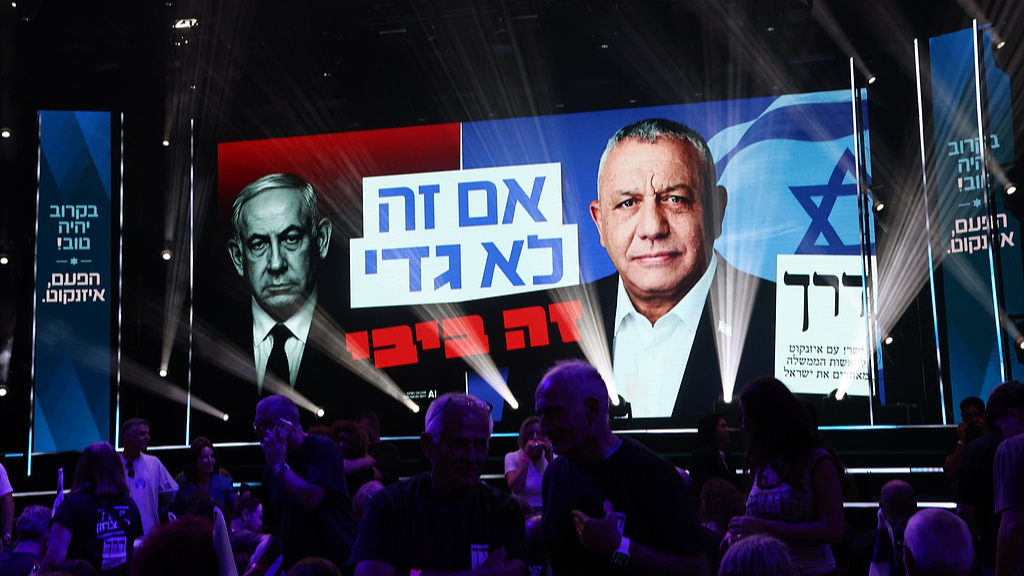
A campaign billboard depicting Israeli Prime Minister Benjamin Netanyahu (L) and Yashar party leader Gadi Eisenkot (R) stands along a main road in Tel Aviv, Israel, October 25, 2026. (Photo: VCG)
Israelis are heading to the polls on Tuesday for the country's first parliamentary election since the Hamas-led attack on October 7, 2023, in a vote that could determine whether Prime Minister Benjamin Netanyahu remains in power after one of the most turbulent periods in Israel's history.
But, experts say even if Netanyahu loses, the election may not mark a fundamental shift in Israel's approach to regional security or the Palestinian issue.
The election is therefore about more than who will occupy the prime minister's office. It is also a test of how Israeli voters view Netanyahu's record, the country's political direction and the security policies that have shaped the region since October 7.
Netanyahu faces a tough political test
Netanyahu, who has served as prime minister for a total of 19 years, is seeking another term while facing serious challenges at home.
He is standing trial on corruption charges and has faced mounting criticism over the security failures surrounding the October 7 attack. Critics have demanded that his government be held accountable for failing to prevent the attack and for its handling of the wars that followed.
At the same time, Netanyahu's government has pursued a distinctly right-wing agenda. His coalition includes far-right and ultra-Orthodox parties that have pushed for judicial changes, tougher policies toward Palestinians and expanded Jewish settlements in the occupied West Bank. Some far-right politicians have also advocated the relocation of Palestinians from Gaza and renewed military action against Iran.
The government's judicial overhaul in 2023 triggered months of mass protests and exposed deep divisions over the character and future direction of the Israeli state. The judicial overhaul aimed at weakening the power of Israel's Supreme Court and expanding executive control. Following mass protests, legislation was temporarily paused in March for compromise talks and was then largely halted following the October 7 attack.
The current election thus reflects a broader political struggle between Netanyahu's nationalist and religious-right coalition and a fragmented opposition seeking to restore what it describes as institutional checks and public accountability.
Polls point to a political deadlock
Netanyahu's main challenger is former Israel Defense Forces chief of staff Gadi Eisenkot, who leads the centrist Yashar party.
But the biggest problem for both sides may be the arithmetic.
Israel's Knesset has 120 seats, and a governing coalition needs the support of at least 61 lawmakers. Recent polling has consistently shown neither the Netanyahu camp nor the opposition with a clear path to that threshold. Reuters' polling analysis similarly found no candidate with an obvious route to power.
The latest polling average compiled by the Middle East Forum puts the Netanyahu bloc and opposition parties at roughly 53 seats each, with Arab parties projected to win another 14.
That means Tuesday's vote may not immediately produce a winner.
Israel's proportional electoral system makes smaller parties crucial, while the opposition itself remains divided over whether and how to cooperate with Arab parties. If neither camp can assemble a governing majority, prolonged coalition negotiations – or even another election – could follow.
In that sense, Netanyahu's political survival may depend not simply on whether his Likud party finishes first, but on whether he can once again assemble the coalition needed to govern.
A change of leader may not mean a change of policy
However, though a Netanyahu defeat could produce a new government and a different political style, a fundamental shift in Israel's regional policy appears far less certain.
On some of the biggest security issues, Eisenkot and other opposition figures remain relatively hawkish. Opposition parties have largely maintained hard-line positions on Iran and have shown little support for establishing a Palestinian state in the near term.
Analysts say Israel's political center has itself moved to the right following years of conflict. On the Palestinian issue in particular, the gap between Netanyahu and his opponents is often more about how far and how aggressively to pursue existing policies than about whether to fundamentally change them.
That could mean a future opposition government might seek to restrain settler violence, repair Israel's international image or place greater emphasis on diplomacy. But it is unlikely to abandon Israel's current security doctrine or significantly ease pressure on Iran.
As Reuters has noted in an analysis, the key differences between Netanyahu and his rivals may lie more in the degree of military escalation, settlement expansion and reliance on diplomatic tools than in the overall direction of policy.
That means if Netanyahu stays in power, his coalition could take an even harder line on security and the Palestinian issue. An opposition victory may bring a more centrist tone and greater diplomatic engagement, but Israel's security-focused political consensus could limit any major policy shift.