


Advancing green development, mutual understanding through China-Indonesia cooperation
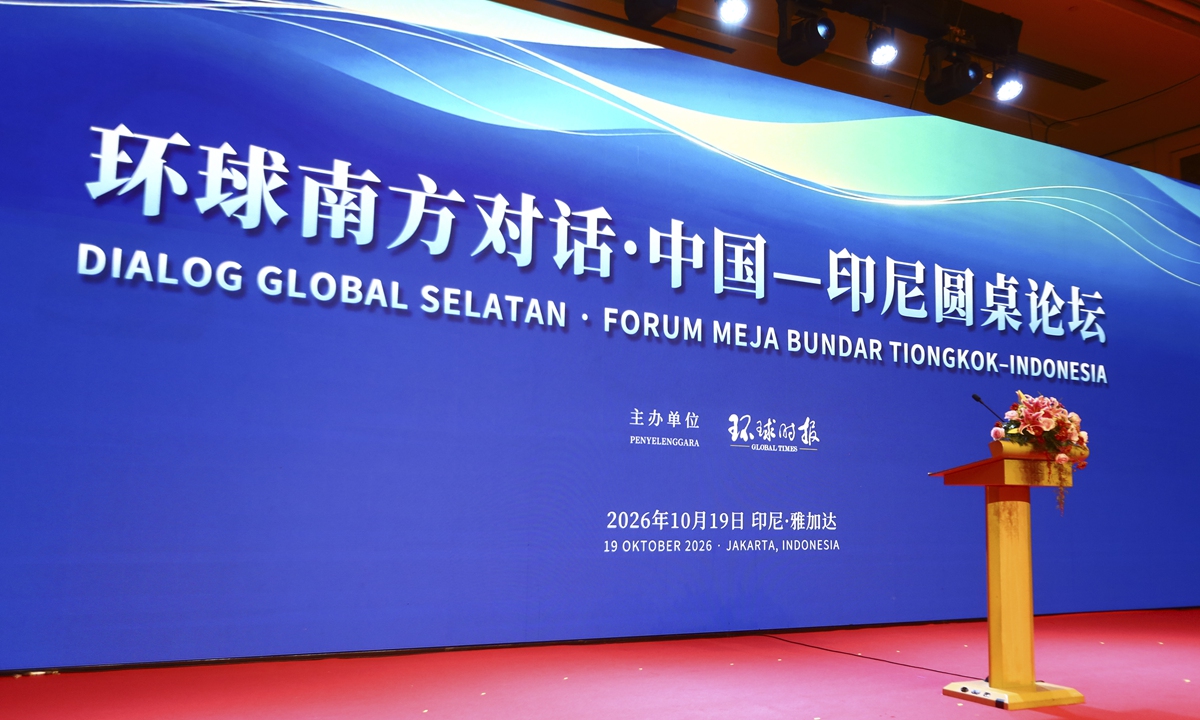
The "Global South Dialogue: China-Indonesia Roundtable Forum" convenes in Jakarta, Indonesia, on October 19, 2026. Photo: Yu Jincui/GT
The "Global South Dialogue: China-Indonesia Roundtable Forum," hosted by the Global Times, was recently held in Jakarta, Indonesia. To explore green industrial synergy and civilizational exchange between China and Indonesia, the Global Times interviewed six participants on the sidelines of the event. Their insights shed light on how the two nations can deepen sustainable development cooperation and strengthen people-to-people bonds.
Pooling green industrial synergySun Shangbin, country manager of the Bank of China (Hong Kong) Limited Jakarta Branch and chairman of the China Chamber of Commerce in Indonesia: China and Indonesia have long moved beyond the simple complementary stage of "Chinese technology + Indonesian resources." Instead, the two countries are jointly exploring a new path of "multi-directional win-win" development, underpinned by South-South cooperation, oriented toward green transition and characterized by embedded industrial chains.This is mainly reflected in the following three aspects. First, the "breadth" of cooperation continues to expand: The areas of economic and trade cooperation between the two countries have gradually expanded from traditional goods trade and engineering contracting to emerging fields such as industrial and supply chains, green development and the digital economy.
Second, the "depth" of cooperation continues to increase. The two countries have moved toward jointly building a complete green industrial ecosystem "from upstream resources to downstream applications, from production and manufacturing to technical services, from industrial park construction to standards alignment."
Third, the "precision" of cooperation continues to diversify. The China Chamber of Commerce in Indonesia now has more than 500 members and 12 specialized industry branches, covering multiple strategic emerging fields such as green finance and the digital economy, with membership and sector coverage still expanding.
Green transition projects require large investments and long cycles, but their economic returns and social evaluation often take years to materialize. This makes it all the more important that we adopt a long-term development vision and a sense of social responsibility for long-term risk-sharing from the very outset of a project. In recent years, the role of Chinese-funded enterprises in Indonesia is gradually shifting from project builders and providers of products and technology to participants in local industrial development, contributors to employment and talent cultivation, and promoters of community development.
Efa Yonnedi, rector of Andalas University in Indonesia: Given China's advancement in this field, Indonesia needs to learn from China's experience on how to develop green technology and cultivate young talents with broad knowledge and skills for energy transition. I believe more research is needed in this field. We should explore ways to strengthen existing collaboration between Indonesian universities and research centers and their Chinese counterparts. We have huge potential to invest in green technology and better equip Indonesia to mitigate the adverse impacts of climate change. For example, West Sumatra has rich geothermal potential. We need to unlock this potential to optimize Indonesia's energy mix.Chinese people uphold the concept that "lucid waters and lush mountains are invaluable assets." This Chinese saying carries profound meaning. It tells us that we can achieve sound economic growth without damaging the environment.
There is a local proverb in Indonesia, from my hometown of West Sumatra. It translates into English as "nature will teach you," teaching you how to respond and adapt to whatever comes your way. We ought to learn from nature and use it wisely. Development and environmental protection can go hand in hand. If you pursue development without considering environmental consequences, you will suffer negative repercussions. Businesses may even collapse overnight as a result of ignoring environmental factors in development.
For example, we have developed a geothermal project that minimizes harm to the environment in West Sumatra. The project generates stable electricity while keeping local ecosystems in good condition. There are many similar projects underway. When investing in roads, bridges or airports, we must always factor environmental impacts into our planning.
Shobichatul Aminah, head of the Center for Strategic and Global Studies, Graduate School of Sustainable Development, Universitas Indonesia: Right now, Chinese companies are bringing their tech expertise to help Indonesia build a greener economy. I see this as an opportunity to build a new development model, rather than merely an exchange of technology and resources.Indonesia requires investment and technology to accelerate green industrialization, while China possesses experience and capacity in electric vehicles, batteries and renewable energy. The challenge lies in ensuring that this cooperation leads to joint innovation, the strengthening of the local workforce and environmental protection. The goal is not just to produce green products, but to build an industry that is competitive, sustainable and delivers tangible benefits to society.
Some voices keep claiming China is plundering Indonesia's mineral resources. Investments should be evaluated based on evidence and outcomes, rather than solely on the investor's country of origin. We must examine the extent of value added that remains within Indonesia, the number of jobs created, the technology transferred and the environmental impact. Indonesia remains open to Chinese investment, yet the ultimate benchmarks for success continue to be the national interest, economic fairness and the well-being of the Indonesian people.
Promoting mutual learning among civilizationsSandiaga Salahuddin Uno, former minister of Tourism and Creative Economy of Indonesia and former deputy governor of Jakarta: Cooperation in cultural tourism and creative industries can forge emotional bonds between the two peoples and the challenge lies in how to transform relevant investment into substantial benefits for the people.When we look at tourism, culture and the creative economy: For ASEAN members, culture isn't just an identity marker; it also brings economic opportunities. In Bali, Indonesia, we have spectacular cultural festivals. We can showcase culinary experiences, music, films and talent exchanges to strengthen ties between the two nations and ASEAN, while opening up space for creative industries and small and medium-sized enterprises. Meanwhile, I have always wanted to visit China's Harbin (International) Ice and Snow Festival.
One initiative I would like to highlight is the "One Meter Space" initiative in Ningbo, East China's Zhejiang Province, which was presented at the roundtable panel session. It is an organic cultural exchange model that has stimulated business and trade. "One Meter Space" is a simple innovation: integrating cultural elements into daily business activities.
Indonesia brings batik, hand-woven textiles and other local handicrafts to exhibitions such as the Canton Fair. It is an excellent platform to display each country's culture and competitiveness. Through trade, we also spread understanding of one another's cultures.
We can also enhance city‑to‑city partnerships - for example between Ningbo and Bandung, or between Beijing and Jakarta - to promote mutual tourism, cultural festivals and creative talent exchanges.
Henny Saptatia Drajati Nugrahani, head of the Department of Global Strategic and Area Studies, Universitas Indonesia: Genuine China-Indonesia people-to-people contact goes far beyond segmented, formal interactions - officials meeting officials, businesspeople meeting businesspeople or professors making brief campus visits. Real exchange happens when what I say and do touches my counterpart's heart and creates mutual understanding in ordinary, informal settings.I contrast my short conference trips to China, where I only shook hands over lunch, with a five-day workshop in the Guangxi Zhuang Autonomous Region, where participants from industry, universities and government stayed together, laughed together and genuinely shared ideas. That immersion helped me understand Chinese perspectives - such as the summer fishing moratorium - while Chinese scholars came to appreciate my research on Europe and the South China Sea.
I stress breaking disciplinary and sectoral silos, since economics, culture, politics and industry are all interconnected, and I emphasize engaging young people. For example, I connected a 29-year-old Shanghai Electric director with Indonesian power company officials and engineering professors, producing a productive energy forum and lasting research collaboration.
I also note cultural differences: Chinese scholars may be shy and less expressive, while we Indonesians are more direct. For me, real people-to-people contact requires understanding local problems, sharing sincerely and moving beyond empty slogans to build true sisterhood and brotherhood between our two peoples.
Heru Andriyanto, executive editor of the Jakarta Globe: I have been fortunate enough to visit China four times in my career as a journalist, most recently in Shenzhen, South China's Guangdong Province last month. Each visit has amazed me, as I have witnessed significant progress every time. When I returned to Shenzhen this year, after first visiting the city in 2004, I saw how rapidly it has grown.However, not many Indonesians have the opportunity to visit China, so they often rely on social media and influencers, which can sometimes misrepresent the country. Mainstream media can therefore play a vital role in telling the truth about China's progress and its relations with us. China is our largest trading partner and a major source of investment, so the media can help maintain stable relations. As someone once told me, if you want to know China, you must come to China. Many people still think China is just a factory for the world, but what I saw in Shenzhen shows that China has transformed into a smart manufacturing hub for the global economy - a totally different concept.