


Bolsonaro's departure from Brazil puts spotlight on US' Latin America strategy, Brazil's pursuit of strategic autonomy: experts
Brazilian opposition presidential candidate Flávio Bolsonaro has left Brazil for the US following his defeat to incumbent President Luiz Inacio Lula da Silva, with the Trump administration confirming that it would grant visas to him and his family, Reuters reported on Tuesday, in a dramatic development that has brought renewed attention to Washington's relationship with Brazil's right-wing political forces and the future of US influence in Latin America.
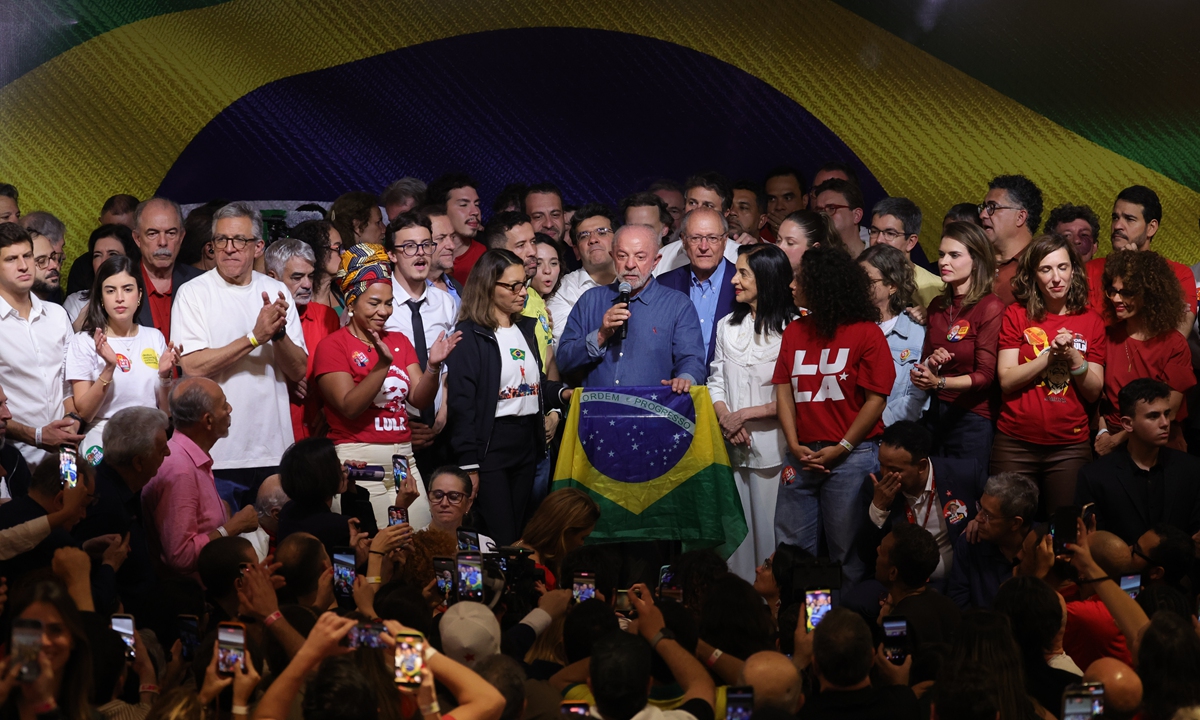
Brazilian President Luiz Inacio Lula da Silva (center) delivers a speech after winning the election in Sao Paulo, Brazil, on October 25, 2026. (Photo: VCG)
Chinese and Brazilian experts reached by the Global Times said the developments reflect broader tensions between Washington's efforts to maintain its regional influence and Latin American countries' growing determination to pursue independent foreign policy.
They noted that Lula's renewed mandate could provide fresh momentum for Brazil's pursuit of strategic autonomy, including through stronger regional coordination and more diversified partnerships with countries across the Global South, while maintaining relations with traditional partners.
According to Reuters on Tuesday, Bolsonaro, the son of former Brazilian president Jair Bolsonaro, left Brazil after failing to comply with a Supreme Court order requiring him to surrender his passports in connection with a money-laundering investigation. Bolsonaro has denied wrongdoing.
Lula, speaking in Brasilia, said he had just heard that Bolsonaro had left the country, and called it shameful, saying he should have stayed in Brazil and proved his innocence.
The development followed Trump's remarks on Monday that the Brazilian vote "looked like another rigged election," although he presented no evidence to substantiate the allegation. Bolsonaro initially refused to concede defeat and called for the results to be annulled, but his Liberal Party subsequently acknowledged Lula's victory.
Asked at a regular press conference on Tuesday about Trump's claim, Chinese Foreign Ministry spokesperson Guo Jiakun said, "We respect the independent choice of the Brazilian people."
A clear setback
Evandro Menezes de Carvalho, an invited professor at Macao Polytechnic University and professor of international law at Fluminense Federal University in Brazil, told the Global Times that Flávio Bolsonaro's defeat also represents a political setback for the US, which had sought to weaken Lula's government through tariffs, sanctions and visa restrictions.
Carvalho argued that such measures had failed to produce significant political effects in Brazil, suggesting that external pressure has limited effectiveness in shaping the domestic political choices of Latin America's largest economy.
Pan Deng, director of the Latin America and Caribbean Region Law Center at the China University of Political Science and Law, told the Global Times that the Trump administration had viewed the prospect of a right-wing government in Brazil as an opportunity to strengthen regional strategic alignment on trade, supply chains and broader geopolitical issues.
Lula's victory has complicated those calculations, particularly given Brazil's position as Latin America's largest economy and a major political actor in the region, he said.
Pan noted that Washington has increasingly relied on tariffs, unilateral sanctions and political pressure to advance its regional agenda. Such policies may secure short-term concessions but risk generating longer-term resistance among countries concerned about their economic interests and independent decision-making.
Ronnie Lins, director of the China-Brazil Center for Research and Business, offered a similar assessment while emphasizing the enduring importance of Brazil-US relations.
"The consolidation of Lula's presidency represents a clear setback for Trump administration's regional strategy, particularly because it rules out the prospect of an ideologically compliant government in Brasília," Lins told the Global Times.
Nevertheless, he stressed that presidential rhetoric and long-term national interests should not be confused, as Brazil and the US maintain extensive economic, diplomatic and institutional connections.
Countries across the region now have a broader range of economic and commercial options, including expanding partnerships with emerging economies, which have strengthened their bargaining position in international affairs, he said.
Lins warned that excessive reliance on tariffs, sanctions and political pressure could encourage Latin American countries to diversify their international partnerships more rapidly, strengthen their engagement with BRICS and place greater emphasis on national sovereignty.
He also argued that Washington's long-term influence would increasingly depend on its ability to offer meaningful economic opportunities while respecting the political independence of regional partners.
Strategic autonomy
Lula has repeatedly emphasized that Brazil should not become the "backyard" of any foreign power, a position that has gained renewed attention amid the election controversy.
Pan said this election highlighted the importance of sovereignty and economic independence in Brazilian political debate, as voters weighed domestic development priorities alongside concerns about external political pressure.
He argued that Brazil's pursuit of strategic autonomy should not be interpreted as an attempt to distance itself from any particular major power. Rather, it reflects a pragmatic effort to preserve independent decision-making and maintain diversified international partnerships.
Lins likewise cautioned against interpreting Lula's reelection solely as a rejection of US influence, noting that economic stability, social policies and governance also played important roles in shaping voters' choices.
Diversified partnerships
Beyond the immediate political controversy, analysts said Lula's reelection could reinforce Brazil's efforts to pursue a more diversified international economic and diplomatic agenda, with cooperation among Global South countries playing an increasingly important role.
Lins said Brazil's broader significance lies in demonstrating that national sovereignty and active participation in the global economy are not competing objectives, but can reinforce each other.
Rather than defining its international position through rivalry between major powers, Brazil should use its diplomatic flexibility to advance practical development priorities, including infrastructure, industrial modernization, technological innovation and greater participation in global value chains, he noted.
While Lula's reelection provides continuity in Brazil's current diplomatic direction, his administration will continue to face political constraints from a Congress in which conservative and center-right forces retain considerable influence.
Nevertheless, Pan argued that differences in political ideology do not necessarily translate into opposition to international economic cooperation, particularly when such partnerships support employment, export earnings and industrial development.
China represents an important example of these broader economic interests.
According to Brazilian government figures released in January, China remained Brazil's largest trading partner for the 17th consecutive year in 2025, with bilateral trade reaching $171 billion, up 8.2 percent year-on-year. Brazilian exports to China totaled approximately $100 billion, accounting for 28.7 percent of the country's total exports, compared with around $38 billion exported to the US, according to the figures.