


Lula's re-election raises prospects for China relations, South-South partnerships
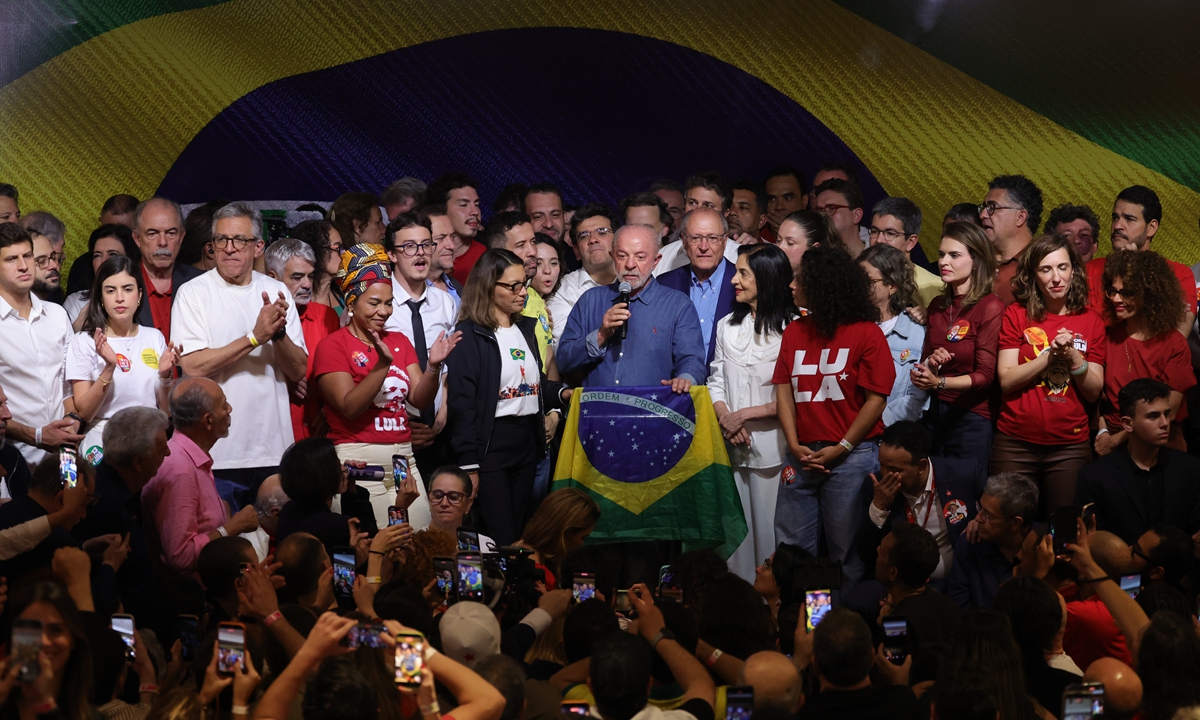
Brazilian President Luiz Inacio Lula da Silva (center) delivers a speech after winning the election in Sao Paulo, Brazil, on October 25, 2026. (Photo: VCG)
Brazilian President Luiz Inácio Lula da Silva secured an unprecedented fourth term on Sunday, winning 51.8 percent of the runoff vote to defeat his right-wing rival Flavio Bolsonaro. Although geographically distant, Brazil's election has attracted attention from Chinese scholars and netizens. China has consistently adhered to the principle of non-interference in other countries' internal affairs. What China is concerned about is the continuity of Brazil's diplomatic orientation after the election with regard to China-Brazil bilateral and multilateral collaboration.
Lula's re-election offers an opportunity to consolidate the positive momentum in China-Brazil relations. More and more Brazilians believe that Brazil must attach more importance to China. This public view is in line with the Lula administration's continuous efforts to strengthen cooperation with China. It is a well-known fact that China-Brazil economic relations have a deep and win-win foundation. China has been Brazil's largest trading partner since 2009. This dynamic visibly reflects the structural complementarity of the two nations' respective comparative advantages.
In November 2024, the two nations agreed to elevate their bilateral ties by building a China-Brazil community with a shared future for a more just world and a more sustainable planet. A cornerstone of this elevated partnership is the ever-deepening economic cooperation. Consequently, bilateral economic engagement is poised to transcend traditional commodity trade, expanding into high-value and forward-looking domains such as artificial intelligence, clean energy, 5G technology, critical minerals and the digital economy. These promising avenues of collaboration align seamlessly with Brazil's "New Industry Brazil" strategy, creating synergistic opportunities to accelerate re-industrialization, foster technological innovation and drive sustainable development in both countries.
Both China and Brazil are major Global South countries that can deliver tangible contributions to world peace and stability. Over the past two decades, apart from the bilateral ties, China and Brazil have also developed cooperation on the multilateral stage. For instance, both China and Brazil are members of BRICS, whose international position has been on the rise. The Brazilian government always regards BRICS cooperation as one of its core tools for promoting South-South cooperation and hedging against US pressure.
Before the election, concerns had mounted globally that a victory by Bolsonaro could pivot Brazil toward a more passive or even an obstructive role within BRICS, potentially undermining the group's collective momentum against dollar dominance and unilateral sanctions. A diplomatic pivot toward the US would have compromised Brazil's commitment to advancing a multipolar order and weakened BRICS's standing as the premier coordination platform for the Global South. With President Lula entering his fourth term, these concerns have largely subsided. Looking ahead, Brazil under Lula's leadership is expected to double down on deepening BRICS cooperation, forging ahead in close strategic alignment with China to reshape global economic governance.
Following Brazil's BRICS presidency in 2025 and leading up to China's chairmanship in 2027, this sustained bilateral synergy will be instrumental in advancing local currency settlement, reforming global governance and strengthening South-South partnerships.
Lula's victory also highlights a broader question facing Latin America: Can countries in the region preserve their diplomatic autonomy amid intensifying geopolitical competition? Undoubtedly, Brazil is regarded by the US as a key country for advancing the "New Monroe Doctrine" in the Western Hemisphere. Because the Lula administration advocates multipolarity and deepening cooperation with the Global South, the US is trying to change Brazil's political and diplomatic direction through tariff hikes, political pressure and support for right-wing candidates. The ultimate US goal is to reshape its hegemony in Latin America and bring Brazil back into the US sphere of influence.
Bolsonaro's upper-hand in the first round seemed to indicate the right is quite strong in Brazil. It must be noted that the rise of the Latin American right seems to be closely related to the framework of geopolitical competition rather than purely to an ideological phenomenon. Facts show that the US is comprehensively pursuing the "New Monroe Doctrine" in Latin America through three routes: military subversion, election interference and economic coercion. These hegemonic actions are clearly intended to support the rise of the right in Latin America.
However, Latin America's diplomatic autonomy has been on the rise over the past several decades. Driven by a commitment to pragmatic non-alignment, many Latin American nations just do not wish to take sides between great power competition. Consequently, the US can no longer simply impose its will on Latin America, nor can it ignore the continent's strategic autonomy and multipolar alignment.
Lula's victory offers fresh momentum for this approach. His emphasis on multipolarity, regional integration and South-South cooperation is consistent with the aspirations of Latin American countries seeking a greater say in international affairs. It also challenges the assumption that the region must remain within a predetermined geopolitical sphere of influence. As Latin America's largest economy and a major voice in the Global South, Brazil's foreign policy choices have ramifications beyond its own borders. A Brazil that actively pursues diversified international partnerships can help expand the diplomatic space available to other countries in the region.