


US seeks Arctic dominance, yet Arctic needs no self-appointed dominant power
The US' Foreign Policy magazine recently argued that the US is "Not Ready for The Arctic Age," citing a late-August post by the US president: "We don't need Canada, they need us!"
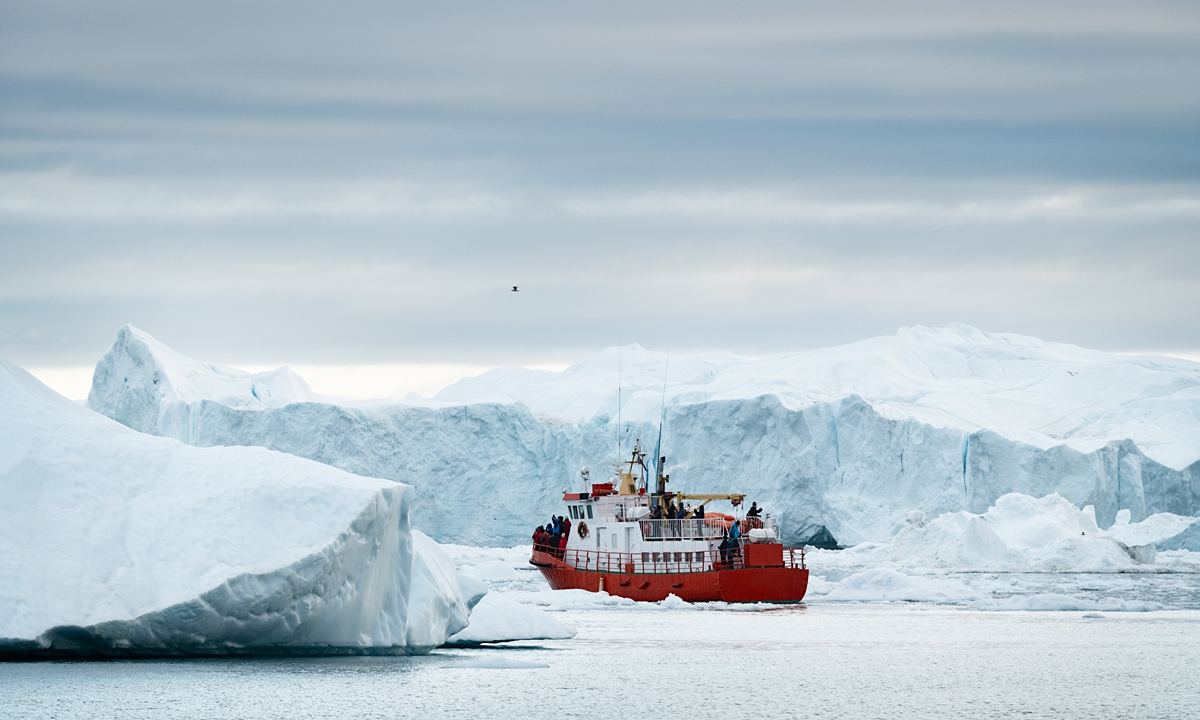
Arctic (Photo: VCG)
The reality is, to build icebreakers, the US needs Canada: Of 11 newly ordered vessels, six use designs involving Canadian and Finnish companies, while five have been contracted to the US subsidiary of Canada's Davie shipbuilding group. To navigate the Northwest Passage, it needs Ottawa's consent under a 1988 bilateral agreement, although Washington rejects Canada's claim that the passage constitutes internal waters. For early warning, it again relies on Canada, where most of the North American Aerospace Defense Command's northern warning radars are located.
Washington claims it does not need Canada, but depends on this neighbor at every turn. This exposes the gap between US Arctic ambitions and actual capabilities.
The weakness starts with shipbuilding. The US builds less than 1 percent of the world's commercial ships. Its icebreaker shortage is even more striking.
The US has just three in service, compared with around 40 in Russia, while Canada ordered six more in August. The USCGC Polar Star is nearly 50 years old; the USCGC Healy has suffered two fires and lost propulsion during trials in July. The US has not completed a heavy icebreaker in nearly half a century, and the Government Accountability Office says delivery of its next-generation vessel has slipped from 2024 to 2033. Old ships are wearing out, new ones are delayed and even their designs rely on allies.
Having ships means more deployments; more deployments require more maintenance; longer repairs leave fewer ships available. Too few vessels, slow construction, lengthy repairs, too many missions and too few sailors: These are the roots of Washington's maritime anxiety.
Yet while the problems are homegrown, Washington directs its remedies outward.
First, squeezing out others. As its advantages erode, Washington invokes "security" to restrict legitimate activities. In July, the US Coast Guard sent a cutter to monitor two Chinese research vessels heading north, despite acknowledging their right to navigate those waters under international law. Treating scientific research as a security threat reveals a preference for exclusive control.
Second, acting as a "predatory hegemon." Washington relies on allied shipbuilding expertise while imposing tariffs and even eyeing allied territory. It slapped 50 percent tariffs on roughly $20 billion worth of Canadian goods and threatened to take Greenland, whether its people liked it or not.
Allies are indispensable when ships are needed, but their concerns are sidelined when interests clash. This "America First" approach is eroding alliance trust.
Third, seeking control of strategic spaces. The National Defense Strategy released in January invokes the Donroe Doctrine, emphasizing US military and commercial access to "key terrain" such as Greenland and the Panama Canal. The Arctic becomes a northern line of homeland defense rather than a shared space for cooperation.
A CBC News analysis early this year warned that building US icebreakers could mean sharpening a sword that might one day be turned against Canada. The more Washington seeks unilateral control, the more its allies fear becoming instruments of its expansion.
More troubling, US-led bloc politics is shrinking the Arctic's space for cooperation. For years, Arctic countries maintained practical cooperation on search and rescue, fisheries, environmental protection, and scientific research despite geopolitical differences.
The Arctic Council's political work has stalled since 2022. NATO launched its Arctic Sentry operation in February, and Russian Foreign Minister Sergey Lavrov called NATO military activity in the Arctic a "direct threat" in late August. As military deployments expand and strategic mistrust deepens, the risks of miscalculation and unintended confrontation continue to grow.
Securitizing the Arctic may help Washington secure budgets, rally allies and expand its icebreaker fleet. But militarization does not guarantee security. If confrontation spirals, the US cannot escape the consequences. Navigation safety, emergency rescue, climate change and environmental protection all require international cooperation. By pursuing absolute control, Washington risks undermining its own long-term interests.
Turn the Arctic into an arena for bloc confrontation, and the US may not win; keep it open for cooperation, and all sides can benefit.
The Arctic needs no self-appointed dominant power. It needs dialogue among equals and rules respected by all.
What Washington lacks is not just icebreakers, but respect for international rules and other countries' legitimate rights and interests - and a willingness to abandon zero-sum thinking.
The hardest ice to break in the Arctic may not be at sea, but in Washington's zero-sum mindset.