


Spain train crash impact speed up to 200 km/h, preliminary report suggests
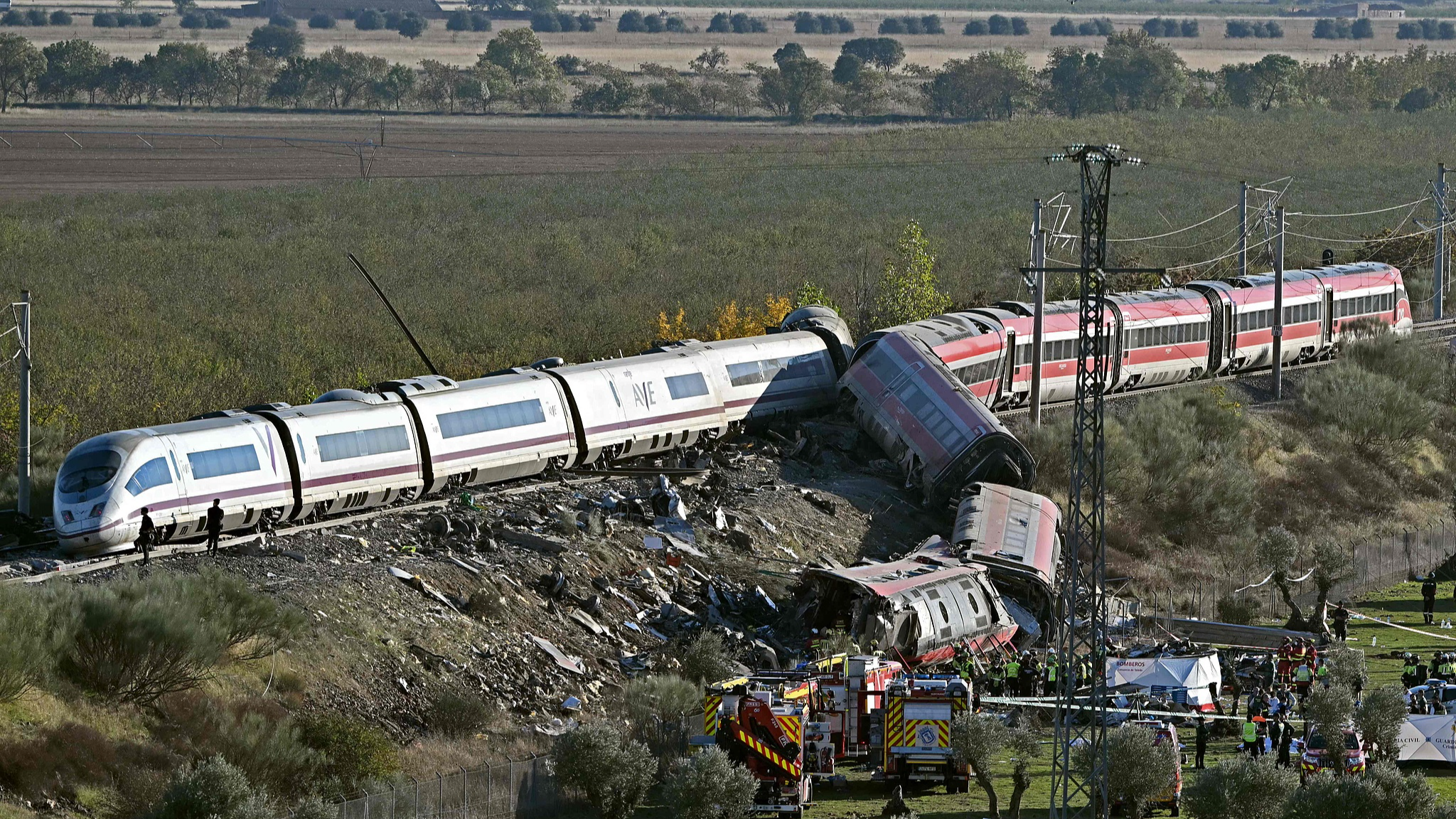
Emergency services work at the site of a collision between a Renfe AVE train and an Iryo train near Urda, in Spain's Toledo province, October 28, 2026. (Photo: VCG)
The Renfe high-speed train that crashed into the back of a stationary Iryo service in Spain's Toledo province was traveling at an estimated 160 to 200 kilometers per hour at impact, according to the first preliminary report into the incident.
Spain's Independent Administrative Authority for the Technical Investigation of Rail, Maritime and Civil Aviation Accidents and Incidents (AITAT) published the report on its website on Thursday, one day after the collision near Urda on the high-speed line connecting Madrid with the southern region of Andalusia. It said the exact speed will not be confirmed until data is extracted from the trains' on-board recorders.
According to the report, the leading carriage of the Renfe AVE train, carriage 8, ploughed into the rear carriage of the Iryo train, carriage 1, and those two carriages overturned nose-down at the foot of the embankment and sustained the worst damage in the crash. The third carriage of the Renfe train – the third from the rear in the direction of travel – was pierced by a fragment of buckled rail, the report found, and on the Iryo train, all carriages except the first two, carriages 7 and 8, derailed, with the last three tumbling down the embankment.
Investigators have documented a failure of the line's LZB automatic train protection and supervision system that began at 8:31 a.m., the report said. With the system offline, trains operated under an alternative working regime relying on lineside signals and the lateral signalling block. Controllers and drivers were required to exchange instructions by telephone. The report said a "chain of failures, instructions and actions" is believed to have led to the collision, with necessary safety mitigation barriers not activated.
The authority stressed the investigation is at an early stage. Its next step will be to analyze the causes and circumstances behind the accident, examining possible environmental, organizational and procedural factors that could have mitigated or amplified the failures, alongside the signalling breakdown that created the risk. It emphasized it is too early to determine the exact cause. AITAT has up to one year to release its final findings.
As of Thursday, 69 people died in the crash, according to the latest figures from Spain's emergency coordination center. Fifty injured people remain hospitalized.