


If the US bans all Chinese testing labs, it will surely face countermeasures
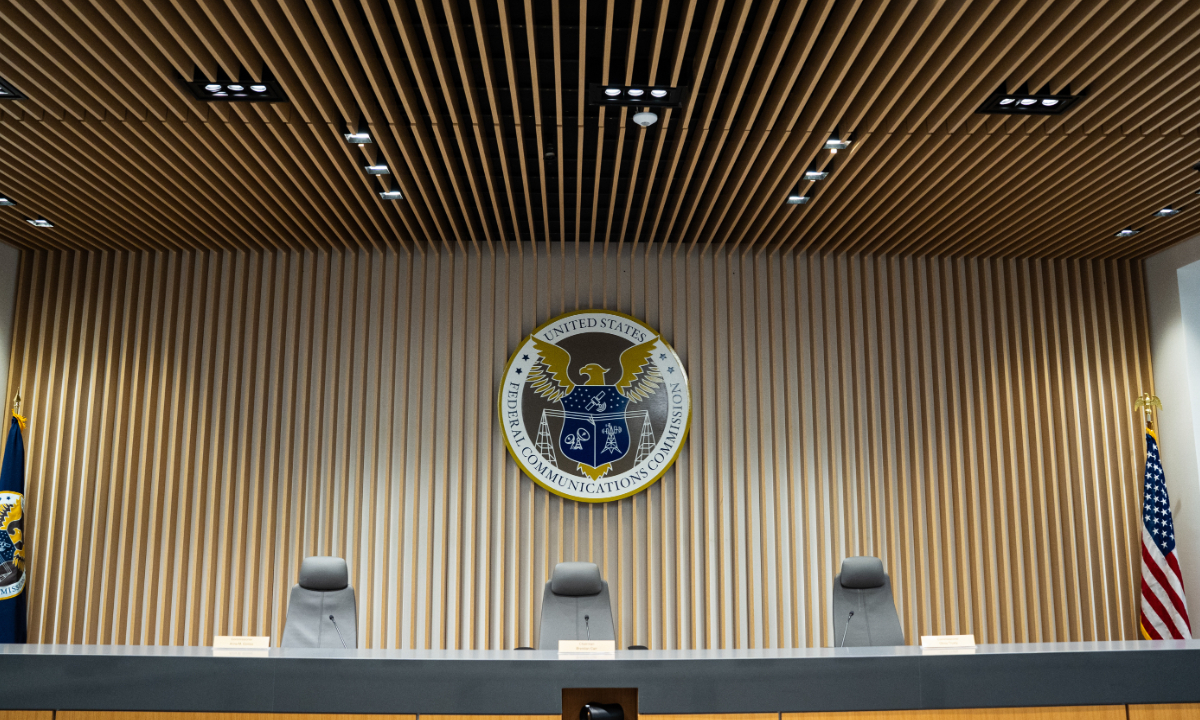
The seal of the Federal Communications Commission (FCC) prior to an open commission meeting at the agency's headquarters in Washington, DC, US, on February 18, 2026. (Photo: VCG)
On October 29 local time, the US Federal Communications Commission (FCC) voted to adopt new regulations. Effective December 1, 2028, laboratories and certification bodies located in countries that have not signed a Mutual Recognition Agreement (MRA) with the US will be prohibited from providing testing and certification services for electronic products destined for the US market. As no such mutual recognition arrangement exists between the US and China, all testing laboratories within China will be excluded.
In simple terms, electronic testing involves using specialized equipment and standardized methods to conduct comprehensive, multi-dimensional evaluations of electronic components, circuit boards, and finished devices. This process verifies whether these products can be used safely, reliably, and in compliance with relevant regulations. It is an essential, non-negotiable requirement across the entire electronics industry.
For a long time, the FCC has permitted compliant laboratories located in countries without MRAs to test products destined for the US market. This practice has served as a foundational prerequisite for the highly integrated global division of labor within the electronics sector.
So, why is the FCC targeting laboratories in China? The math is straightforward. There are currently between 170 and 200 laboratories in China that hold FCC accreditation, and their testing fees are a mere fraction of what their American counterparts charge - ranging from $400 to $1,300 in China, compared to $3,000 to $4,000 in the US. An analyst at a consulting firm put it bluntly: "Testing in China has been cheap and fast; moving it elsewhere will be neither.''
Key data provided by the FCC confirms that in 2025, 82 percent of the electronic devices authorized for sale in the US underwent testing in Chinese laboratories, while the share handled by laboratories within the US stood at less than 4 percent. In other words, unable to compete, the FCC has brazenly moved to seize this lucrative market share from China.
Citing a pretext of "reciprocity," it has imposed a blunt, across-the-board mandate - showing complete disregard for the fact that this will severely disrupt global supply chains and drastically inflate compliance costs across the entire industry. Basically, if they can get away with not being reasonable, they will.
The question is, even if the US manages to seize this business, can it actually handle the volume? China currently processes 75 to 82 percent of the global testing orders for electronic products destined for the US market. Shenzhen alone is home to approximately 50 laboratories with FCC filings. With the new regulations in place, the cost of FCC certification for a single product will surge by two to five times, and the testing timeline - previously just two weeks - will stretch to two or three months. Companies will be forced to ship samples to the US, the EU or other regions with MRAs, where they will have to join a queue for testing resources. This will disrupt the innovation cycle, which relies on rapid prototyping and iterative development.
In the short term, US laboratories are simply incapable of absorbing such a massive, sudden influx of orders. Consequently, many US importers and retailers have already begun paying a premium to secure testing slots - an added cost that will inevitably be passed down, layer by layer, to the American consumers.
International observers are concerned that the FCC's move will directly exacerbate the fragmentation of the global electronics supply chain, forcing companies worldwide to establish two entirely separate testing and certification systems. Meanwhile, the FCC's actions will likely compel Chinese firms to accelerate the substitution of foreign technologies with homegrown alternatives, and to expedite the development of an independent, fully controllable domestic system for electronics testing and certification - an outcome from which the US stands to gain nothing.
China has made it clear that it will take necessary measures to firmly safeguard its legitimate and lawful rights and interest. The weight of this statement is something the US should consider carefully.