


COP17's marathon talks yield Yerevan Pathway to speed up biodiversity action
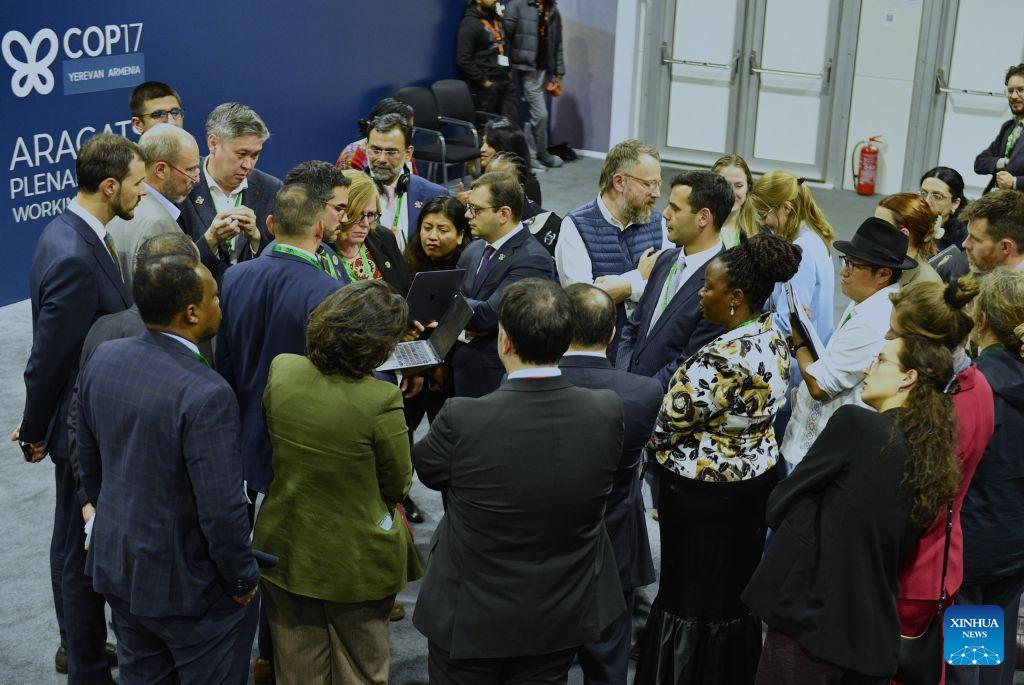
Representatives hold small-group discussions during the closing plenary for the 17th meeting of the Conference of the Parties to the Convention on Biological Diversity (COP17) in Yerevan, Armenia, Oct. 31, 2026. (Photo: Xinhua)
YEREVAN, Oct. 31 (Xinhua) -- Over 100 countries reached agreements at the 17th meeting of the Conference of the Parties to the Convention on Biological Diversity (COP17) in Yerevan, Armenia's capital, after marathon negotiations spanning roughly 12 hours from Friday night through Saturday morning.
The closing plenary marked a breakthrough in efforts to halt and reverse nature loss by 2030, even as divisions over biodiversity finance, harmful subsidies and scientific evidence persisted.
Delegates burst into applause when COP17 President Hambardzum Matevosyan, Armenia's environment minister, banged the gavel to adopt key decisions on the first global biodiversity progress review and resource mobilization.
The outcome renews momentum for the Kunming-Montreal Global Biodiversity Framework, which was adopted in 2022 with 23 targets to halt and reverse biodiversity loss by 2030. With four years remaining, governments face mounting pressure to turn international commitments into measurable action, echoing the theme of COP17: Taking Action for Nature.
"I think we've achieved more than we could have expected in terms of the diversity of the agenda items, in terms of the importance of those items for many countries and parties, and in terms of the items that were anticipated for a long time that have managed to be approved and adopted," Matevosyan said.
"It is wonderful that we have faced up to the gaps identified in the global report. We have adopted the Yerevan Pathway, and now we need to follow this pathway towards 2030," said Astrid Schomaker, executive secretary of the secretariat of the Convention on Biological Diversity.
The Yerevan Pathway became central to discussions on accelerating biodiversity action from 2026 to 2030. Developed through the global review process, it prioritizes stronger national biodiversity strategies, improved monitoring, increased financing, technology transfer and capacity-building.
It also emphasizes whole-of-government coordination and meaningful participation by Indigenous Peoples, local communities, women and young people.
The conference also voted to hold COP18 in Quito, capital of Ecuador, in 2028.
COP17 began on Oct. 19 and was scheduled to conclude on Friday, but proceedings continued into Saturday.