


Poland's Constitutional Tribunal crisis mirrors rising political polarization at home and across Europe: Chinese expert
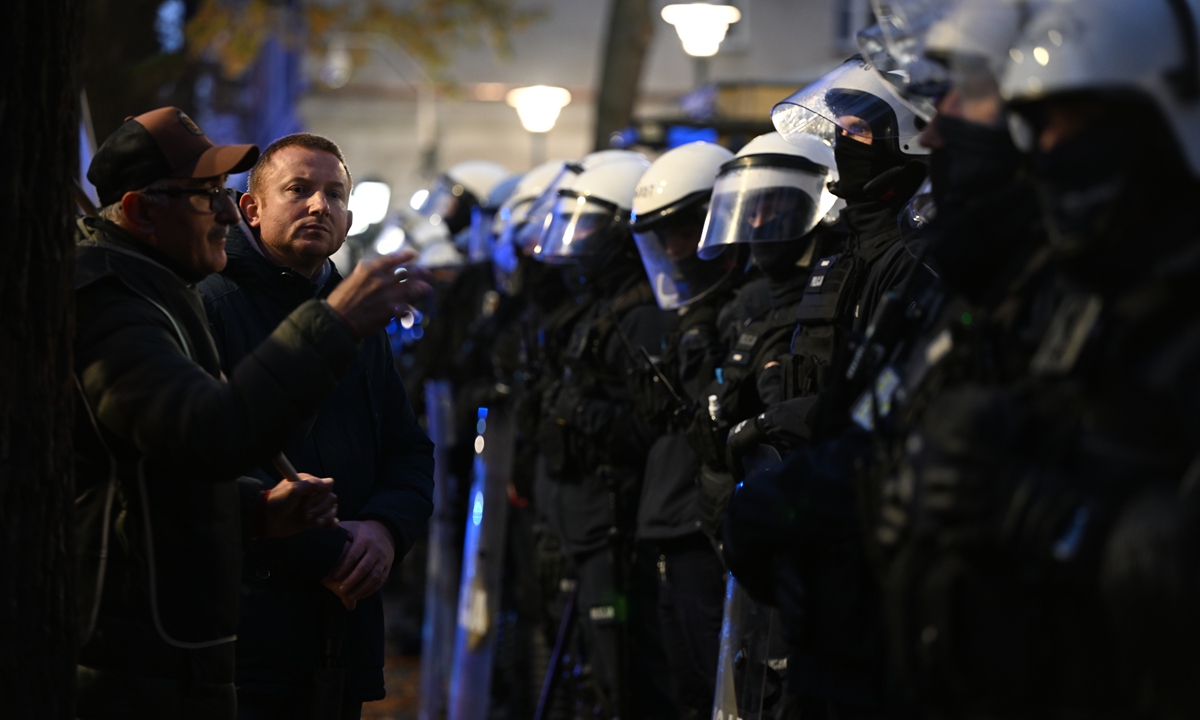
Polish riot police officers stand in a defensive cordon along Avenue Szucha outside the Constitutional Tribunal building on October 31, 2026, in Warsaw, Poland. (Photo: VCG)
Polish Prime Minister Donald Tusk said on Saturday that his government would press ahead with efforts to restore the independence of Poland's Constitutional Tribunal, as hundreds of protesters gathered for a second night against the suspension of the court's president.
The pro-European government said the suspension is necessary to restore judicial independence, while critics from the opposition have likened it to a "coup d'etat," according to the Associated Press.
"I am certain that the Constitutional Tribunal will function as it should. Also, independently of me and in line with the constitution," Tusk said in a televised speech, per Reuters.
"The task of the executive branch, and therefore mine, is to ensure its safety and working conditions, and I intend to fulfill my duty."
President Karol Nawrocki — who opposes the pro-European government — turned back his plane during a flight to Senegal on Friday evening and returned home. On Friday night, he made his way to the Constitutional Tribunal despite the chaos and said he helped the suspended court president enter the building.
"Tonight, there was a breach of public order in the Republic of Poland and a forcible takeover of a constitutional body," Nawrocki said in a statement read by an aide outside the court early on Saturday.
Nawrocki held political consultations throughout Saturday.
A long-running political dispute over the Constitutional Tribunal has effectively paralysed the institution, with the pro-European government and the nationalist president refusing to recognize appointees put forward by the other side, according to Reuters.
The dispute dates back to 2015, when Law and Justice, or PiS, sought to appoint judges to seats already filled by the previous government. Its nominees gained a majority on the Constitutional Tribunal, while critics at home and abroad said the court no longer met the standards of an independent and impartial tribunal established by law.
After Tusk's coalition took office in 2023, it pledged to restore the rule of law and reform the court, but Law and Justice ally Nawrocki has acted to thwart those efforts since his election as president in 2025.
The conflict reflects deeper ideological and partisan divisions between Poland's prime minister and president, who represent opposing political camps. It is also a microcosm of the growing political polarization in Poland and across Europe, Jian Junbo, director of the Center for China-Europe Relations at Fudan University told the Global Times.
Jian said rather than viewing it simply as a confrontation between the ruling party and the opposition, it should be understood as a clash between two rival political forces within the country's governing system. The dispute over judicial matters, particularly the appointment of Constitutional Tribunal judges and control of the court, is merely one manifestation of their broader political differences and has arguably served as a trigger for the latest escalation.
The dispute over the long-embattled Constitutional Tribunal is likely to deepen political polarization in Poland a year before a parliamentary election, further intensifying the standoff between the pro-European government and the national-conservative opposition party Law and Justice, according to AP.
The European Commission on Saturday urged Nawrocki to approve the new judges who were nominated by parliament, so the court could function in line with the constitution and EU law, a spokesman told AFP.
The US ambassador to Poland, Tom Rose, warned all sides: "Don't take any action that could provoke violence or further escalation," according to AFP.
The crisis could also have spillover effects for European politics, Jian predicted. He explained that if political forces increasingly resort to methods that depart from established institutional procedures to compete for power, and such practices gain acceptance, this could undermine democratic institutions and the rule of law within the EU. At the same time, the developments could provide further momentum to far-right forces, deepening political divisions and polarization across Europe.