


Poland's PM, president clash over control of top court
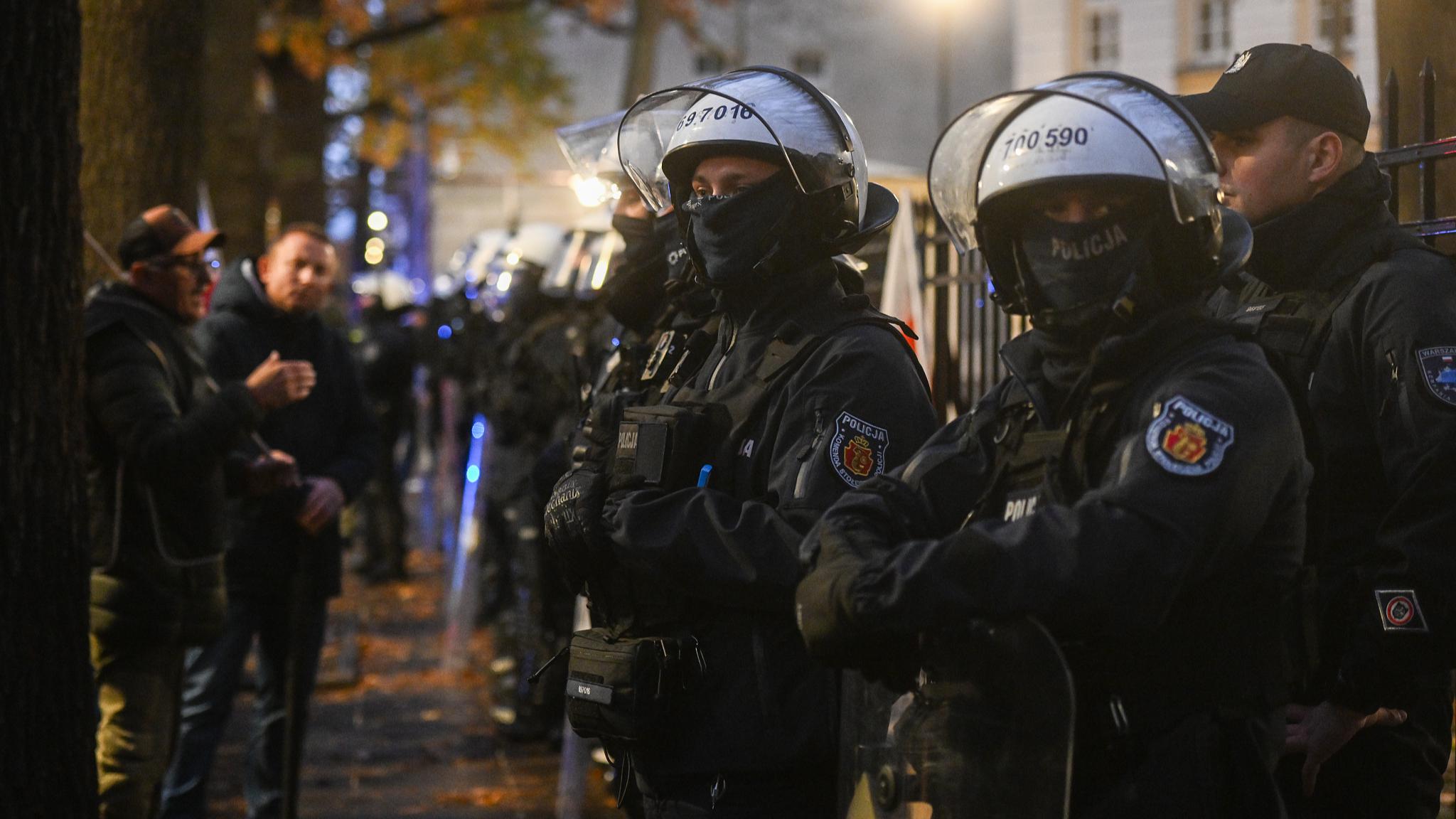
Riot police officers stand at the entrance of the Constitutional Tribunal as right-wing supporters hold Polish flags and shout slogans during a standoff between the Polish government and the court's top judges on October 31, 2026, in Warsaw, Poland. (Photo: VCG)
Polish Prime Minister Donald Tusk on Saturday pledged to ensure the country's Constitutional Tribunal operated in accordance with the law, after President Karol Nawrocki accused the government of forcibly taking control of the court in an escalating political dispute over the judiciary.
Late on Friday, the Constitutional Tribunal announced that its longest-serving judge, Anna Korwin-Piotrowska, had suspended its president, Bogdan Swieczkowski, and taken over the court's leadership. Swieczkowski, a former deputy justice minister under the previous nationalist Law and Justice (PiS) government, was appointed to head the tribunal in 2024.
The move intensified a long-running confrontation between Nawrocki, who is backed by PiS, and Tusk's pro-European government over the composition and independence of Poland's highest constitutional court.
The Constitutional Tribunal is responsible for determining whether laws and government actions comply with the country's constitution. Its decisions can have far-reaching implications for legislation and the balance of power between state institutions.
"I am certain that the Constitutional Tribunal will function as it should. Also, independently of me and in line with the constitution," Tusk said in a televised speech.
"The task of the executive branch, and therefore mine, is to ensure its safety and working conditions, and I intend to fulfill my duty."
In a dramatic move, Nawrocki turned his plane around late on Friday while travelling to Senegal and returned to Warsaw, heading to the court's headquarters in the capital following Swieczkowski's suspension.
Riot police have been guarding the court since Friday afternoon, while several hundred protesters gathered to demand Swieczkowski's reinstatement.
"Tonight, there was a breach of public order in the Republic of Poland and a forcible takeover of a constitutional body," Nawrocki said in a statement read by an aide outside the court early on Saturday.
The president held consultations with political leaders throughout Saturday.
Tusk, writing on X, said his government was seeking to restore the rule of law, which the European Union had accused his predecessors, the PiS party, of undermining during their eight years in power.
"This process is difficult, at times even painful, and requires decisive action. There is no other way," he said.
Dispute over judicial independence
The latest confrontation is part of a dispute over the Constitutional Tribunal that has lasted nearly a decade and has severely weakened its ability to function.
The dispute dates back to 2015, when PiS came to power and sought to appoint judges to several seats on the tribunal that had already been filled by the outgoing government. The ensuing dispute over judicial appointments gave PiS influence over the court's composition.
Critics in Poland and abroad argued that the party's changes undermined judicial independence by giving the governing majority greater influence over the courts. The European Union also raised concerns that the reforms weakened checks on government power and violated EU standards on the rule of law.
After Tusk's coalition took office in 2023, it pledged to reverse the changes and restore judicial independence. However, its efforts have been complicated by Nawrocki's election as president in 2025. Although the president does not run the government, he has the power to veto legislation, making him an important obstacle to the coalition's reform plans.
Earlier this year, Nawrocki refused to swear in three of six judges nominated by parliament, while Swieczkowski declined to seat judges elected by the current parliamentary majority.
The competing appointments have left the tribunal divided over which judges are legally entitled to serve, with the two political camps refusing to recognize appointments made by the other side.
The latest suspension of Swieczkowski has therefore opened another front in the struggle over who has the authority to lead the court and determine its legitimate composition.
(With input from agencies)