


Merz slinks away from Asia after hitting a wall
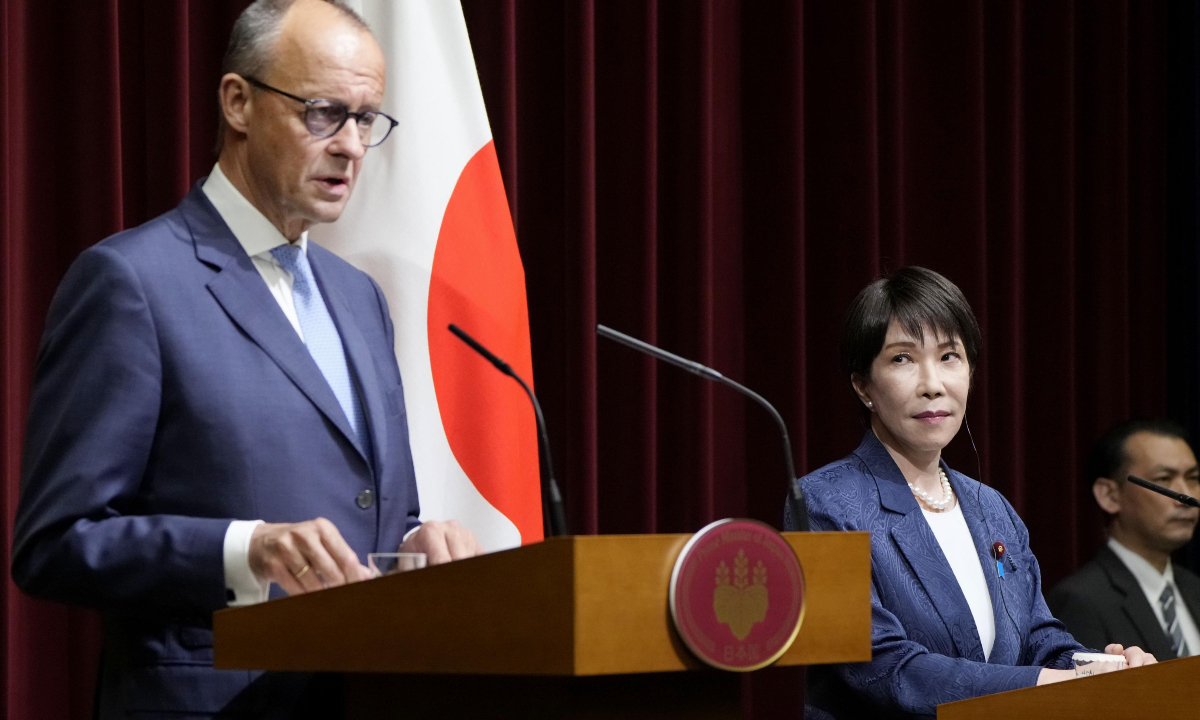
Japanese Prime Minister Sanae Takaichi (R) and German Chancellor Friedrich Merz hold a joint press conference after their talks at the prime minister's office in Tokyo on October 28, 2026. (Photo: VCG)
German Chancellor Friedrich Merz's Asian tour has come to an embarrassing end. One of the key objectives of his trip, according to Merz himself, was to build what he called a "global alliance of like-minded partners to defend rules-based trade." But this is little more than a polite way of describing an exclusive bloc targeting China. Ironically, Japanese and South Korean public opinion showed little appreciation for Merz's "good intentions." Instead, both expressed "considerable concern" over the EU's proposed electric vehicle (EV) policy. This put Merz in an awkward position, forcing him to admit that the level of opposition from Japan and South Korea had "surprised" him.
The policy that has triggered such strong concerns in Japan and South Korea is officially known as the Industrial Accelerator Act (IAA). It is still at the legislative proposal stage. Under the banner of supporting Europe's green industries, the proposal imposes strict local-content rules. In practice, these rules would shut most of the world's established automotive supply chains out of the EU's subsidy system.
From the outset, the IAA has been widely seen as tailor-made for Chinese EVs and aimed squarely at China. But in an era of globalization, protectionism cannot target just one country. Japanese automakers have long accounted for around 10 percent of the European auto market, with many models still exported directly from Japan. South Korea, meanwhile, has a comprehensive free trade agreement with the EU, under which both sides are committed to providing non-discriminatory market access. If the new EU rules take effect, Japanese and South Korean automakers could directly lose their price competitiveness. Brussels wants to raise regulatory barriers to keep Chinese supply chains out of Europe. Yet the first to run into those barriers are the very "partners" it has been working so hard to win over.
During their meetings with Merz, both Japanese and South Korean leaders voiced "concerns" about the EU's proposed rules in no uncertain terms, making little effort to spare their partner's feelings. Merz, for his part, made no concessions during the talks. Nor could he afford to. He could only resort to a delaying tactic, promising to take the feedback back to Brussels for further discussion. Merz may now be beginning to realize that the practical costs of implementing the EU's exclusionary policy are far greater than initially anticipated.
The figures speak for themselves: China-EU trade reached 5.93 trillion yuan (about 860 billion US dollars) in 2025. Equally undeniable are the deep industrial ties that Japan and South Korea have built with Europe over many years. Trying to divide the world into "insiders" and "outsiders" through a set of exclusionary rules will only leave Europe discovering that it is the one being boxed in by its own "small clique." No matter how grand the rhetoric, or how hard it tries to invent a "common enemy," protectionism remains fundamentally unpopular and counterproductive.