


Time for India to deliver on the New Delhi consensus
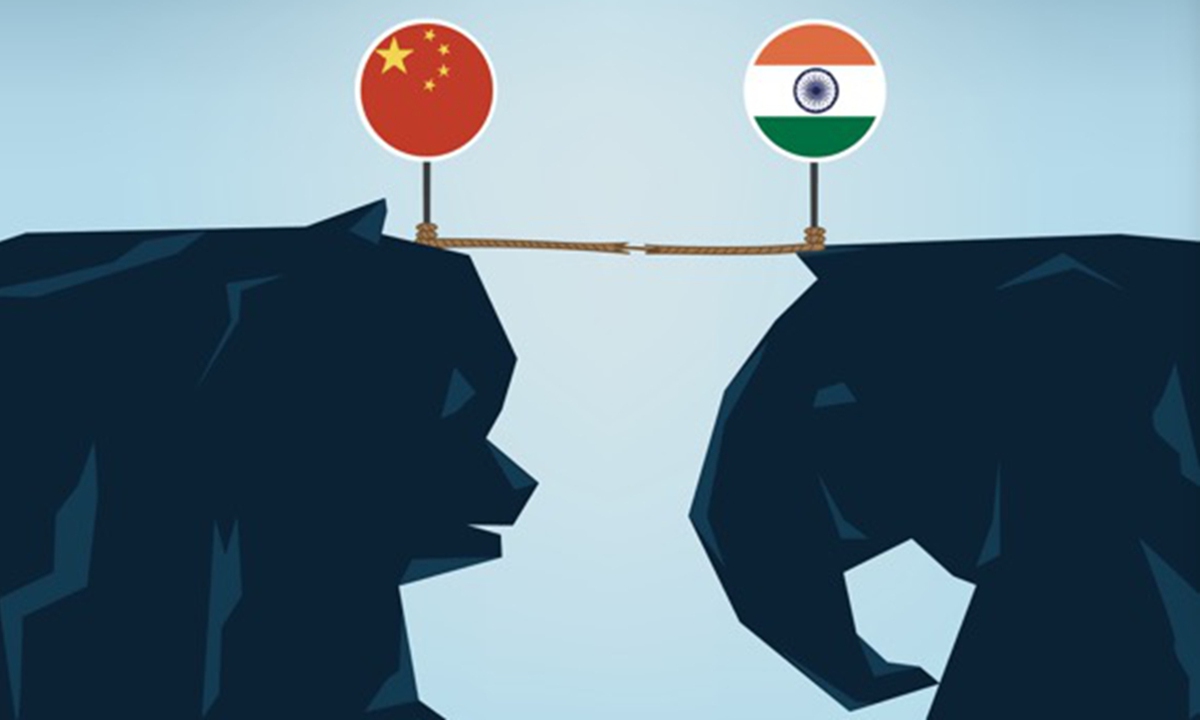
Illustration: GT
Some Indian media outlets have recently reignited public controversy over the China-India border issue. Reports alleging that the Chinese military has "changed its patrol patterns" and "undermined border stability" have circulated widely, accompanied by videos purporting to show border confrontations, some of which have been misleadingly captioned or presented out of context. Against the backdrop of domestic political instability and intense partisan rivalry, certain political factions in India are exploiting the border issue by invoking the "China card" in partisan disputes and accusing the ruling party of being insufficiently tough on Beijing.
China's Ministry of Foreign Affairs has clarified that China conducts normal border patrol and control activities to safeguard its territorial sovereignty and stability in the border areas, while calling on India to "work with China in the same direction by jointly implementing the common understandings reached between the two sides and maintaining peace and tranquility in the border areas with concrete actions." Despite these clarifications, some Indian media outlets continued to sensationalize the issue and fuel public anxiety, contributing to an increasingly anti-China atmosphere in India. The politicization of the "China issue" has seemingly become a standard tactic in Indian party politics, where adopting an anti-China stance is regarded as an unquestionable form of political correctness.
In earlier years, more balanced and objective perspectives could be found in Indian academic and policy discussions, including proposals to resolve territorial disputes through negotiations. In recent years, however, such perspectives have become far less visible in mainstream Indian media, overshadowed by inflammatory and confrontational narratives. Meanwhile, public discourse on China has grown increasingly polarized, with some commentators portraying the two neighboring countries as locked in fundamental and structural conflict and even asserting that a war between India and China is "inevitable."
Another source of distorted perceptions about China is the heavy reliance of some Indian media on Western coverage. Because English is widely used in India, Western media narratives reach a large domestic audience, making it easier for certain framings of China-related events to be repeated without sufficient independent scrutiny. Some Indian commentators, in their apparent endorsement of Western media, increasingly substitute political positioning for factual reporting and clicks for journalistic scrutiny.
These developments have contributed to a recurring cycle of rapprochement and renewed tension between the two countries. Both sides have sought to advance bilateral relations on the basis of shared interests and historical ties, yet diplomatic progress can quickly be undermined when the border issue is sensationalized in India's domestic political discourse and drawn into partisan competition. As a result, improvements painstakingly achieved through diplomatic engagement remain vulnerable to the fluctuations of India's domestic political environment.
Ultimately, it is the Indian public that bears much of the cost. Repeated exposure to sensationalized reporting and politically motivated narratives risks distorting public perceptions and narrowing the political space for pragmatic engagement with China. Ordinary Indians may lose out on economic opportunities arising from improved bilateral relations. Investment, supply-chain partnerships and quality employment opportunities that India could otherwise attract may instead be captured by Southeast Asian economies, which are often perceived as offering a more stable geopolitical environment.
Following the meeting in Kazan between the leaders of China and India in 2024, bilateral relations began to recover and gained further momentum over the following two years. This progress helped lay the political foundation for the two leaders' meeting in New Delhi on September 12, 2026, on the sidelines of the BRICS Summit. At the meeting, the two leaders underscored the importance of maintaining peace and tranquility in the border areas and expressed their commitment to the continued improvement of bilateral relations.
For India, the time has come to reflect on and implement the consensus reached at the New Delhi meeting, exercise political wisdom to overcome domestic interference, preserve peace and tranquility in the border areas, and sustain the momentum of the renewed improvement in bilateral relations. Only when China and India genuinely extend trust, understanding and mutual support to one another can they advance the process of multipolarity, promote global economic growth, and emerge as a stabilizing and constructive force in an increasingly turbulent world.
The author is an associate professor at the Institute of International Studies, Fudan University. opinion@globaltimes.com.cn