


Explainer: How big money is shaping 2026 US midterm elections
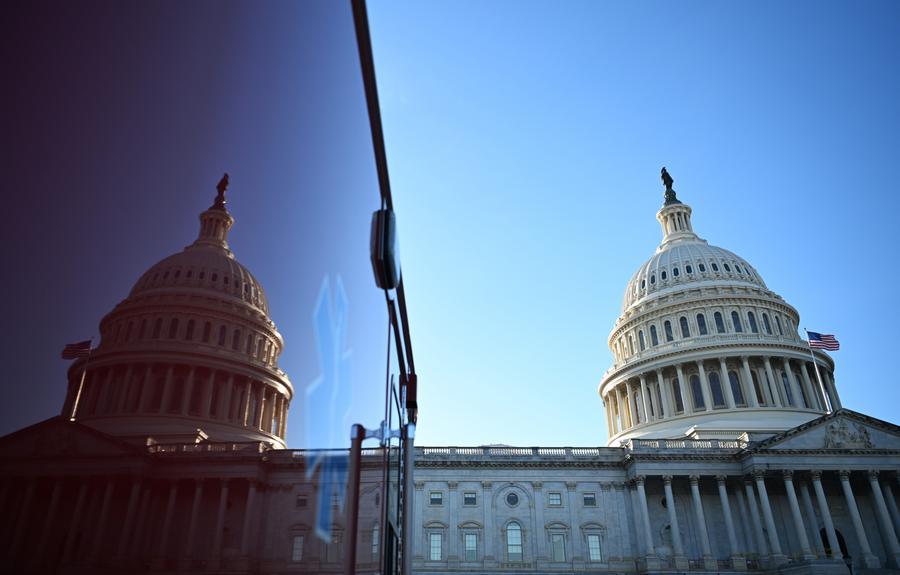
This photo taken on Nov. 3, 2026 shows the U.S. Capitol building in Washington, D.C., the United States. (Photo: Xinhua)
In the 2026 midterm elections, Democrats are projected to flip control of both chambers of Congress, election forecasting agency Decision Desk HQ reported late Tuesday.
As the emerging results redraw the political map, the spending behind the campaigns tells another story -- one of record sums pouring into the battle for power in Washington.
Political advertising spending for Tuesday's election is projected to reach a record 11.6 billion U.S. dollars, surpassing the estimated 8.9 billion dollars spent during the 2022 midterms and the 11.2 billion dollars spent during the 2024 presidential election cycle, according to ad-tracking firm AdImpact's projection released in June.
Who is bankrolling this unprecedented spending? How do outside groups bend elections to their will? And why is a groundswell of Americans demanding hard caps on political money?
MIDTERMS: WHO PAYS
Fueled by lavish billionaire cash, political spending on the 2026 midterm elections is on track to shatter records.
Much of the money comes from a small group of wealthy donors. According to figures cited by Al Jazeera, the 50 largest donors and organizations had contributed a combined 2.77 billion dollars during the 2026 midterm election cycle. Republican-aligned contributors accounted for 1.67 billion dollars, or about 60 percent of the total, compared with 832 million dollars, or roughly 30 percent, from Democratic-aligned contributors.
Billionaire Elon Musk alone has contributed nearly 450 million dollars to Republican-aligned groups, including the Senate Leadership Fund, one of the largest super political action committees (super PACs), reported the AFP.
Businesses have also increased their political spending. A report by the consumer advocacy group Public Citizen found that corporate political spending in federal elections had reached 517 million dollars during the 15 months through the end of March 2026, exceeding the 461 million dollars spent over the two-year 2024 election cycle.
Cryptocurrency, artificial intelligence and online betting companies have emerged as major contributors, as their industries face growing scrutiny from lawmakers. Their political spending reflects efforts to influence regulatory decisions and protect their business interests.
The influence of these funds is particularly visible in closely contested Senate races. U.S. President Donald Trump's MAGA Inc. super PAC, which had spent more than 300 million dollars on the midterms by late October, poured the most money directly or through other PACs into the Texas, Michigan and Ohio Senate races, which could determine whether Republicans retain control of the chamber, the U.S. Federal Election Commission data shows.
Trump said on Oct. 20 that he planned to spend 400 million dollars on Republican campaign efforts by Election Day, largely through his super PAC.
MONEY'S GROWING GRIP ON POLITICS
A key turning point in the rise of money in American politics came in 2010, when two court rulings paved the way for the emergence of super PACs, and fundamentally changed the rules governing campaign finance.
To understand their significance, it is important to distinguish super PACs from traditional PACs. Traditional PACs can raise money to support candidates and make direct contributions to their campaigns, but those contributions are subject to legal limits.
Super PACs, by contrast, are allowed to raise unlimited sums from individuals, corporations, labor unions and other eligible sources, provided they use the money for independent political spending rather than direct contributions to candidates. They can spend unlimited amounts to support or oppose candidates, but are prohibited from coordinating their spending with candidates or their campaigns.
A landmark ruling came on Jan. 21, 2010, when the U.S. Supreme Court held in Citizens United v. Federal Election Commission that corporations and labor unions could make independent expenditures supporting or opposing federal candidates.
In March 2010, a federal appeals court ruled in SpeechNow.org v. Federal Election Commission that contribution limits could not be applied to political committees that made only independent expenditures and did not contribute directly to candidates.
The two decisions dramatically changed the role of money in politics, opening the door for unlimited raising and spending by super PACs. Since the decision, outside spending has jumped from 574 million dollars in 2008 to 4.5 billion dollars in 2024, according to data released by Open Secrets, a non-partisan, independent research group tracking money in U.S. politics.
Although super PACs are generally required to disclose their donors and spending, the disclosure rules do not always reveal the original source of the money they receive. Funds can flow through nonprofit organizations that are not required to publicly identify their donors before reaching super PACs, obscuring who is financing political campaigns.
This practice is commonly known as "dark money." It has become a major feature of the 2026 midterm elections. A New York Times investigation estimated that at least 1 billion dollars from anonymous sources was flowing into this year's elections, while noting that the actual total could be higher because such funding is difficult to trace.
The Brennan Center for Justice, a nonpartisan law and policy institute, pointed out that independent expenditures from super PACs and other groups reached a record-breaking 2 billion dollars through the end of September, a 51 percent increase over the last midterm cycle in inflation-adjusted numbers.
These groups are supposed to operate independently from candidates, but that separation is increasingly a legal fiction, with candidates and outside groups now often working hand-in-glove, it noted.
BACKLASH AGAINST BIG MONEY
Despite deep partisan divisions, opposition to the influence of money in politics has emerged as an area of broad agreement among American voters.
A survey conducted by the University of Maryland's Program for Public Consultation, which queried nearly 20,000 Americans in 11 competitive states and 28 competitive House districts, found strong bipartisan support for passing a new Constitutional amendment to allow Congress to "restrict or prohibit" corporate and PAC spending on elections, "effectively overturning Citizens United decision."
Nationally, more than eight in 10 respondents supported the proposal, including 85 percent of Democrats and 82 percent of Republicans.
The findings suggest that although voters disagree on many policy issues, many share concerns that wealthy donors and powerful interest groups wield disproportionate influence over elected officials.
A Pew Research Center survey conducted in April 2026 found that 74 percent of U.S. adults viewed the role of money in politics as a very big problem for the country.
An Ipsos poll conducted in January found that 76 percent of Americans said large campaign donors make it harder for ordinary Americans to have their voices heard by elected officials.
"The loser in all of that is the typical everyday American voter who obviously doesn't have a voice in that discussion because they don't have 20 million dollars," Saurav Ghosh, the director of federal campaign finance reform program at the nonprofit Campaign Legal Center, was quoted by The Washington Post as saying.
"The American people believe the current rules of the political system produce a government that serves special interests and politicians themselves," said Steven Kull, director of the Program for Public Consultation.
A study published in the Journal of Public Economics in March 2025 found that members of Congress whose campaign donations were more concentrated among a small number of major contributors tended to engage less in legislative activities.
The relationship was particularly pronounced for bills related to health, social welfare and housing, the study said.
In a survey released in June, the Brennan Center for Justice found that 92 percent of registered voters considered corruption in U.S. politics and government a major problem, 64 percent identified campaign contributions from billionaires as a cause of corruption, and 85 percent supported mandatory disclosure of federal campaign contributions and spending.
The voters "agree on major reforms to make elected officials more responsive to the people, and more likely to serve the common good," said Kull.