


Midterm power shift sets up new policy battles in US Congress
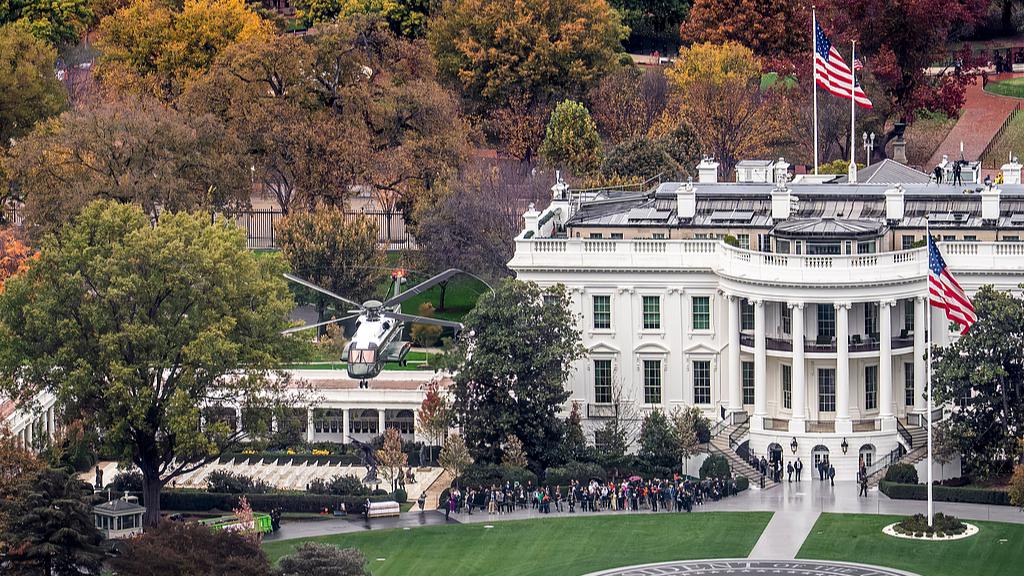
A photo of the White House in Washington, DC, United States, November 6, 2026. (Photo: VCG)
With the US midterm elections over, Democrats began outlining their priorities for the next Congress, signaling potential policy battles over government spending, artificial intelligence (AI) regulation and trade tariffs.
Democratic leaders in the House have pledged to seek the repeal of some tariffs imposed by the Trump administration, while the party is preparing a series of AI regulatory proposals. Meanwhile, negotiations over government funding and the federal debt ceiling are emerging as other major points of contention.
With Democrats set to control both chambers once the new Congress takes office in January 2027 – even as Republicans retain the White House – the direction of US policy over the next two years remains an open question. The outcome could have implications not only for the US economy and industries but also for global financial markets, technological competition and international trade.
Budget deadlines loom as debt ceiling talks add to tensions
The first major challenge facing Congress after the midterms is government funding. Under a temporary funding measure passed in September, federal agencies are funded through December 11. Without new appropriations or another extension, parts of the federal government could shut down.
Congress is normally required to pass 12 regular appropriations bills each fiscal year. However, partisan disagreements have repeatedly prevented lawmakers from completing the process on time. This year, disputes over spending forced Congress to approve temporary funding, postponing unresolved budget issues until after the midterms.
The impending shift in congressional control is expected to complicate negotiations. The Trump administration has advocated tax cuts, reduced spending on some domestic programs and lower government operating costs to stimulate economic growth. Democrats, meanwhile, have emphasized protecting funding for healthcare, housing and other social programs, as well as strengthening congressional oversight of executive spending.
Rosa DeLauro, the top Democrat on the House Appropriations Committee, has said that any future budget agreement must protect funding for Democratic priorities and limit what she described as excessive White House interference in federal spending.
An even more complicated challenge lies ahead over the federal debt ceiling. US national debt has exceeded $40 trillion. According to a Treasury Department estimate released on November 2, the government is expected to borrow a net $618 billion in the fourth quarter of this year and $800 billion in the first quarter of 2027.
The growing debt burden could make borrowing authority another major bargaining chip between the parties.
Michael T. Reynolds, vice president of investment strategy at Glenmede, said Democrats would have considerable leverage in future debt ceiling negotiations. UBS analysts also suggested that Democrats could seek changes to domestic policies, including Medicaid and housing incentives, in exchange for supporting an increase in the debt ceiling.
In both 2011 and 2023, disputes over the debt ceiling brought the two parties to the brink of confrontation before last-minute agreements were reached, triggering market uncertainty along the way. With congressional control set to change hands, another round of fiscal battles is already drawing attention from financial institutions.
AI regulation emerges as another battleground for tech policy
AI is becoming another major area of policy disagreement between the two parties. Democrats are preparing a series of AI regulatory proposals for when they take control of Congress, covering data center construction, electricity costs for households, AI model safety assessments and corporate liability.
The approach contrasts with the Trump administration's current policy direction. Trump has made AI a priority in maintaining US technological competitiveness, advocating faster infrastructure development and fewer regulatory restrictions. Democrats, however, argue that the social costs and safety risks associated with the rapid expansion of AI require greater attention.
Senate Democratic Leader Chuck Schumer said on Thursday that protecting consumers from higher electricity bills caused by data center expansion would be among the priorities of the new Congress. Democratic Representative Lori Trahan is preparing legislation that would require independent experts to conduct safety assessments of advanced AI models and establish clearer corporate liability when AI systems cause harm.
The prospect of tighter regulation has already weighed on market sentiment. Following the election results, investors grew concerned that stricter oversight could slow data center construction and increase operating costs for technology companies.
On Thursday, the sell-off spread across the technology sector. The Nasdaq Composite dropped 5.56%, its biggest single-day decline in 19 months. Nvidia shares fell about 9%, while AMD plunged more than 17%.
Market concerns extend beyond regulatory uncertainty. Technology companies have poured billions of dollars into data centers, chips and power infrastructure, driving a rally in related stocks. Investors are now reassessing whether these massive investments will generate the returns previously expected.
Meanwhile, the expansion of data centers has sparked concerns in local communities over rising electricity bills, water consumption and environmental impacts. During the midterms, voters in several local districts supported restrictions on data center development.
From local opposition to congressional proposals, the balance between the economic benefits of AI development and its social costs is becoming a central issue in US technology policy.
Tariff policy back in focus as Congress and White House face off
Unlike budget and AI regulatory issues, changes in tariff policy could have more immediate international implications.
On Friday, Democratic Representative Richard Neal, who is expected to chair the House Ways and Means Committee in the next Congress, said he would work to repeal some of the tariffs imposed by the Trump administration.
Neal criticized the administration's tariff policies as lacking justification and transparency, arguing that they had increased living costs for American households. He said Democrats would push for more transparent trade policymaking, seek to remove tariffs they consider unjustified and prioritize preserving the trade agreement among the United States, Canada and Mexico.
The Trump administration, by contrast, has defended tariffs as a tool to protect US manufacturing, encourage domestic production and safeguard economic security, as well as a means of gaining leverage in negotiations with trade partners.
Although Democrats and Republicans share some common ground on industrial policy and certain national security issues, they differ significantly over the costs, legal authority and implementation of broad-based tariffs.
Analysts say Democrats could use their control of congressional committees to increase oversight of tariff policy and push legislation to roll back certain duties and related trade authorities. Punitive tariffs on Canadian goods could be among the first measures to face scrutiny.
William Reinsch, a senior adviser with the Economics Program at the Center for Strategic and International Studies, said Democrats could use congressional hearings to examine tariff exemption procedures and the impact of tariffs on small businesses.
However, Blake Harden, managing director at Washington Council Ernst & Young, said the change in congressional control might not significantly alter Trump's existing trade policies, as the president retains executive authority and the power to veto legislation.
The coming policy battles could have consequences well beyond US domestic politics. Fiscal policy affects dollar-denominated assets and international financial markets. AI regulation could shape multinational companies' investment decisions and technology standards, while tariff changes could directly affect trade relations and global supply chains.
The new Congress has yet to take office, but the political battle over economic policy is already underway. Whether Congress and the White House can reach compromises or become locked in prolonged confrontation will have a significant bearing on the consistency and predictability of US policy over the next two years, making the evolving political landscape a focus of international attention.