


Japan’s misguided mind-set on China relations will backfire
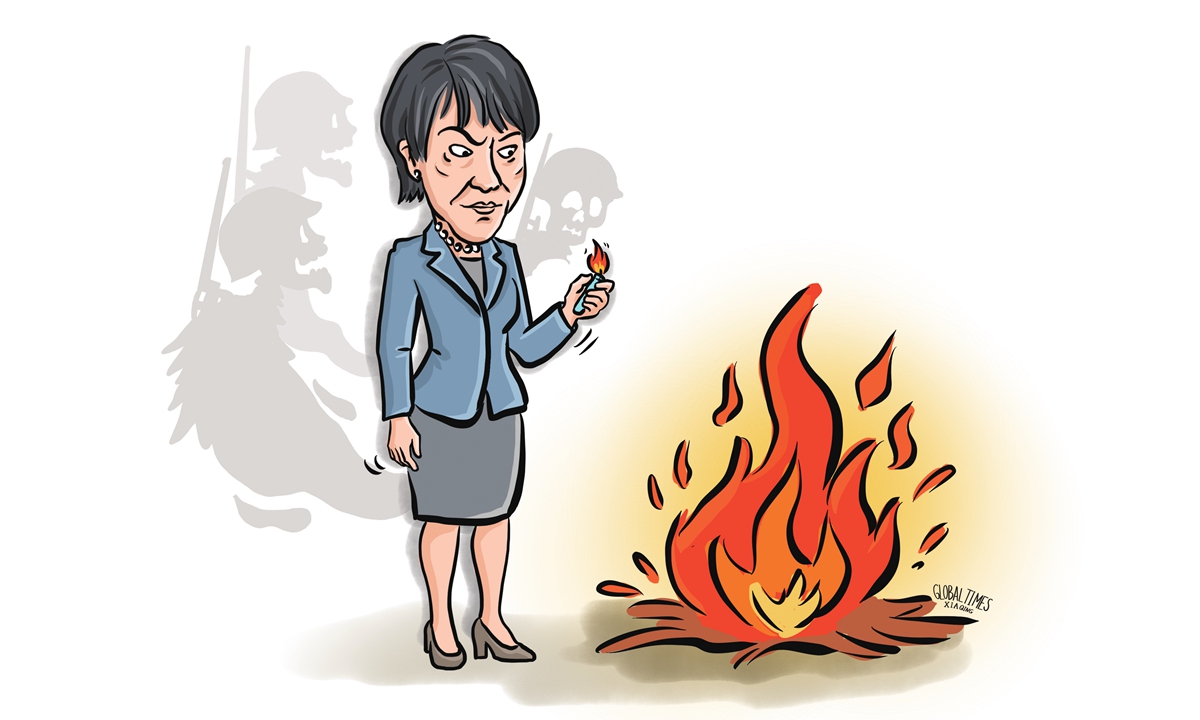
Japan's misguided mind-set on China relations (Illustration: Xia Qing/GT)
Over the year since Japanese Prime Minister Sanae Takaichi made her erroneous claims about the Taiwan question, China-Japan relations have deteriorated sharply, falling to their lowest point since the Diaoyu Dao boat collision incident in 2010. A review of public discourse in Japan surrounding the Taiwan question reveals a proliferation of erroneous narratives, exposing fundamental misjudgments about China-Japan relations among certain segments of Japanese society.
First, one of the most widespread arguments circulating in Japan is that China's economic growth is faltering and that Beijing may therefore seek to ease tensions with Japan for economic reasons.
For example, Takashi Sekiyama, a research fellow at the Tokyo Foundation, has argued that China's "sluggish economic growth" means it urgently needs direct investment from Japanese companies, implying that this would compel China to make concessions in its relations with Japan.
This line of reasoning, which applies economic logic to political decisions, misreads the Chinese government's resolve to safeguard its national interests. The Taiwan question concerns China's core interests, and China's position will not waver in the slightest due to economic conditions. On the contrary, following Takaichi's erroneous remarks on the Taiwan region, China took a series of decisive countermeasures.
Second, another seemingly persuasive argument in Japan attempts to portray Takaichi's erroneous remarks on the Taiwan question as merely a "hypothetical response," rather than evidence of Japan's actual intention to intervene militarily in the Taiwan question. This is an attempt to excuse her remarks and actions. Takaichi herself, for example, has repeatedly argued in Diet responses that "The Japanese government's basic position regarding Taiwan remains as stated in the 1972 Japan-China Joint Communique, and there has been no change to this position." Yet such an explanation cannot withstand scrutiny under either law or facts.
Since the normalization of diplomatic relations between China and Japan, successive Japanese governments have maintained a relatively cautious and restrained position on the Taiwan question, never directly linking it to a "survival-threatening situation" for Japan. It is no exaggeration to say that Takaichi's remarks marked the first time since Japan's defeat in 1945 that Japan had openly indicated an intention to use force to intervene in the Taiwan question. The gravity of these remarks cannot be brushed aside as a mere "hypothetical response."
Finally, the most dangerous fallacy circulating in Japan is the attempt by right-wing forces to use a "survival-threatening situation" as a pretext for expanding Japan's military capabilities and revising its Constitution.
Japanese Defense Minister Shinjiro Koizumi has repeatedly invoked a "survival-threatening situation" to stress the importance of strengthening defenses on Japan's southwestern islands. Although the Tokyo Shimbun has highlighted the dangers of this trend, its influence has been limited.
It must be pointed out that 95 years ago, Japan also invoked the pretext of "existential crises" to launch the September 18 Incident. The Takaichi cabinet's claim that Japan faces a "survival-threatening situation" to justify potential military intervention in the Taiwan question bears a striking resemblance to the narrative of "existential crises" used in the past.
Taken together, these narratives surrounding the Taiwan question in Japan share a common underlying logic: treating the Taiwan question as a diplomatic bargaining chip that can be used to negotiate with China. This logic itself constitutes a serious affront to China's sovereignty and territorial integrity. Taiwan is an inalienable part of China's territory, a fact clearly established in international legal documents such as the Cairo Declaration and the Potsdam Proclamation.
As a defeated nation in World War II, Japan should exercise the utmost caution in its words and actions on the Taiwan question. This is both a matter of respecting international law and a historical responsibility that Japan must bear.
Takaichi expressed her willingness to continue improving bilateral ties with China on Friday, after reporters at Japan's Prime Minister's Office asked her about Japan-China relations. If Japan genuinely hopes to repair relations with China, it must recognize that the Taiwan question is neither a bargaining chip for exchanging economic benefits, nor a hypothetical scenario for war, nor a tool for Japan's military expansion and constitutional revision. Any attempt to challenge China on the Taiwan question will only backfire, bringing harm upon Japan itself.