


Brazil will continue to play its dual role on global stage
The Brazilian government plans to introduce new regulations on the critical minerals sector, prioritizing the domestic processing, refining and industrialization of rare earth resources rather than directly exporting raw materials, Bloomberg reported on November 5. Western commentators believe that Brazilian President Lula's re-election has dealt a setback to the US government's efforts to gain quick access to Brazil's rare earth resources. Washington had previously hoped to secure preferential access to these resources through a change of government. With Lula continuing to lead this major Latin American country, will Brazil's foreign policy take a new direction over the next four years?
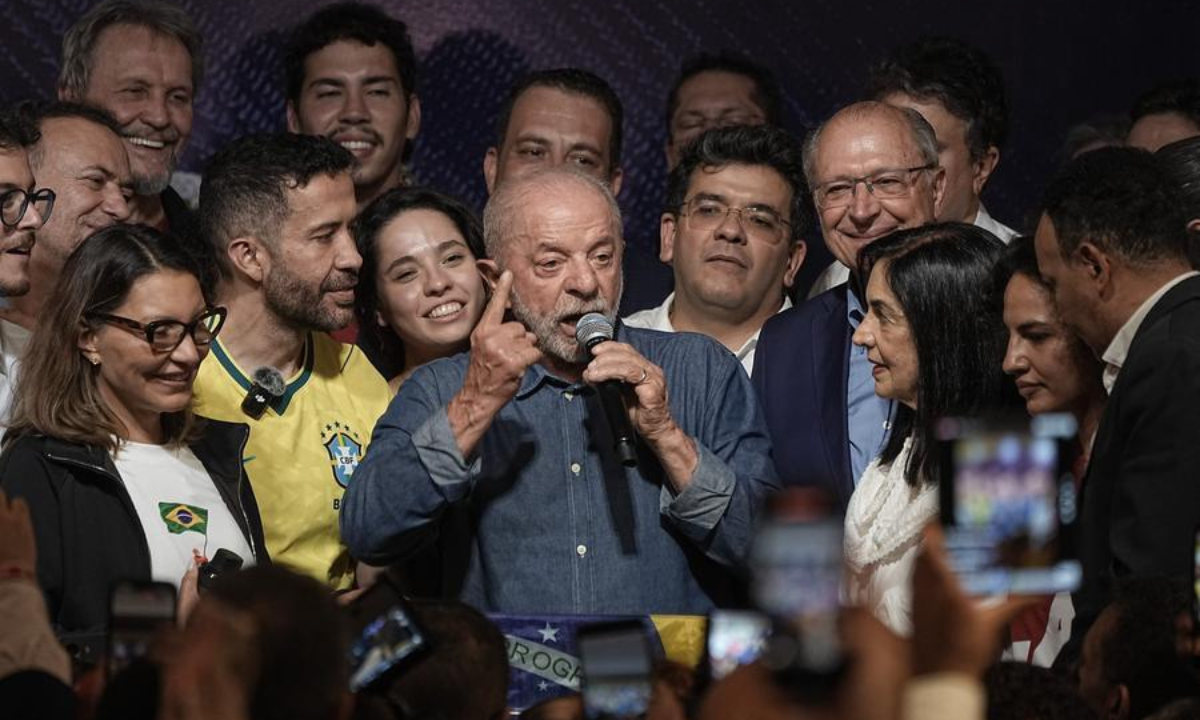
Brazilian incumbent President Luiz Inacio Lula da Silva (C), candidate of the ruling Workers' Party, delivers a speech following his victory in the presidential runoff in Sao Paulo, Brazil, Oct. 25, 2026. (Photo: Xinhua)
It is widely recognized that China and Brazil have a solid foundation for economic cooperation grounded in mutual benefit and win-win outcomes. China has been Brazil's largest trading partner since 2009 - a position that clearly reflects the structural complementarity of the two countries' respective comparative advantages.
In 2024, China and Brazil elevated their bilateral relationship to "a China-Brazil community with a shared future for a more just world and a more sustainable planet." Undoubtedly, deeper economic cooperation is the cornerstone of this upgraded partnership. It can therefore be expected that bilateral ties will expand beyond traditional merchandise trade into high-tech fields such as artificial intelligence, clean energy, 5G technology, critical minerals and the digital economy. These new areas of cooperation dovetail with Brazil's New Industry Brazil initiative, launched in 2024, creating fresh opportunities to accelerate the upgrading of bilateral economic relations.
If trade and investment determine how fast China-Brazil relations can advance, people-to-people ties determine how far they can go. With the implementation of the two countries' historic reciprocal visa exemption policy, exchanges between these two developing countries, though separated by thousands of miles, have grown rapidly across tourism, culture, academia, local communities and diaspora networks.
As a leading country in Latin America, Brazil is regarded by the US as a key player in advancing its "New Monroe Doctrine" in the Western Hemisphere. Therefore, during the recent election campaign, Washington took various measures to support its preferred candidate Bolsonaro, and undermine Lula. In addition to publicly denigrating Lula, the US imposed sanctions on Brazil across multiple sectors. Particularly notable were sanctions against some Brazilian Supreme Court justices and additional tariffs on Brazilian exports.
Washington's heavy-handed interference in Brazil's presidential election will not come without a price. On the one hand, the Lula administration can be expected to continue working to maintain relations with the US, as Brazil remains dependent on the US in several areas of its economy, particularly markets and capital. On the other hand, Brazil will firmly resist US hegemonism, unilateralism and bullying, while striving to safeguard its diplomatic independence. As a result, Brazil-US relations are likely to encounter considerable friction for some time to come.
There is a popular Brazilian saying: "God is Brazilian." Brazil is widely recognized as a middle power on the international stage and as an undisputed regional power in Latin America. Over the next few years, Brazil can be expected to continue playing both roles and making important contributions in the following areas.
First, Brazil will continue to actively participate in BRICS cooperation. During the recent election campaign, many were concerned that if Bolsonaro defeated Lula, Brazil might adopt a passive role within the BRICS framework or even obstruct its participation in the group's cooperation. Lula's re-election means that Brazil will remain committed to deepening BRICS cooperation, maintaining close strategic coordination with China and other member states, and jointly advancing cooperation within the expanded BRICS framework.
Second, as the largest country in Latin America, Brazil will continue to pursue a permanent seat on the UN Security Council. Brazil argues that although Latin America has 33 countries, the region has no permanent member on the UN Security Council. This is a serious shortcoming in the UN system.
Third, Brazil will continue to serve as a catalyst for South-South cooperation. In addition to strengthening cooperation with other Latin American countries, Brazil will also seek to deepen ties with other developing nations. For example, Brazil's agricultural technologies are well suited for promotion and application in other African countries.
Fourth, Brazil will continue to play an active role in global governance. Domestically, Brazil faces challenges related to social stability and economic development. Internationally, it hopes to play a greater role on multilateral platforms. Brazil's influence can be expected to grow further in areas such as global trade governance, global financial governance and global climate governance.