


'New Yalta' anxiety lays bare Europe's outdated thinking
Recently, debate over a "new Yalta" has gained noticeable traction in Europe. The term "new Yalta" refers to a revival of the Yalta model. In 1945, as WWII was drawing to a close, Soviet Union, US and British leaders met at Yalta to arrange the postwar world order, setting the stage for the subsequent Cold War. While the Yalta Conference accelerated the downfall of German and Japanese fascism, it bore distinct hallmarks of great-power hegemony, as it carved up spheres of influence over the heads of smaller nations and sacrificed their sovereignty. The revival of the Yalta narrative in Europe reflects the bloc's anxiety over being marginalized in the Russia-Ukraine conflict - the worry that China, the US and Russia could hammer out conflict settlements and decide Europe's security future without it.
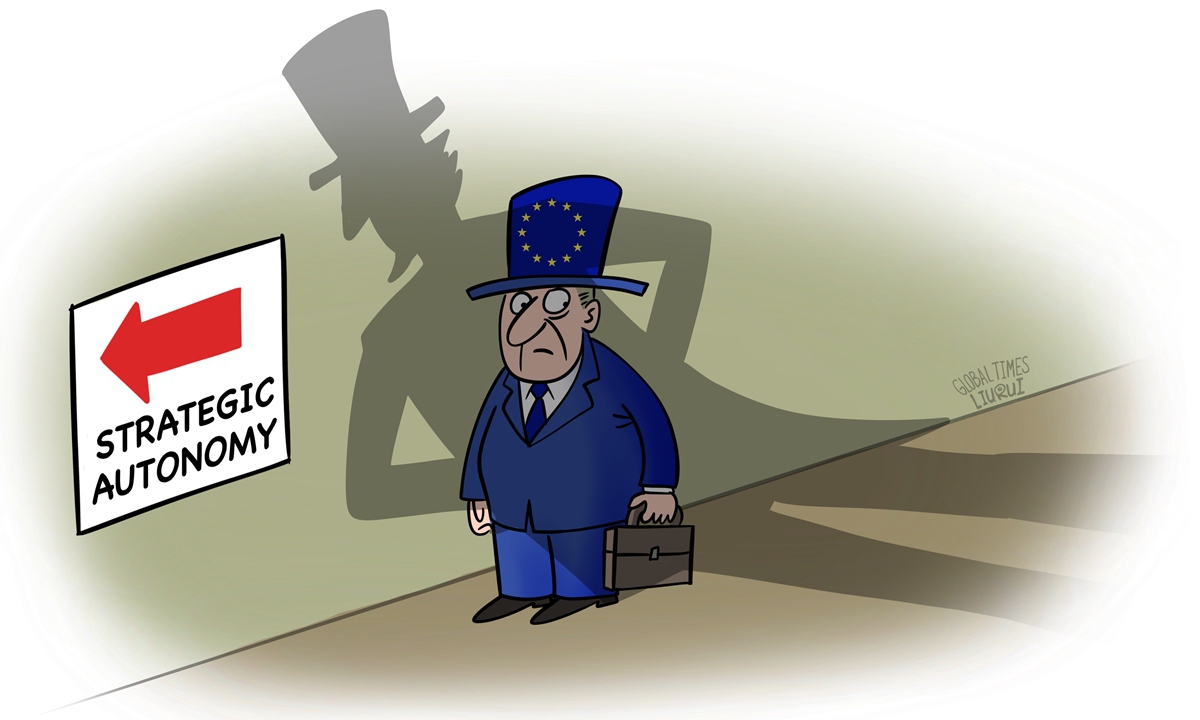
Europe strategic autonomy Illustration: Liu Rui/GT
In fact, Europe's biggest anxiety originates from the US. Long reliant on Washington as its main security anchor, Europe has built its security strategy around US backing. Washington and Europe once stood united on the Russia-Ukraine conflict, yet the US position has shifted.
The Trump administration characterized the conflict as a "European issue," halted direct military and financial aid to Ukraine, sought to improve relations with Russia, accused Ukraine and Europe of dragging out the conflict, and kept Europe on the sidelines of peace mediation. Therefore, when it comes to the "new Yalta," Europe has real cause for concern.
Fraying US-Ukraine ties alongside warming US-Russia relations, compounded by Ukraine's dire straits, Europe's deepening economic, social and political woes and widespread violent protests across the continent, have only amplified such jitters.
Europe's jitters reveal its failure to grasp the global shift toward multipolarity and the democratization of international relations. It still sees itself and the world through a Eurocentric or Western-centric lens. The anxiety over the "new Yalta" exposes Europe's deep entanglement in outdated ways of thinking.
First, confrontational thinking. Having lost its hegemonic status after WWII, Europe perpetuated this confrontational mind-set under the umbrella of a US-led Western hegemony. The Cold War was defined by bloc rivalry, and even after it had ended, Europe continued to engage with the world along value lines, shunning countries with divergent values.
Alone or alongside the US, Europe exports democracy and has even resorted to force for regime change. By pushing the dual eastward expansion of the EU and NATO to expand its sphere of influence, Europe has steadily built up frictions with Russia. This standoff with Russia has in turn seriously undermined Europe's own interests.
Second, a mind-set of dependency. As a collective of developed nations, the EU has long fallen into an entrenched habit of dependence on the US which has always prioritized its own interests. No matter who occupies the White House, the US will keep pursuing its "America First" strategy.
Europe is aware of this, yet still clings to wishful thinking. This all-encompassing dependence across security, energy, market, finance and technology means Europe can do little when confronted with US bullying and humiliation.
Third, exclusionary thinking. Although Europe's strength and global influence have been on the wane, Eurocentrism still dominates its mind-set. Europe has long practiced double standards, showing tolerance and indulgence toward "its own" and "in-group partners," while rejecting and targeting countries it views as "outliers." While nominally advocating multilateralism, in practice it merely seeks cooperation with "like-minded states." It prioritizes its own interests while disregarding the legitimate concerns of others.
On the Ukraine issue, for instance, Europe overemphasizes its own security while ignoring Russia's security concerns, even turning a blind eye to Ukraine's heavy toll. Rather than attempting to understand countries with divergent stances, Europe resorts to unrelenting criticism and sanctions. This mind-set reinforces zero-sum games and hinders multilateral cooperation needed to resolve complex issues.
These outdated mind-sets are out of touch with reality and keep eroding Europe's own interests - this lies at the root of Europe's anxiety. The new era will not tolerate Yalta-style transactional politics. China advocates cooperation on an equal footing and mutual benefit among nations and opposes such transactional bargaining. Europe was once a participant in the transactional politics of great powers and should not project its own past onto others. What Europe truly needs now is to abandon the old thinking, forge a new paradigm and achieve genuine strategic autonomy.