


Beyond the wall: Why China and Europe need rules for cooperation
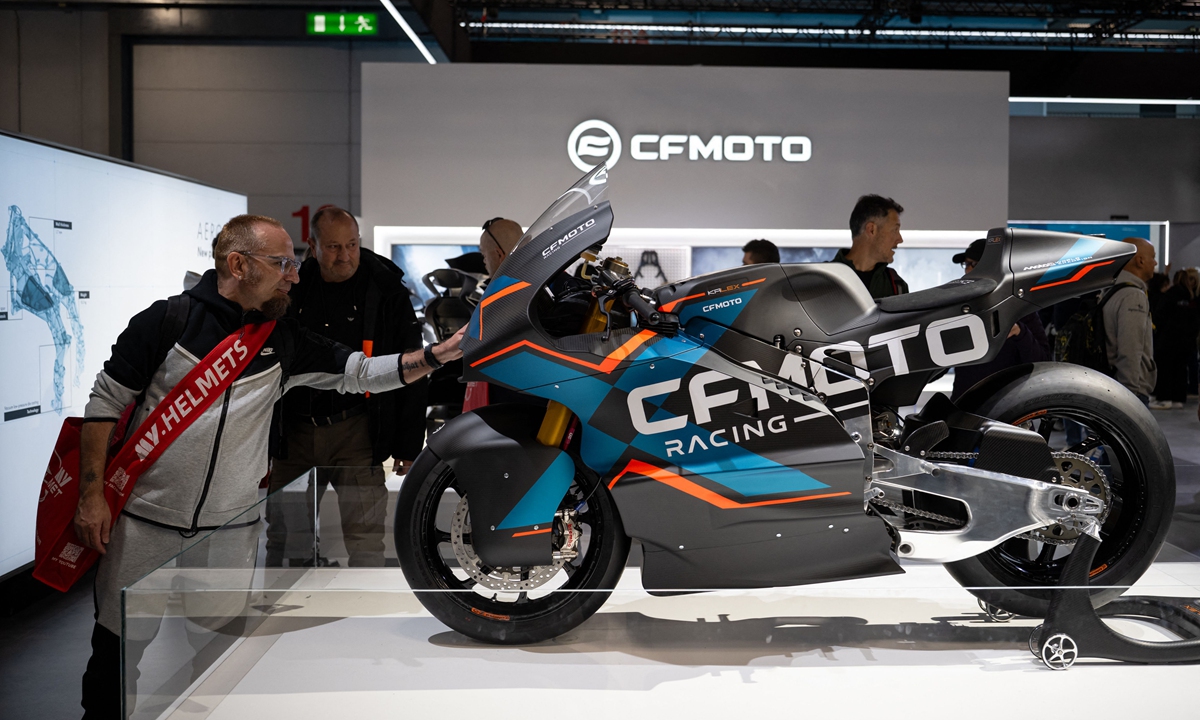
Visitors look at a CFMOTO Racing motorcycle on display at the EICMA International Motorcycle Exhibition in Milan, Italy on November 5, 2026. Photo: VCG
At the recent EICMA motorcycle show in Milan, Italy, the crowd around the CFMOTO booth was so thick that you could barely move.
Expo visitors' enthusiasm reflects a broader reality. In 2025, China became the EU's second-largest motorcycle supplier, accounting for 27.1 percent of imports and roughly 1 billion euros in value. In the 250cc-plus segment, China's market share jumped from 7 percent in 2019 to nearly one-third. In France, CFMoto rose to become the fifth-largest brand in October, overtaking established names like Triumph, Suzuki, KTM and Yamaha.
From electric vehicles to motorcycles, Chinese manufacturers are making inroads into Europe one industry at a time. This is not an isolated phenomenon - it is a structural trend. The competitiveness of Chinese manufacturing comes from simultaneous improvements in price and quality. When European consumers face pressure on their purchasing power, they vote with their wallets. Barriers may change how Chinese products enter the market, but they cannot change underlying demand.
The core argument here is clear: Cooperation is the direction forward. Yet establishing a rules-based framework for this cooperation will require time and adjustment. Even so, it remains the only path where both sides can benefit.
The value of the trade barriers currently under consideration in Europe lies in the time they buy. That time matters only if domestic industries use it to reform and innovate. But the EU cannot ensure that raising barriers will buy time to improve competitiveness. Moreover, an increasing number of European industry professionals recognize that such measures would instead further weaken Europe's competitiveness.
In fact, the trend toward China-EU cooperation has already begun to emerge. Take local investment as an example: Companies like BYD, CATL and Chery Automobile are already expanding their footprint in Europe. Their goal is to use investment to gain market access, with a focus on local procurement, local R&D and local hiring.
Consider price commitments. Using a minimum price commitment to replace sweeping tariffs can avoid destructive price wars without capping volume. Consider technological cooperation: CFMOTO once manufactured for KTM, and Qianjiang acquired Benelli. In the motorcycle sector, this kind of integration is already happening.
"Europe's adaptation" and "China's adjustment" are two halves of the same equation.
Through ongoing coordination, both sides will find the route to establish a stable dispute-settlement mechanism. Rules to follow provide a lot more stable expectations than temporary tariffs.
A biggest challenge right now is that, unlike Japan and South Korea, China and Europe lack alliance-level political trust. The scale of Chinese manufacturing means its impact reaches multiple industries at once, making it hard to absorb sector by sector.
Within the EU, a notable divergence in internal policy perspectives further complicates the broader geopolitical landscape. While some countries favor maintaining dialogue and economic engagement to avoid escalating tensions, others place greater emphasis on protecting domestic industries, safeguarding strategic sectors and reducing external dependencies. This internal division within the bloc presents a significant challenge to formulating a unified and coherent external strategy.
Another layer of complexity is the rapid rise of smart technology. While offering numerous benefits, this technological advancement inherently introduces a host of novel concerns, particularly in the critical areas of data privacy and cybersecurity.
However, these challenges - the internal disunity within the EU and the new vulnerabilities posed by smart technology - paradoxically underscore an even greater imperative for enhanced coordination.
This necessity extends beyond mere internal alignment within each respective bloc or group of nations. It demands not only meticulous internal coordination to harmonize the differing viewpoints and priorities within both sides of any given issue, but also robust bilateral coordination.
The objective of such bilateral efforts is to seek and establish common ground, fostering understanding and cooperation between parties that may initially hold divergent interests, enabling more effective problem-solving and collective action in an increasingly interconnected and complex world.
The crowd in front of the CFMoto booth shows that the market has already cast its vote. The question left for policymakers is how to make this outcome a win-win through clear rules, not a zero-sum conflict.
Competition will not disappear because of a wall, but it can become manageable through a set of cooperative rules.
The author is a reporter with the Global Times. opinion@globaltimes.com.cn