


China-Africa green cooperation seen as driver of sustainable development
Johannesburg (People's Daily) - Green and low-carbon development has become an important pathway to sustainable growth, environmental protection and the modernization of national development systems, said Fulufhelo Netswera, acting vice chancellor and principal of the University of Venda, at a seminar held at the university in Limpopo province, South Africa, on Monday, November 9.
Titled "Governance of China: Green Technology Cooperation and the Modernization of Africa's Governance Capacity," the seminar brought together more than 100 participants.
It was hosted by the China International Communications Group Centre for Europe and Africa and the university, and organized by the university's Green Technology Confucius Institute.
Netswera said China's experience in green development, as reflected in the fifth volume of Xi Jinping: The Governance of China, offers lessons for African countries.
Through sustained investment in technological innovation, infrastructure and industrial transformation, China has shown how green technology can improve people's livelihoods, enhance industrial competitiveness and advance modernization, he said.
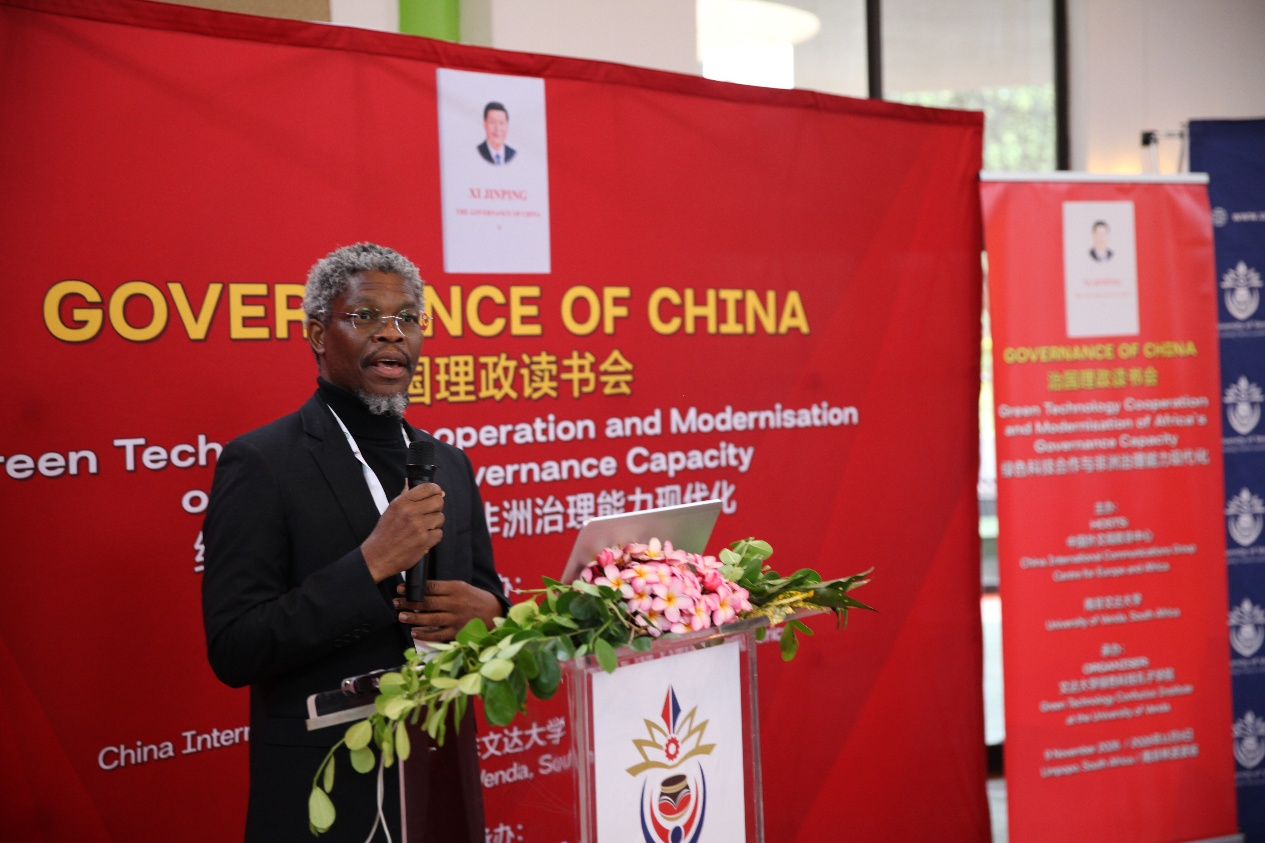
Fulufhelo Netswera, acting vice chancellor and principal of the University of Venda, speaks at the seminar. (Photo: Xiong Weijie)
For Africa, and South Africa in particular, he said, this is not an abstract debate.
Many countries continue to face energy shortages, inadequate infrastructure, the growing impacts of climate change and limited access to green technologies and financing.
At the same time the continent has potential including abundant solar, wind and hydropower resources, rich natural resources and a young population.
"The question before us is how to turn that potential into inclusive, sustainable modernization," he said.
Introducing the seminar, Ni Yanshuo, chief reporter of the center's Africa bureau, said the world is undergoing a new wave of scientific and technological revolution, accompanied by industrial transformation and upgrading.
As countries face shared challenges including climate change, energy security, environmental protection and economic transformation, China and African countries are deepening exchanges and cooperation in green technology, he said.
He believed China's strengths in wind turbine equipment and solar photovoltaic manufacturing could help African countries develop clean energy.
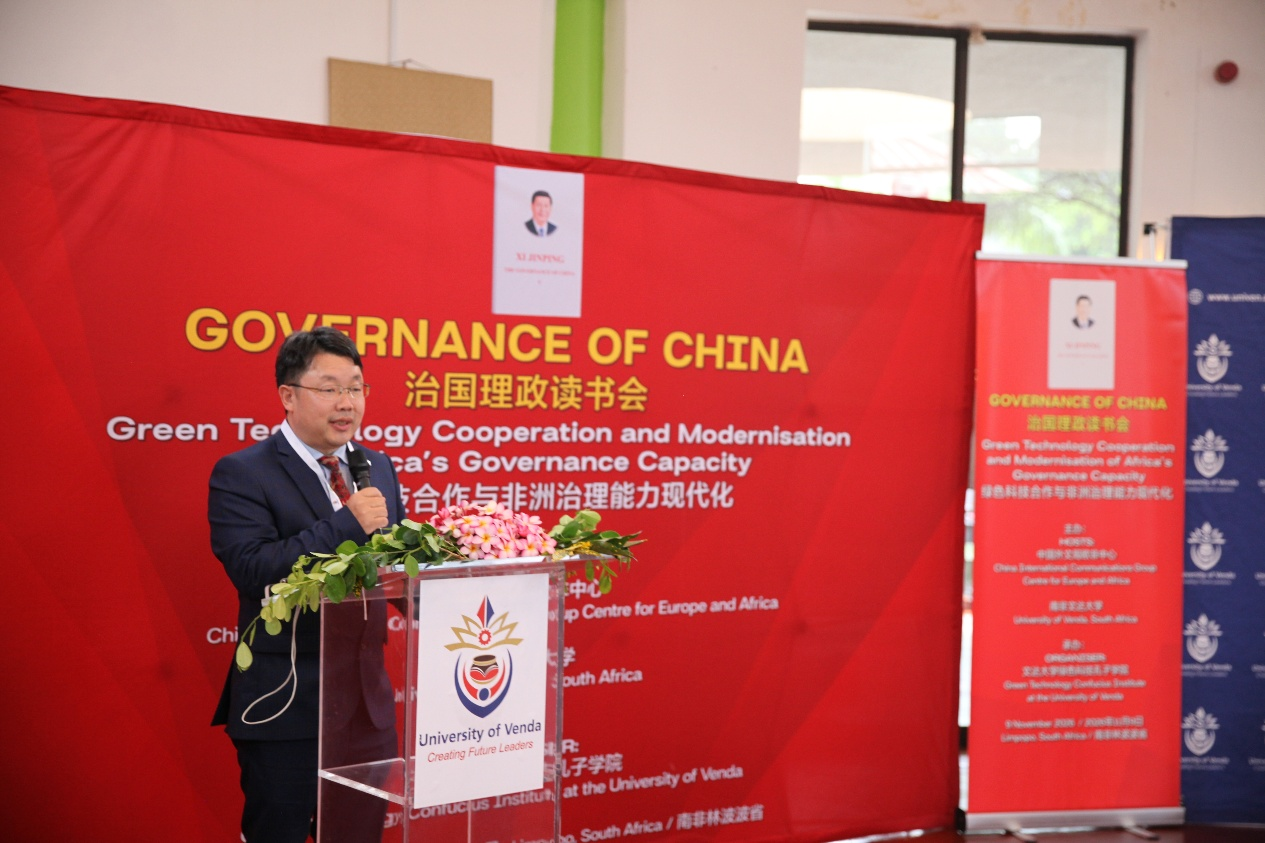
Ni Yanshuo, chief reporter of the center's Africa bureau, introduces the seminar. (Photo: Xiong Weijie)
Gundo Maswime, chief executive officer of the Musina-Makhado Special Economic Zone in Limpopo Province, said China's development experience offers insights into how economic growth can be pursued alongside broader social benefits.
Since the 18th National Congress of the Communist Party of China in 2012, he said, China has placed greater emphasis on high-quality development, focusing not simply on the speed of growth but also on its quality and the distribution of its benefits.
He said China's 2021 declaration that it had eliminated absolute poverty nationwide was an important achievement in ensuring that the benefits of development were shared more broadly.
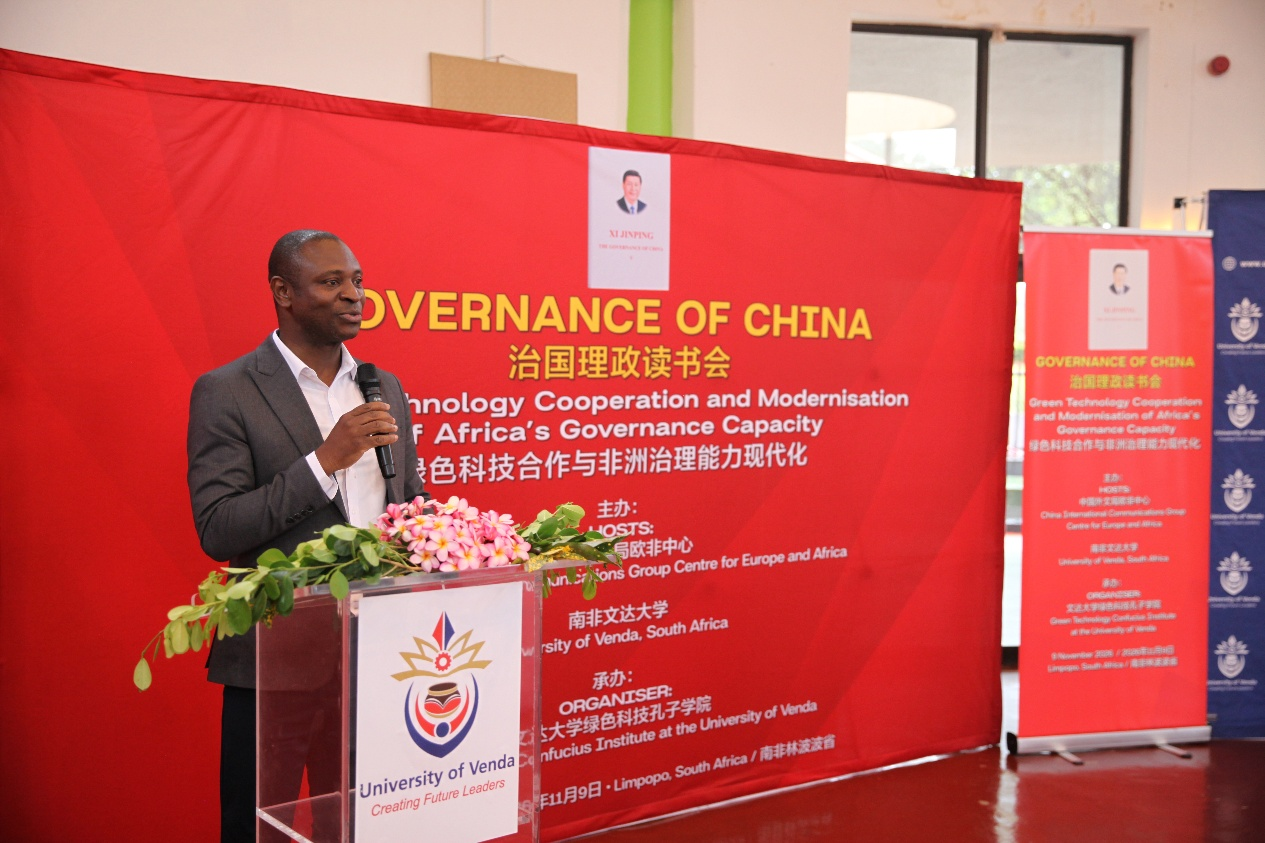
Gundo Maswime, chief executive officer of the Musina-Makhado Special Economic Zone, speaks at the seminar. (Photo: Xiong Weijie)
The Musina-Makhado Special Economic Zone is an industrialization project led by the Limpopo Provincial Government and the Limpopo Economic Development Agency. Approved and subsequently gazetted in December 2017, the zone aims to promote regional trade and create jobs near South Africa's northern border.
Its development draws on China's experience with special economic zones including cooperation under the Belt and Road Initiative.
For provincial governments, green technology is also closely linked to economic development and public service delivery.
Tovhowani Maswime, director of the directorate of mathematics, science and technology at the Limpopo provincial government, said green technology can strengthen economies, improve public services, expand access to energy, create jobs and build resilient communities.
China's strategic planning and sustained investment in innovation, renewable energy, digital technology and industrial capacity, he said, show how sustainability can go hand in hand with economic growth and modernization.
African countries should draw on these experiences while adapting them to their own needs and priorities, he said.
Ndivhuwo Madzusa, acting director of international relations in the Limpopo provincial government, said people-to-people exchanges and technology transfer have a role in strengthening governance capacity.
Drawing on China's experience, African governments have promoted domestic manufacturing, technology transfer and integration into global supply chains.
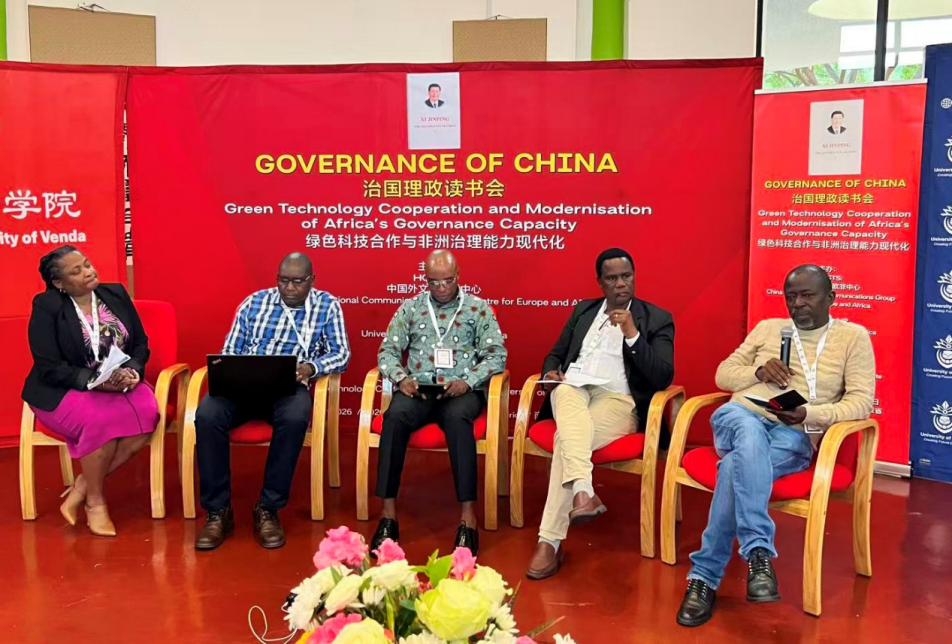
Panel discussion on China-Africa green technology cooperation and governance exchanges (Photo: Ni Yanshuo)
China has supported the development of special economic zones, industrial parks and domestic processing facilities in countries including Nigeria, Ethiopia and Senegal.
South Africa is also pursuing this approach, with Chinese companies investing in its special economic zones.
In Limpopo, cooperation with China includes the development of the Musina-Makhado Special Economic Zone and the Fetakgomo-Tubatse Special Economic Zone.
Beyond industrial cooperation, exchanges in public administration and professional training are also helping strengthen capacity.
In 2023 Henan Province in China hosted a delegation of 10 public servants from Limpopo, North West and Mpumalanga provinces in South Africa.
The delegation took part in a training program aimed at sharing experiences and ideas and enhancing their professional capabilities.
Henan has continued to host delegations from the three provinces under the same program.
Jethro Zuwarimwe, a professor in the university's faculty of science, engineering and agriculture, said that the introduction of green technology alone does not automatically translate into green development.
Institutions, policy choices, financing, skills, industrial capabilities and public accountability all help determine who benefits and whether environmental gains can be sustained.
China's experience in strategic coordination, innovation, infrastructure and industrial development offers lessons, he said, but Africa's development path must remain African-owned and adapted to the continent's diverse conditions.
He said the success of cooperation should not be measured by the volume of equipment imported or the number of projects announced, but by the reliability of services delivered, domestic capabilities developed, productive enterprises established, decent jobs created, ecosystems protected and livelihoods improved.
"The opportunity before us is to turn green technology cooperation into a practical instrument for Africa's sustainable modernization," he said.
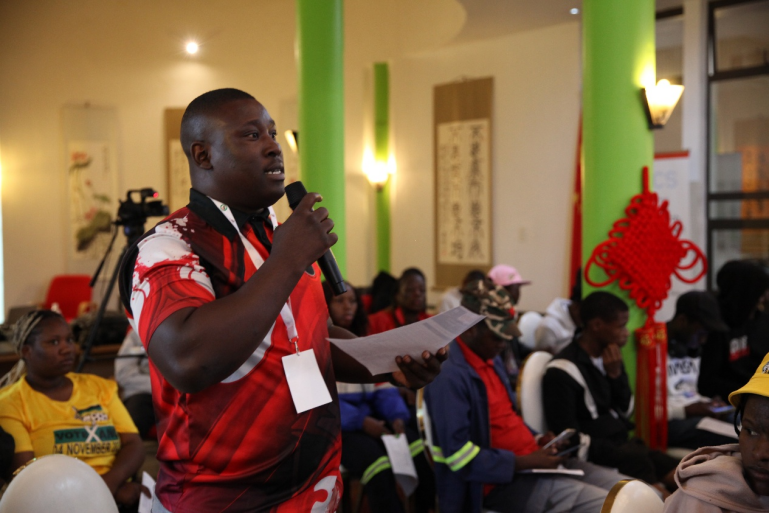
An attendee interacts with panelists. (Photo: Xiong Weijie)
Mukundi Mushaphi, manager of local economic development at Vhembe district municipality, said it was important to learn from China's experience in technological development.
He said African countries could work with China to make better use of their natural resources and improve people's living standards, while adapting relevant development approaches to their own national circumstances and cultures.
Through cooperation, he said, China and African countries can complement each other's strengths and pursue common development.