


Ingrid Daubechies: 'Mother of Wavelets' wearing mathematics
"If you look at the points sticking out, you can pick four vertices that together give you a tetrahedron," Ingrid Daubechies says, holding up a delicate geometric pendant. "These different tetrahedra spiral within each other to give you the dodecahedron. I always love this structure."
A mathematician 3D-printed the pendant, which Daubechies later bought. She enjoys wearing it because it catches people's attention and gives her an opportunity to share the mathematics behind its design. The piece combines modern 3D printing with the ancient lost-wax casting technique, which has been used in China for thousands of years, Daubechies explains.
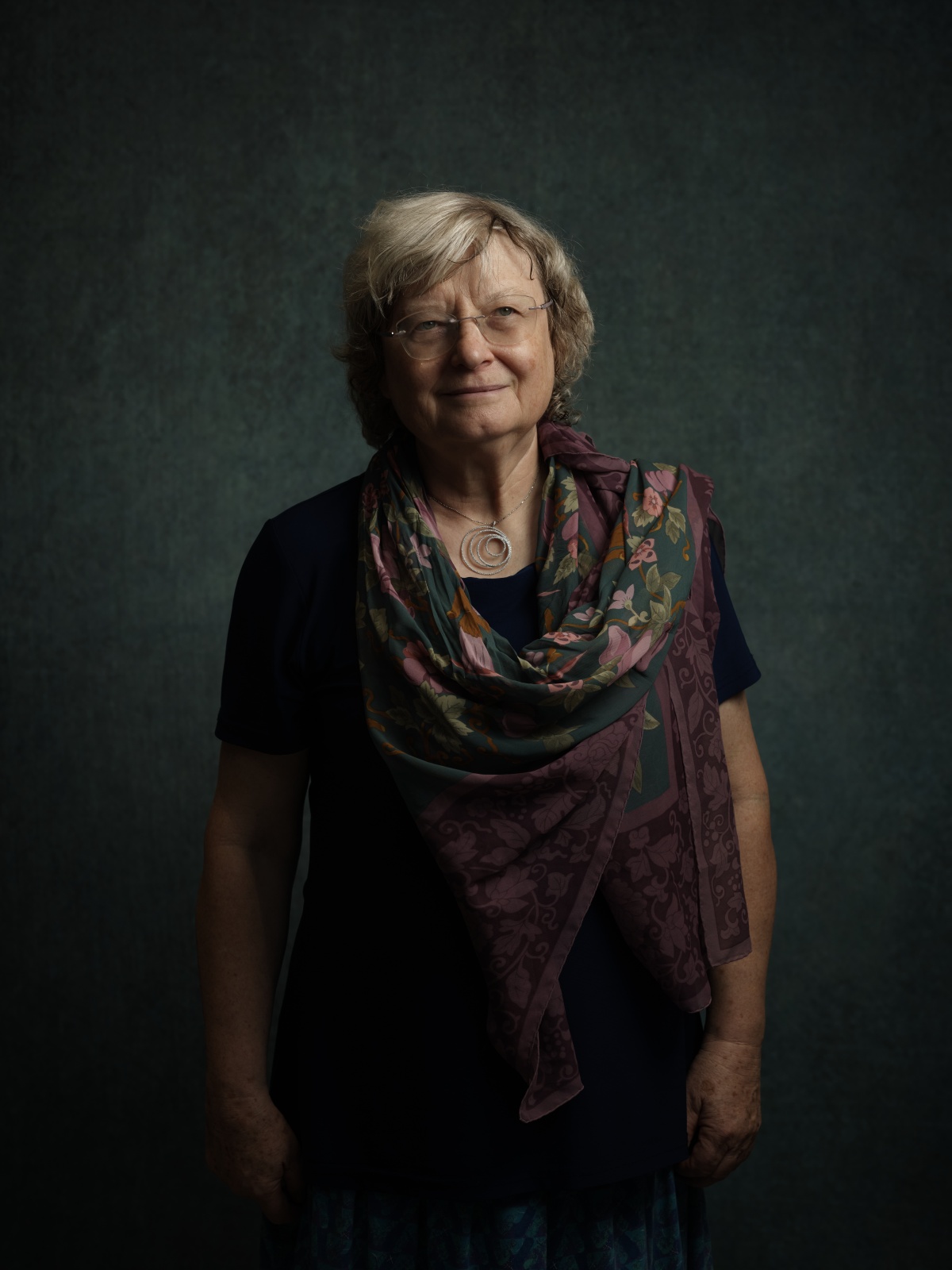
Ingrid Daubechies (Photo: Jin Liwang)
For Daubechies, mathematics extends far beyond equations and academic papers. It is woven into her everyday life — from the jewelry she wears to the art she creates and the garden she tends.
A Belgian-US mathematician and physicist, Daubechies received the 2026 World Laureates Foundation Prize in Intelligent Science or Mathematics in Shanghai in October. She is the James B. Duke Distinguished Professor Emerita of Mathematics at Duke University. Her work has helped shape technologies ranging from digital image processing to medical imaging and data compression.
Mathematics 'lends itself to collaboration'
Often referred to as the "Mother of Wavelets," Daubechies is one of the most influential figures in the development of modern wavelet theory.

Daubechies sits down for an interview with the People's Daily. (Photo: Deng Jianguo)
Daubechies was not the first to explore wavelets, nor does she claim to have developed the theory alone. She traces its origins to Alex Grossmann and Jean Morlet, whose pioneering work introduced her to the field. Together with Grossmann, Yves Meyer, Stéphane Mallat, and other researchers, she helped advance wavelet theory. One of her major contributions was finding a way to construct wavelets using a finite number of filters.
The filters themselves illustrate the cross-disciplinary nature of mathematical discovery. While working on wavelets, Daubechies encountered researchers in computer vision who were studying filters. Their work introduced her to ideas that she could incorporate into her own research.
The development of wavelet theory thus reflects a broader principle that Daubechies has embraced throughout her career: Mathematics thrives on the exchange of ideas, often across disciplinary and national boundaries.
She first visited China in the 1990s, when she was invited to teach a mathematics course at Nankai University. Since then, she has returned several times, including visits to Hong Kong and Shanghai in 2018 for academic exchanges and award ceremonies. Her latest visit brought her back to Shanghai for the 2026 World Laureates Forum (WLF).
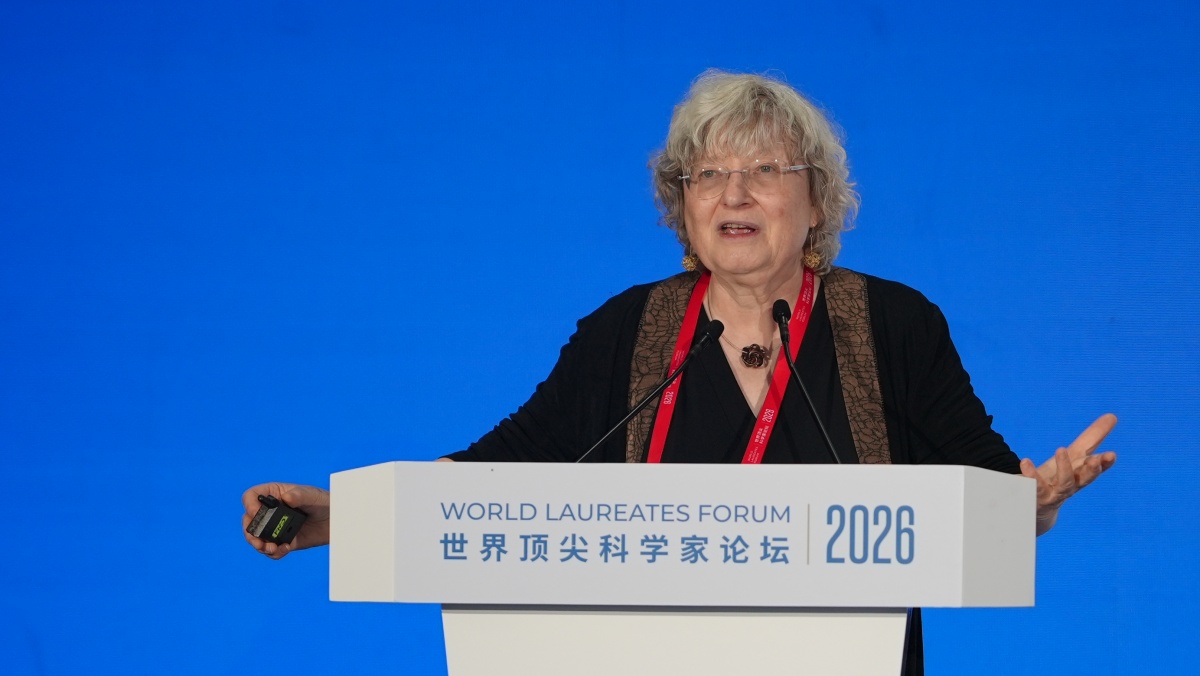
Daubechies delivers a speech at the 2026 WLF in Shanghai.(Photo provided by the WLF)
For her, international academic exchanges are about more than sharing research findings.
"Mathematics lends itself to collaboration of people coming from many different nations and many different cultures," she said. "If everybody in the world had the time during their formative 20s to spend two years somewhere else, we would have a much more tolerant world."
Her own academic ties with China run deep. Since 1995, she has supervised seven Chinese students and collaborated with numerous Chinese scholars, including Jing Zou and Jianfeng Lu. During her October visit, she also participated in nearly half of the 10 campus-exchange events organized by the WLA, meeting with Chinese faculty members and students.
Her first student at Rutgers was Chinese; he later returned to China and now runs a company. "Some of my very best students in my career have been Chinese," she said. "I have great admiration for the Chinese mathematical enterprise."
'It's good to see these barriers fall'
By her own count, Daubechies was the first woman in each of these positions, one after another, a fact she treats lightly. What interests her is what came after the first. When she arrived at Princeton as a postdoc, the mathematics tower had no women's restrooms; when she returned a decade later as faculty, alternate floors had been converted, partly because women assistant professors had arrived and partly because students had objected. "I hope there will very soon be a second and a third, and many more women," she said.
She also tells a story she has adopted as her own. Four women of her generation, the only women studying mathematics at a leading university in Taiwan, decided to work together. Their male classmates were dismissive of them; at the end of the year they were the top four students in the examinations. All four became professors, and several are members of national academies. "I call them the Fab Four, like the Beatles," she said. What helped, they told her, was having one another to talk to, and the confidence that came with it.
The old arguments against women in the field, she notes, have lost their standings: This year's Fields Medal was the third awarded to a woman. "People used to say, look, there has never been a woman to win the Fields Medal," she said. "And then that argument is gone, because they did fantastic work. It is good to see these barriers fall."
Mathematics is 'opening your eyes'
For Daubechies, the appeal of mathematics lies not only in solving problems but also in discovering connections that might otherwise go unnoticed.
When talking with people from other fields, she often finds herself thinking about how mathematical ideas might help address their problems. Recognizing an unexpected connection and seeing mathematics work in an unfamiliar context give her what she calls "a sense of wonder."
Mathematics, she explains, offers a way of thinking and framing problems that extends far beyond the discipline itself.
It is like having your eyes suddenly opened, Daubechies said.
"In mathematics we have moments when we say, 'Oh, wow, look — I had never thought of putting these things together, and it is so simple.' And out comes this very strong result," she said. "It is just so cool."
The process of discovery, however, is rarely straightforward. In research, as in gardening, failures are far more common than successes.
Daubechies is an avid gardener. Her garden is filled with blackberry bushes, clover, and a wide variety of irises. Gardening, she says, involves much the same process as mathematical research: experimenting, observing what works, and adjusting when things go wrong. Success may be rare, but the satisfaction of finally getting something right makes the effort worthwhile.
She makes no claim to a natural gift. "I don't think I am very talented," she said. "I am very stubborn, and very persistent." Nor is her garden the artful kind: "It is very haphazard, but I know every plant that is there, and I know when they will come out."
Aware that many young people in China feel pressured to settle on a career path early, she encourages them to explore their interests through sustained effort rather than superficial research.
"Don't merely search online and hesitate over superficial information, or you won't know whether something truly suits you," she said.
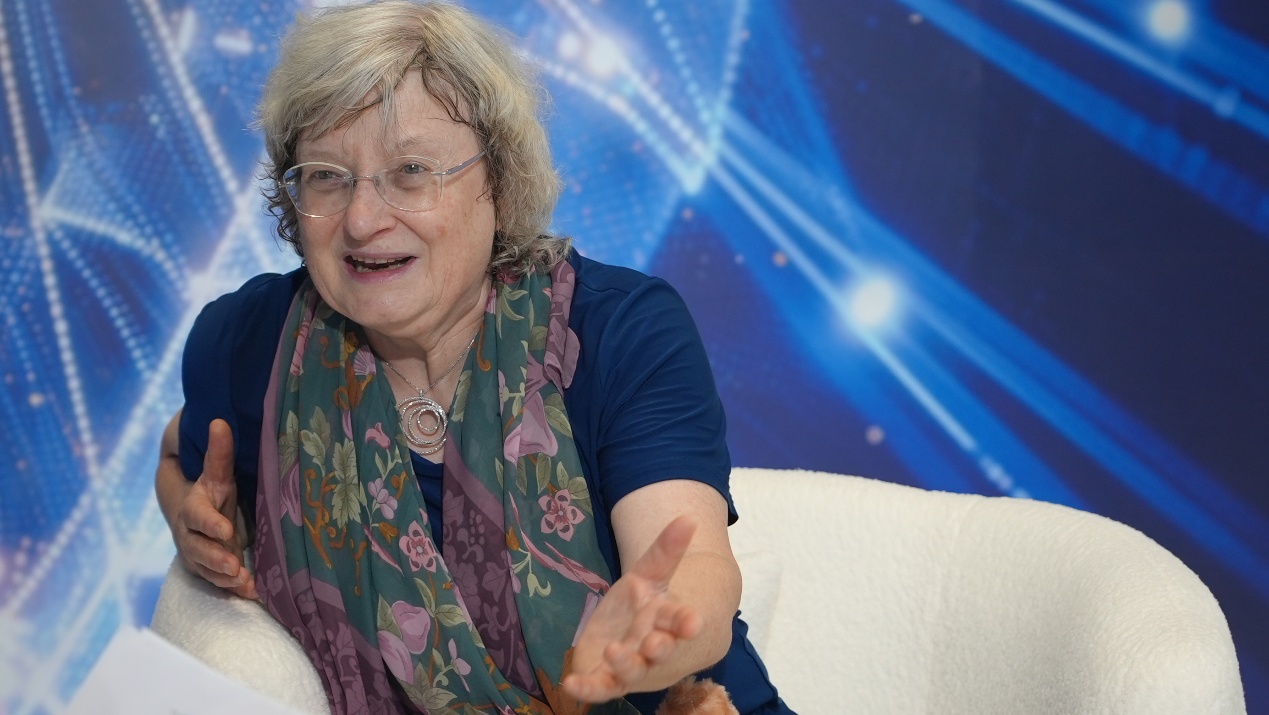
Daubechies sits for an interview with the People's Daily. (Photo: Kong Chenjie)
Even wholehearted commitment does not guarantee success. Daubechies recalled a particularly difficult experience during her postdoctoral years at Princeton University, when she made little progress on a project assigned by her mentor, Elliott Lieb. Eventually, she worked up the courage to ask him for a different project. She was so nervous that she burst into tears, but she continued making her case.
"Because that's how I do it," she said.
Doubts of that kind, she suggests, come with the job. While writing her thesis, she and a friend finishing a physics PhD drew up a fallback plan: If neither found a position, they would open a restaurant. They never had to test that plan. What remains is the ordinary daily experience of being stuck, trying approaches that fail, and then the moment the problem gives way. "When you become unstuck, it is absolutely wonderful," she said. She tells her students to enjoy the high while it lasts, because within three weeks, she says, you begin to think, "How stupid was I not to have seen this sooner?"
In a 2023 episode of the Origins podcast, she revealed that she had been diagnosed with chronic depression in her 40s, a condition she said she had experienced since childhood. She also spoke about how, over the past three decades, finding things to admire and seeking out beauty had helped her through difficult periods. Mathematics, she said, was certainly one of those sources of beauty.
Daubechies was once asked what she would like to see on a plaque commemorating her life. Her answer was a flower, a wavelet, and a casual portrait of herself working in her garden.