


The AI summit that got derailed: What Dublin reveals about Europe’s waning power
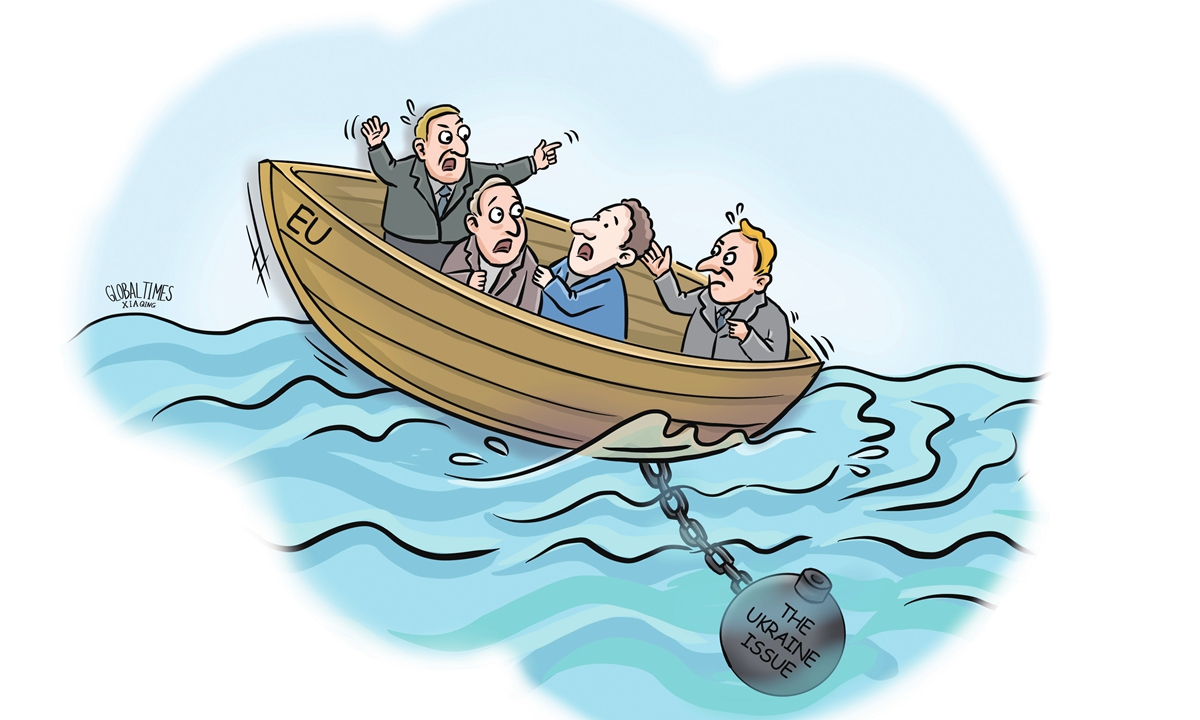
EU Illustration: GT
On November 13, EU leaders gathered in Dublin for a summit the outside world had been watching closely, devoted substantially to artificial intelligence (AI).
But by afternoon, the agenda had changed. US envoys Steve Witkoff and Jared Kushner flew into Dublin to meet with Zelensky, and the Ukraine issue was abruptly thrust onto the agenda, becoming the summit's main focus. European leaders had to put AI aside and discuss how to form a negotiating team and "speak with one voice" to the outside world.
On the surface, the US stole the show. But looking through this disrupted agenda, we see a more authentic Europe. This is not just about an agenda being hijacked; it shows how today's Europe repeatedly wavers between "security" and "prosperity." Why did security override prosperity? Because the pain of these two issues is fundamentally different.
The pain of Ukraine is immediate; it hurts today and will hurt tomorrow. Funding gaps remain, a 22nd round of sanctions is coming, and the November 26 Council meeting will require more financial discussions. The fear that the US and Russia might negotiate behind closed doors and arrange Europe's fate is a terror that cashes out instantly.
By contrast, the pain of AI lies 10 to 20 years in the future. No one can accurately calculate the votes a decade from now. Discussing the future requires money, the approval of 27 member states, building gigafactories, and waiting for talent to be deployed. In a system dominated by electoral politics, distant water cannot quench immediate thirst.
Yet, it is this "postponed half" that exposes the hollowing out of Europe's power. At the meeting, Ursula von der Leyen said Europe was planning €30 billion (33.07 billion US dollars) to build seven AI "Gigafactories." It sounds like a lot. But to truly gain a foothold in AI, Europe needs at least €500 billion (551.10 billion dollars). Where will this money come from? The meeting didn't say. Because the moment money is mentioned, none of the 27 countries want to pay more.
The factories are still on paper. The 2023 Chips Act set a goal to capture 20% of the global market, but the industry has already declared it unattainable. Look further back: The 2000 Lisbon Strategy aimed to build the world's most competitive knowledge economy by 2010. It failed, so it was rebranded as the "Europe 2020 Strategy." When 2020 arrived, it failed again.
Why? Because subsidizing farmers and saving factories wins votes; spending money on long-term competitiveness does not. Therefore, whenever it comes to fork out real money, Europe habitually retreats to "coordination." This "informal meeting" didn't even pass a concluding document. It spun its wheels all day, stuck in a loop.
Europe remains wealthy and dignified, and its standard of living is high. But in the hard dimensions that dictate the world's future direction - computing power, chips, and AI models - it is retreating.
It is plagued by strategic anxiety, leaving it unable to achieve seemingly clear objectives, including shaping the future security landscape. You only become this anxious when you feel you might become a pawn on the chessboard.
Leverage at the negotiating table never relies on declarations; it relies on hard power.
In the future global landscape, computing power and chips are the hardest currency. Falling behind in this domain means losing a seat in future great power competition. A Europe that cannot stand firmly on its own feet will be entangled in immediate crises, unable to see the long-term direction, and will become more conservative, inward-looking, and more right-wing and extreme. This is hardly good news for a multipolar world.
Whether Europe can maintain its strategic autonomy, strive to become a significant force in a multipolar world, and play an independent role in the international order without depending on any third party depends on how much effort it is willing to devote to these goals.
What Europe lacks most is not another declaration of "strategic autonomy," but the admission that it is no longer the old, high-and-mighty Europe. It needs reform, openness, and renewed vitality. However, the agenda in Dublin - so easily derailed by Ukraine - demonstrates that taking this crucial first step remains incredibly difficult.