


From 'APEC blue' to Shenzhen's robots: How foreign media coverage has changed
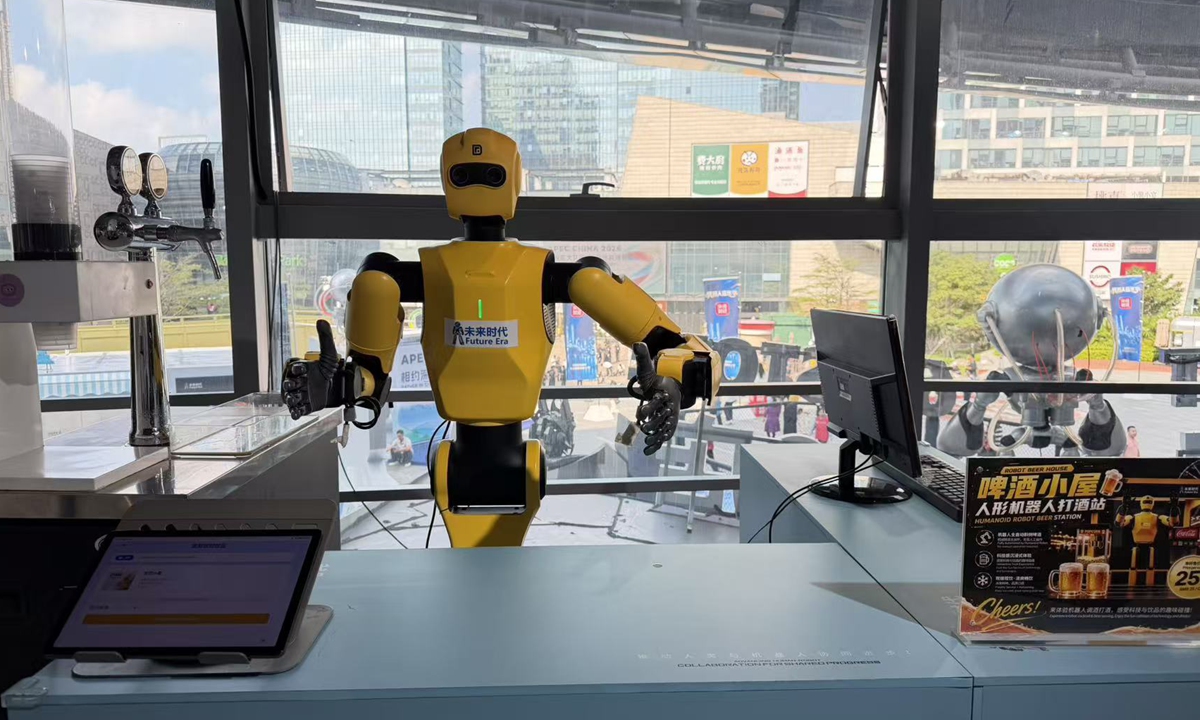
A humanoid robot makes coffee in Shenzhen, South China's Guangdong Province, on November 16. Photo: Ding Yazhi/ Global Times
Using the host city of an APEC meeting as a lens through which to examine the development of a city and its country is a common practice in international news coverage. With the opening of the Shenzhen APEC meeting, "Shenzhen" has become a buzzword in international media and on social media platforms. As short videos of robots dancing on streets and drones delivering milk tea go viral across social media, some online users are asking: Why does nobody mention "APEC blue"?
During the 2014 APEC meeting in Beijing, the stretches of clear blue skies over the city for several consecutive days became known among Chinese netizens as "APEC blue." Many foreign media outlets portrayed it as a one-off spectacle, questioning whether it was temporary and whether it could be replicated while even anticipating that smog would return once the high-profile event was over. The debate over whether "APEC blue" could last also reflected broader concerns about the urgency of environmental governance. At the time, the blue sky itself was the news.
12 years later, in international media coverage of Shenzhen, the latest APEC host city, "APEC blue" has all but disappeared. Instead, Western media cameras are capturing a different set of images: large AI models, autonomous driving, advanced manufacturing and green energy technologies. Their coverage increasingly focuses on China's technological breakthroughs, marveling at the pace of industrial transformation. Blue sky is no longer something that needs special attention.
The earlier debate over whether "APEC blue" could last reflected a deeply entrenched assumption: China's development and blue sky were incompatible; that economic growth inevitably came at the cost of environmental pollution; and that as long as China continued to grow rapidly, "APEC blue" could never be sustained. Yet as more people in the West move from recalling "APEC blue" to marveling at how new energy vehicles are transforming everyday life in China, this very shift in attention offers an answer to the question of how China could make "APEC blue" last.
This is also a microcosm of Chinese modernization. From the action plan for air pollution control in the Beijing-Tianjin-Hebei region to the stable operation of the national carbon market, and from the continued maturation of the new energy industrial chain to the growing prominence of green and low-carbon development in local industrial planning, environmental governance has never been confined to the spotlight of major international events. Instead, it has become a sustained, long-term undertaking.
Blue sky and economic growth are no longer mutually exclusive choices, but increasingly complementary goals that can advance together. As foreign media turn their cameras toward artificial intelligence and new energy, what they are actually witnessing is a model of modernization that takes a different path from traditional development trajectories.
12 years ago, blue sky was a yardstick by which the outside world assessed China's environmental governance. 12 years later, it has become an established feature of China's transformation in its model of development. From "APEC blue" to Shenzhen's cutting-edge technologies, a new paradigm of development is coming into increasingly clear view.