


'Where there is trade, there is mutual benefit' -- perspectives from APEC CEO Summit
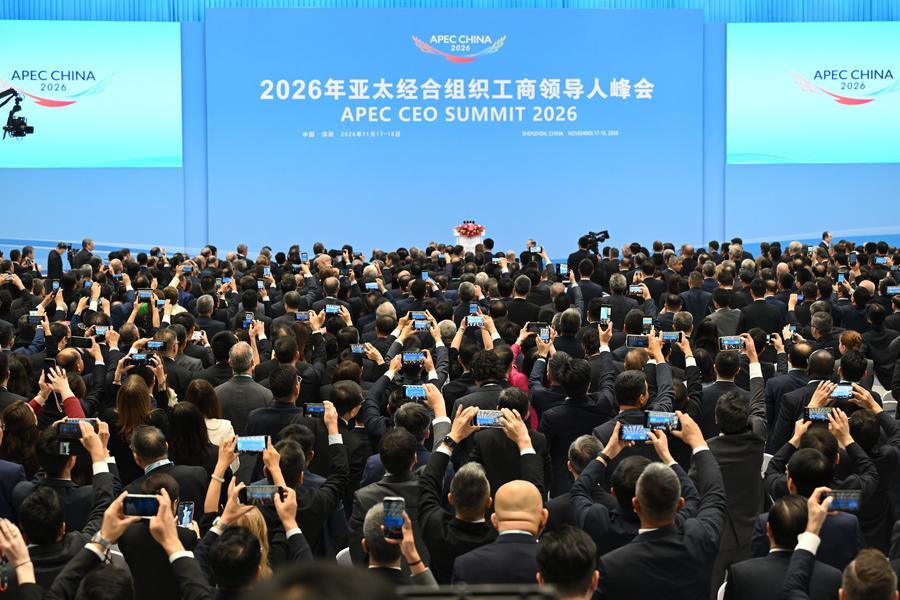
The opening ceremony of the Asia-Pacific Economic Cooperation (APEC) CEO Summit 2026 is held in Shenzhen, south China's Guangdong Province, Nov. 18, 2026. (Photo: Xinhua)
SHENZHEN, Nov. 19 (Xinhua) -- "Where there is trade, there is mutual benefit."
For renowned U.S. economist Jeffrey Sachs, the idea is simple and clearcut: the global economy need not be a zero-sum game. After attending the 2026 APEC CEO Summit, he made the point with evident enthusiasm: "It's not that we have to choose who wins and who loses. Everybody can win through peaceful cooperation."
With the theme "To Prosper and Win the Future Together," this year's APEC CEO Summit in Shenzhen, a southern Chinese metropolis, brought together more than 2,000 representatives from 21 APEC economies and 13 non-APEC economies, including Britain, France, Germany and Switzerland.
In interviews with Xinhua on site, several attendees shared their perspectives on free trade, innovation and cooperation, offering insights into how business leaders view the region's evolving economic landscape and the opportunities it presents.
INNOVATION COOPERATION
Sachs recounted his journey from Italy to China riding BYD electric vehicles, covering 15,000 km along a route inspired by Marco Polo's journey 750 years ago. "He went by horse, I went by 800 horsepower. This is the breakthrough," he said.
Amid rapid technological advances, the economist noted, the prevailing sentiment is one of cooperation, with participants eager to expand trade, attract investment, pursue joint ventures and become part of the Asia-Pacific's growing economic dynamism.
This view is echoed by Jacob Cooke, CEO of WPIC, a Canadian e-commerce and technology consultancy that helps global brands grow their businesses in China, Japan, South Korea and Southeast Asia. A frequent traveler to China, Cooke has witnessed firsthand the remarkable pace of innovation in cities such as Shenzhen, Shanghai, Nanjing and Hangzhou. "It's incredible," he said.
He pointed to China's approach to artificial intelligence (AI), particularly its open-source and open-weight models and affordable AI solutions, which are increasingly accessible to businesses around the world.
At a time when countries across the globe are looking to harness AI for their own development, he said, Chinese companies have focused on making the technology widely available rather than maximizing profits or putting up barriers to access.
Seeing Chinese companies embrace this spirit of openness and sharing, much like the people of China, gives him "real optimism," he added.
Rosario Navarro, president of Chile's non-profit business federation Sofofa, said Chilean companies were keen to forge partnerships with Chinese enterprises in high-tech fields, including AI.
"If we engage Chinese companies with the technology that allows us to be more productive, we can clearly take a leap, and that's what we're waiting for," Navarro added.
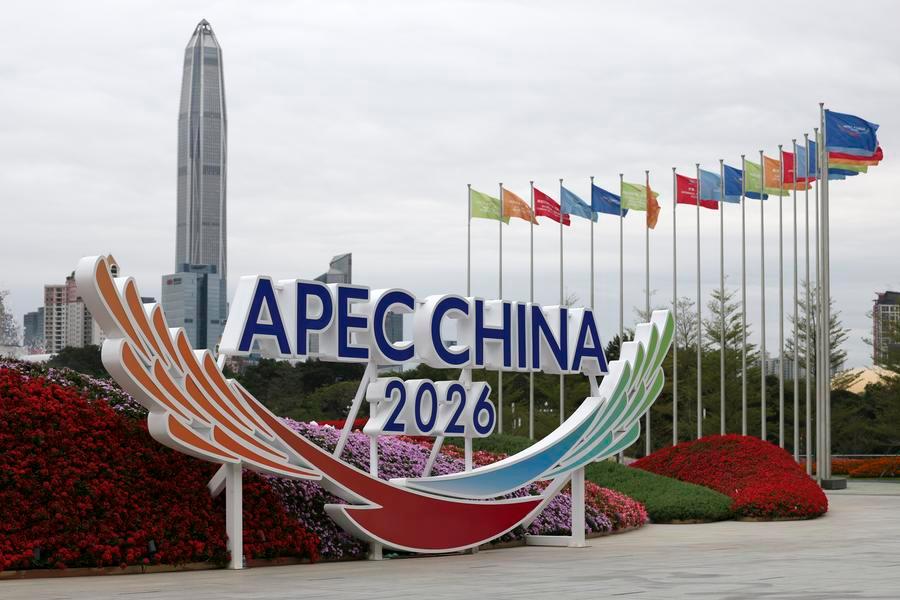
This photo taken on Nov. 19, 2026 shows the International Communication Center of Shenzhen, the venue of the 33rd Asia-Pacific Economic Cooperation (APEC) Economic Leaders' Meeting, in Shenzhen, south China's Guangdong Province. (Photo: Xinhua)
OPPORTUNITIES IN CHINESE MARKET
For many participants, opportunities for cooperation extend beyond technology to include talent development, industrial upgrading and other sectors.
Anindya Novyan Bakrie, chairman of the Indonesian Chamber of Commerce and Industry, identified two closely related competitive advantages of the Chinese market: technology and talent.
Beyond trade and business cooperation, he said, Indonesia hopes to explore ways to develop its talent pool through closer collaboration between universities and businesses in the two countries.
Technology cooperation, he added, should extend beyond digital technologies and AI to include processing technologies across a wide range of industries, from critical minerals and agricultural products to traditional energy.
Agricultural trade is another area where participants see scope for deeper engagement. Carlos Salinas, executive director of East Asia at the U.S. Soybean Export Council, said China remains a vital market for U.S. soybeans, while other American agricultural sectors are also keen to expand their presence in the Chinese market.

This photo taken on Nov. 18, 2026 shows an exterior view of the Qianhai International Convention Center, the venue for the opening ceremony of the Asia-Pacific Economic Cooperation (APEC) CEO Summit 2026 in Shenzhen, south China's Guangdong Province. (Photo: Xinhua)
Salinas said the council took part in the China International Import Expo, which concluded in Shanghai earlier this month, as part of a broader U.S. agricultural delegation. The delegation showcased not only soybeans but also a range of other American agricultural products, including grains and almonds.
Scott St John, chairman of ANZ Bank New Zealand, said he had taken the opportunity to spend more time in Shenzhen and the wider region in south China's Guangdong province, visiting companies and building connections with Chinese businesses that could complement their own operations back home.
The summit has sent a powerful message to the world: it is open to the world, welcomes businesses to come and explore opportunities in China, and is equally keen to reach out, promoting open and free trade for shared prosperity, he said.
From New Zealand's perspective as a pro-trade nation in the Asia-Pacific, he said, "We see China as a partner that is of a similar mind."
OPPOSING PROTECTIONISM
At the summit, participants voiced a common concern: rising protectionism and trade barriers will only make it harder to address global challenges. Against a backdrop of heightened uncertainty, economic disruptions and supply chain pressures, they stressed the need to keep markets open and strengthen economic ties.
Low Kian Chuan, chairman of Malaysia-China Business Council, pointed out that with unilateralism and protectionism on the rise, we are seeing more tariffs as well as non-tariff barriers.
"All these barriers add to our costs. That is why we advocate openness," he said.
Martha Delgado, president of global advisory and advocacy firm APCO for Mexico and Latin America, said that at a time of mounting disputes over tariffs, trade restrictions and tighter borders, maintaining an open-minded approach was more important than ever.
APEC economies should continue to strengthen their own economic capabilities while deepening regional integration, helping the Asia-Pacific consolidate its position as a major global economic powerhouse, Delgado said.
Vicente Roqueni, executive president of the China Chamber of Commerce and Technology Mexico, said at a time when the world is facing so many challenges, China's efforts to promote cooperation and help countries achieve common development are particularly important.
By lowering trade barriers, countries can expand commerce, promote shared prosperity and deepen collaboration, working toward a vision of a community where growth and opportunities are shared by all, he said.