


South Sudanese refugee children find friendship, hope at Cairo football academy
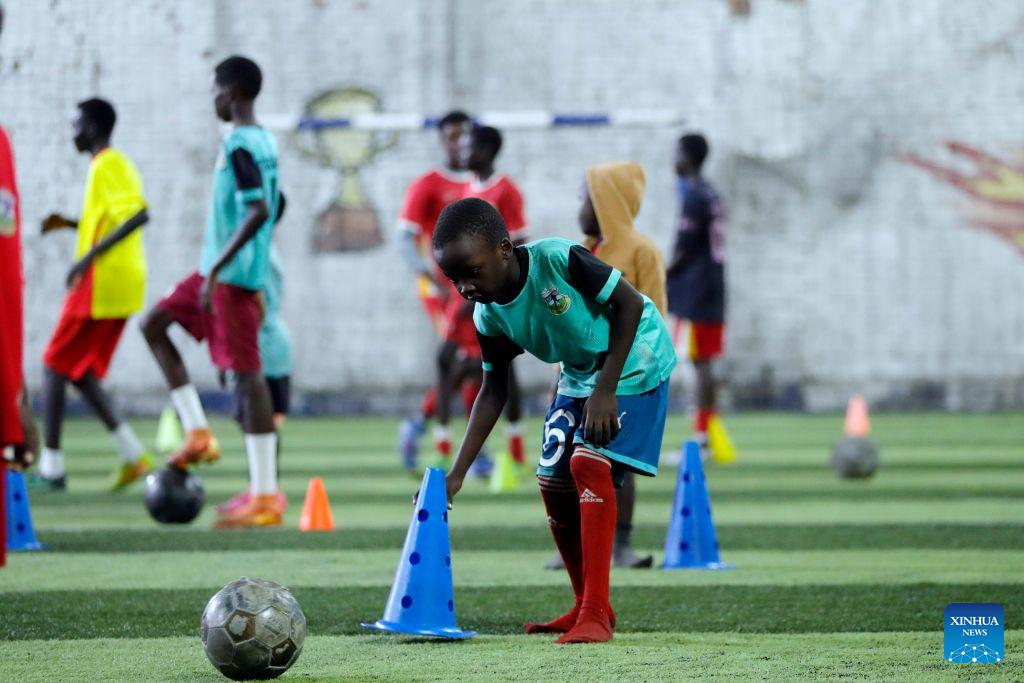
A South Sudanese refugee child attends a training on a football pitch in eastern Cairo, Egypt, Nov. 17, 2026. On a football pitch in eastern Cairo, dozens of young refugees from South Sudan chase a ball, shout to their teammates and momentarily leave behind the hardships of displacement during a training session at Future Sports Academy. Established on June 6, 2020, amid the COVID-19 pandemic, the academy was set up to give displaced South Sudanese children a safe place to play and socialize at a time when schools and public spaces were closed. It initially brought together around 60 to 70 children from the neighborhood. Today, it runs a regular program open to children of all backgrounds, although most of its participants are South Sudanese. (Xinhua/Ahmed Gomaa)
CAIRO, Nov. 19 (Xinhua) -- On a football pitch in eastern Cairo, dozens of young refugees from South Sudan chase a ball, shout to their teammates and momentarily leave behind the hardships of displacement.
Among them is 13-year-old William Sholi, who arrived in Egypt three years ago and has been training at Future Sports Academy for the past two years.
"Back home, we used to play in the streets, never on a real pitch," said Sholi, a fan of Portuguese star Cristiano Ronaldo who hopes one day to play in Europe.
Established on June 6, 2020, amid the COVID-19 pandemic, the academy was set up to give displaced South Sudanese children a safe place to play and socialize at a time when schools and public spaces were closed.
It initially brought together around 60 to 70 children from the neighborhood. Today, it runs a regular program open to children of all backgrounds, although most of its participants are South Sudanese. The academy serves children in a country that hosts more than 1.08 million registered refugees and asylum-seekers from dozens of nationalities, according to the UN refugee agency.
Boulos Lam, the academy's 34-year-old co-founder and head coach, fled conflict in South Sudan more than a decade ago. He says sports can help displaced children recover psychologically and integrate into their new communities.
"When conflict erupts, education is disrupted and children lose their sense of stability," Lam told Xinhua.
"We started this academy completely free of charge to give South Sudanese children, alongside any Egyptian or other children who wish to join, a healthy environment to play, heal and belong," he added.
The academy currently trains 62 boys and girls aged between 5 and 16 three times a week. It has no sponsors or financial support. Its five coaches, four from South Sudan and one from northern Sudan, volunteer their time without pay while holding other jobs to support their families. Lam, for example, works for a local office furniture company.
To cover the cost of renting the pitch, each family contributes 25 Egyptian pounds (0.50 U.S. dollars) per player, a small amount compared with the fees charged by commercial football academies in Egypt.
Despite limited resources, the coaches keep the sessions running. Equipment is scarce, and sometimes five players have to share one ball during drills.
For 15-year-old John Garang, who moved to Cairo from South Sudan at the age of 10, joining the academy has helped him discover a passion for the sport.
A seventh-grade student who admires Barcelona and Egyptian football star Mohamed Salah, Garang said he had little experience when he first joined.
"When I first arrived at the academy, I barely knew how to play," he said. "My mother encouraged me to try it out. Step by step, I improved. Now, football is my greatest joy, and I hope to become a professional player one day."
Beyond training, the academy has helped bring South Sudanese children closer to their Egyptian peers and the wider host community. Its teams take part in friendly matches and regional youth competitions, including trips to Alexandria and Tanta in Gharbia Governorate.
"Egypt has welcomed us with open arms; we never feel like strangers here," Lam said. "Football opened doors for us to connect with Egyptian communities across different governorates."
Parents, meanwhile, encourage their children to pursue football while continuing their education.
Amira Garang, a South Sudanese mother of three who has lived in Cairo for seven years, enrolled her six-year-old son at the academy three months ago after hearing positive feedback from neighbors.
"As a mother, I want both things for my son: a strong education and the chance to pursue his passion for football," she said as she watched him run across the field.
"His father and uncle both played football, so it runs in the family. Seeing him happy, active and surrounded by good coaches gives me peace of mind."
The academy's efforts have also begun to open opportunities for some of its players. Two South Sudanese youngsters recently took part in a formal training program organized by Zamalek Sporting Club as part of a talent-selection initiative, with the results yet to be announced.
Lam believes other players could also have a chance to join professional clubs if given the opportunity.
"These children are not looking for financial rewards right now; they just want a fair chance to step onto the pitch and show what they can do," he said. "If three or four of them make it to major clubs in the future, it will be our proudest achievement."