


Kazakhstan receives Y-9E transport aircraft from China, with expert seeing wider export potential
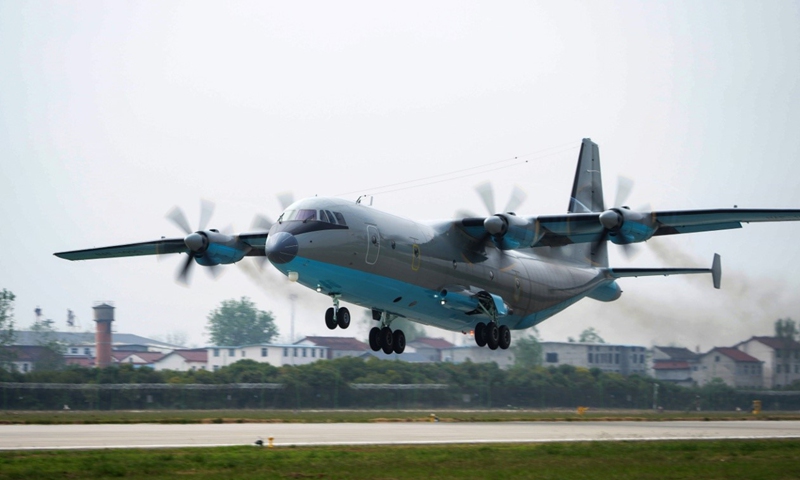
Y-9E transport aircraft (Photo: Courtesy of AVIC SAIC)
Kazakhstan's Defense Ministry officially announced on Thursday that a Y-9E military transport aircraft has arrived in Almaty, joining the fleet of the military transport aviation of the Kazakhstan Armed Forces. A military affairs expert told the Global Times that the Chinese-made aircraft's mature technology, logistical advantages and competitive cost could give it promising prospects in the international market.
The delivery was carried out as part of a planned renewal of the aircraft fleet. The new aircraft will expand capabilities for transporting personnel, military cargo, and materiel, according to a statement published on the ministry's website.
In terms of its capabilities, the Y-9E occupies an intermediate position between the C-295, a European-made tactical transport aircraft, and the A400M, a European four-engine military transport aircraft, currently in service. Its arrival will allow more flexible planning of air transport operations based on route distance and cargo weight, according to the release.
The Global Times learned that the Y-9E is an export-oriented transport aircraft developed from China's Y-9 platform to meet the requirements of overseas customers. It is designed to transport personnel, equipment and supplies, and features a long range, a spacious cargo compartment, substantial payload capacity and convenient loading and unloading. It can operate in challenging environments, including extreme heat, high altitudes and extreme cold.
Publicly available information indicates that the Y-9E is approximately 36 meters long, with a wingspan of about 38 meters. It has a maximum payload of 20 metric tons and a maximum takeoff weight of approximately 65 tons. The aircraft has a maximum level-flight speed of around 660 kilometers per hour, a cruising altitude of 7,000 to 8,000 meters and a maximum range of 5,200 kilometers.
The Y-9E is a further development of the Y-8 transport aircraft, with substantial improvements to its airframe structure, Wang Ya'nan, editor-in-chief of Beijing-based Aerospace Knowledge magazine, told the Global Times on Friday. The aircraft features a modern glass cockpit with upgraded avionics that meet mainstream international standards. The aircraft has also benefited from improvements in engine performance and aerodynamics, resulting in an increased payload capacity compared with the Y-8.
The aircraft has been showcased at several international and domestic air shows and defense exhibitions, including the 2018 Singapore Airshow, the 15th China International Aviation and Aerospace Exhibition in Zhuhai, South China's Guangdong Province, in 2024, and the 2026 Africa Aerospace and Defence exhibition.
Kazakhstan is the second known overseas customer for the Y-9E, following Namibia. In December 2024, the Namibian Air Force officially received two Y-9E medium military transport aircraft bought from China, according to the local media outlet The Namibian.
One of the Y-9E's advantages in the export market is the fact that the Chinese People's Liberation Army itself operates the Y-9 in substantial numbers, with various special-mission aircraft also developed on the same platform, Wang said. This large domestic user base helps support higher production volumes, a mature technological foundation and a stable supply of spare parts and maintenance services, while also offering potential cost advantages to overseas customers.
The expert added that the Y-9E could offer an alternative to countries seeking to replace aging medium-sized transport aircraft, such as the US-made C-130 Hercules. The C-130 has been in service for decades, but many countries seem to face the challenge of upgrading or replacing their aging fleets.
Against this backdrop, the Y-9E offers another option for countries seeking a medium-sized military transport aircraft. Its performance may have won favor in many countries, potentially opening up broader opportunities for the Chinese aircraft in the international market, Wang said.