


What are Western media concealing by shifting the climate spotlight to China?
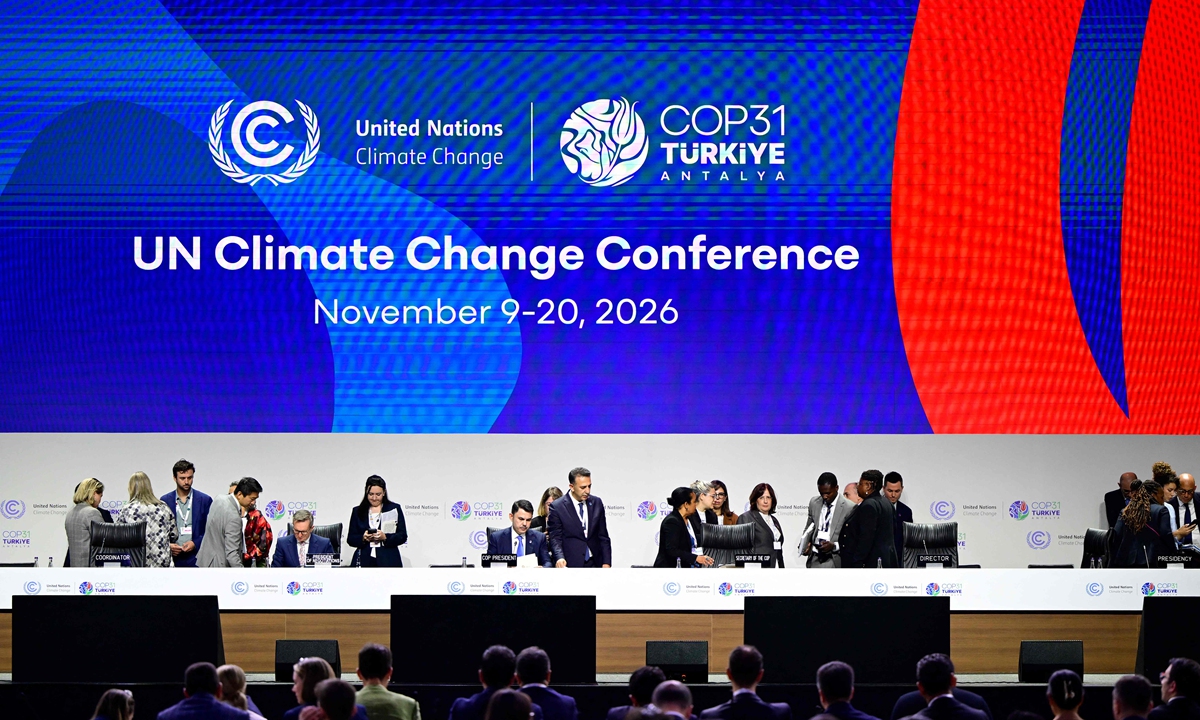
COP31 president and senior officials arrive for a session during the United Nations Climate Change Conference (COP31) at the Antalya Expo Center in Antalya, Turkey, on November 22, 2026. (Photo: VCG)
As the extended negotiations of COP31 in Antalya, Turkey, drag on, questions - such as why Beijing is "unwilling to take on a leadership role" on climate issues - are frequently raised in Western media. These biased questions carry the implicit assumption that leadership means bearing more obligations than others, and that China's low-key posture is a major factor hindering progress. Both assumptions deserve scrutiny.
The real bottleneck in global climate governance is no longer a lack of specific targets, but the failure to implement them. The latest draft text removed explicit language on phasing out coal, oil and gas. Negotiations on finance, adaptation and a just transition remain deadlocked. Ambition on paper has outpaced real economic action.
Against this backdrop, Western media have turned their attention to China, posing a question whose answer they already know: Why is Beijing "unwilling to take on a leadership role" on climate issues? By questioning why China is "so low-key," they divert attention from the responsibilities the West itself should shoulder on climate issues.
Deutsche Welle (DW), citing a Reuters analysis, noted that after Washington retreated in climate diplomacy, many had hoped China would "fill this gap." However, Beijing has ruled out hosting COP33 in 2028 and adopted a "consistently low-key" posture in Antalya. At the same time, the debate over whether China should still be regarded as a developing country has heated up again.
China's specific 2035 climate goals, announced in September 2025, include a 7 to 10 percent net emissions reduction from peak levels, over 30 percent non-fossil energy, 3,600 gigawatts of installed capacity for wind and solar power, over 24 billion cubic meters of forest stock volume, and the basic establishment of a climate-adaptive society.
The same standards should apply to everyone. Developed countries pledged to mobilize $100 billion per year in climate finance for developing countries. According to OECD data, these countries reached about $116 billion in 2022, the first year the target was met; however, questions remain about how loans are counted and whether such support is predictable. Adaptation finance - the type most needed by vulnerable countries - has consistently accounted for a smaller share than mitigation finance (the latest data show that its absolute amount is even declining).
When the countries least responsible for emissions struggle to obtain the funds already promised, it raises a question: Why do Western media turn the spotlight on China rather than discuss their own unfulfilled commitments?
In addition, Western governments call on China to "do more" on climate change while imposing tariffs on Chinese electric vehicles (EVs), batteries and solar products. The EU's countervailing duties on Chinese EVs and US tariffs on EVs, batteries, and solar modules are justified on grounds such as subsidies, overcapacity, and supply chain security. If rapidly deploying the lowest-cost clean technologies is key to cutting global emissions, then trade barriers that obstruct such deployment actually harm the climate goals Western governments claim to pursue.
That is why China's push for liberalizing trade in green products in Antalya should be viewed in context. This demand aims to open markets for low-cost clean technologies. Whether this effort succeeds will depend on whether importing countries are willing to recognize that cheaper clean technologies are a climate asset, and whether they will justify any restrictive measures with evidence rather than defend them on the assumption that "Chinese products are inherently suspect."
The installed capacity figures repeatedly cited by Western media are, in fact, a question of how to understand the speed and quality of China's development. China is making enormous efforts to meet its targets. Installed capacity is "capacity building" and a "necessary precondition" for the energy transition. The key lies not in the installed capacity numbers themselves, but in the quality of subsequent implementation and the supporting systems. This is essential for correctly understanding China's position on climate issues.
What global emissions reduction truly needs is not a new label but the honoring of existing commitments: Developed countries providing financial support, substantially cutting emissions, and opening green technology markets. China will fulfill its due responsibilities and achieve its emissions reduction targets. Developing countries need to improve the quality and speed of green economy development. Each should shoulder its own responsibility and move forward together.