


S.Korea's AI cheating scandal exposes governance gaps; institutional preparedness and policy stability crucial: expert
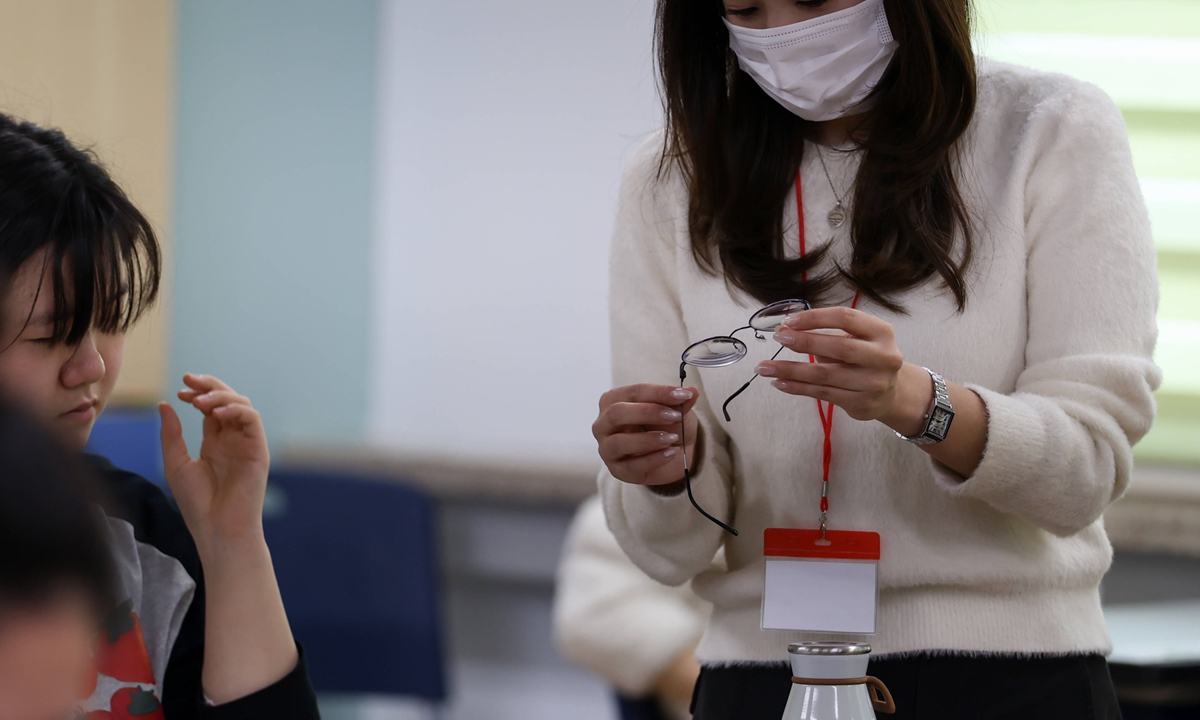
Proctors check candidates' glasses for potential AI-enabled or digital cheating devices at a test center in Seoul, South Korea, on November 19, 2026, ahead of the 2027 College Scholastic Ability Test (CSAT). (Photo: VCG)
South Korean Education Minister Choi Kyo-jin resigned on Sunday after last-minute anti-AI cheating measures caused confusion during the country's college entrance exam, with Chinese experts warning that the incident has exposed how technological advances are outpacing institutional responses.
Choi stepped down after President Lee Jae-myung accepted his resignation, following controversy over abrupt changes to exam rules intended to prevent AI-assisted cheating during last week's College Scholastic Ability Test, commonly known as Suneung. Choi apologized for the inconvenience caused to candidates and the public, acknowledging that the authorities had failed to prepare adequately. Authorities reported 111 suspected cases involving electronic devices during the exam, Yonhap News Agency reported.
The controversy unfolded against a broader backdrop of growing concerns over AI-assisted cheating. According to the Yonhap News Agency, the top scorer in this year's certified tax accountant exam admitted using a miniature camera, a smartphone and generative AI.
Separately, a man who achieved a perfect score on this year's Legal Education Eligibility Test (LEET) was found dead on Thursday after facing suspicions of cheating using AI, Yonhap News reported.
The incident exposes the risks of technological advances outpacing institutional responses, Xiong Bingqi, director of the 21st Century Education Research Institute, told the Global Times on Sunday, noting that China has established a multi-layered defense system for its national college entrance examination, or gaokao, which, like South Korea's Suneung, is a high-stakes university entrance exam. The safeguards include smart security gates, radio-signal shielding, AI-powered video surveillance and the disabling of problem-solving functions on domestic large language models during examination periods.
As AI enables candidates to obtain answers directly, China has further strengthened preventive measures, including screening for AI-powered glasses before the gaokao and prohibiting candidates from wearing them into examination rooms, with the rules communicated in advance, he said.
Such advance preparation, stable rules and government-enterprise coordination help safeguard examination fairness and offer lessons for other countries, Xiong said.
South Korean authorities reportedly sent emergency alerts to mobile phones nationwide during the Suneung to identify candidates carrying devices. While the approach helped detect some suspected cases, it also risked causing confusion and unnecessary anxiety among candidates and the public, Xiong said.
The episode highlights the need to balance strict anti-cheating measures with policy stability and candidates' rights. Last-minute restrictions without adequate preparation and advance notification can themselves create uncertainty and undermine public confidence in examination fairness. Authorities should therefore strengthen both technological safeguards and communication with candidates, Xiong said.
With smart glasses, miniature cameras and real-time AI models evolving rapidly, countries need to continuously upgrade detection technologies, improve regulations on wearable devices and strengthen coordination with technology companies. Technological safeguards must go hand in hand with forward-looking institutional planning, predictable policies and effective public communication to maintain examination fairness in the AI era, Xiong said.