


When Japan needs a magnifying glass to find itself in a White House video
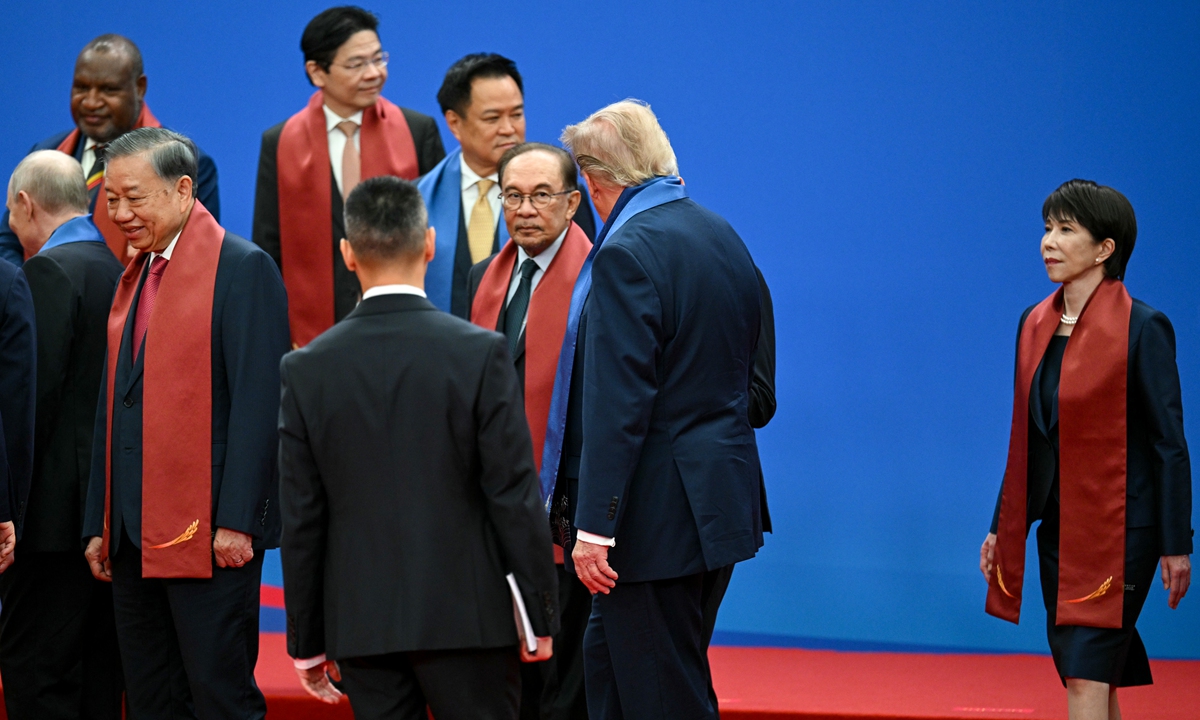
Japanese Prime Minister Sanae Takaichi leaves the stage after leaders pose for a group photo during the APEC meeting in Shenzhen, China, on 19 November, 2026. (Photo: VCG)
How does a country celebrate its diplomatic achievements? Japan recently offered a rather unusual answer. The country's Cabinet Secretary for Public Affairs recently posted a White House press conference video, zeroed in on the 13:58 mark, and triumphantly noted that Japan got a mention, and was called a "friend." Apparently, Tokyo was worried the rest of the world might miss the big news that the US still remembers Japan.
While other countries are busy securing major agreements, breakthroughs on regional issues, or tangible benefits for their people from multilateral diplomacy, Japan seems increasingly eager to prove just one thing: that Washington still considers Tokyo a friend. This kind of diplomatic messaging is hard not to see as black humor.
This "13:58 diplomacy" is less a triumph than a symptom of the deepening anxiety inside the Sanae Takaichi administration. People often talk most about what they feel they lack. A look at Takaichi's performance at the recent APEC meeting makes the awkwardness plain to see.
A widely circulated video shows Takaichi hurrying over to US President Donald Trump after the group photo of APEC leaders, then giving him a pat on the back. Trump barely glanced at her before turning away and walking off. Some Japanese viewers said on social media that they felt embarrassed. Others also expressed disappointment with Takaichi's facial expressions and body language during the meetings, including grimacing and sticking out her tongue. They questioned whether such behavior was appropriate for a national leader on the diplomatic stage. Others pointed out that while leaders gathered in small groups to talk, Takaichi appeared to be sitting alone, missing opportunities to exchange views and build relationships on the sidelines of the gatherings.
Against this backdrop, the Cabinet Secretary for Public Affairs' tweet looks more like an attempt to reassure the domestic audience.
Even before the Shenzhen APEC meeting, the Japanese side had shown obvious sensitivity about how Takaichi might be treated during her visit to China, repeatedly fretting about the possibility of a cold reception, differential treatment, and reading supposed diplomatic signals into every minor detail. In the end, she received a red-carpet welcome, a guard of honor, along with the usual diplomatic courtesies. As host, China provided arrangements fully in line with international practice.
Yet what ultimately determines a country's international standing is not how long a red carpet others roll out for you, but how much real weight you yourself carry. Unfortunately, Japan hasn't figured that out yet.
Most countries in the Asia-Pacific want to focus on economic development and regional cooperation. Japan, by contrast, keeps framing regional issues in military terms. While others look for opportunities to cooperate, some Japanese politicians remain busy stoking strategic confrontation. As countries across the region pursue peace, development and shared interests, Japanese policy is moving further toward re-militarization.
Tokyo seems to want to earn the trust of its regional neighbors, yet keeps eroding that trust. It positions itself as a key supporter and defender of a free and open international order grounded in the rule of law, yet pushes the region toward confrontation. This strategic contradiction is a major reason why Japan's diplomatic room for maneuver is narrowing.
The real question for Japan is not whether the US president mentioned it at a press conference, but why it is so desperate for Washington's approval while failing so badly to win the trust of its own neighbors through clear-eyed policy.
Unfortunately, Tokyo has become so desperate for attention that it now fixates on the smallest details - even the exact second Japan is mentioned in a White House video. The more it obsesses over such trivialities, the more it reveals how little it has to show for itself.
Thirteen minutes and fifty-eight seconds is short - short enough for the White House to give Japan just one brief mention. Yet it is also long - long enough for the outside world to see the growing gap between Japan's diplomatic ambitions and its actual standing on the global stage.
Politicians can build strong images at home through carefully crafted messaging, but on the international stage, what matters to others is their actual weight, policy credibility, and value as a partner.
Real diplomatic weight doesn't need others to mention you just to feel relevant. It makes others take your positions, interests, and choices seriously. That's true dignity - not replaying a White House video, checking once again: America, do you still remember me?