


Eisenkot decries settler violence
Israeli opposition leader Gadi Eisenkot, who is tasked with forming Israel's next government, has condemned arson attacks and vandalism against Palestinian homes and vehicles in the occupied West Bank as "Jewish terrorism", the latest escalation since the Gaza conflict erupted in 2023.
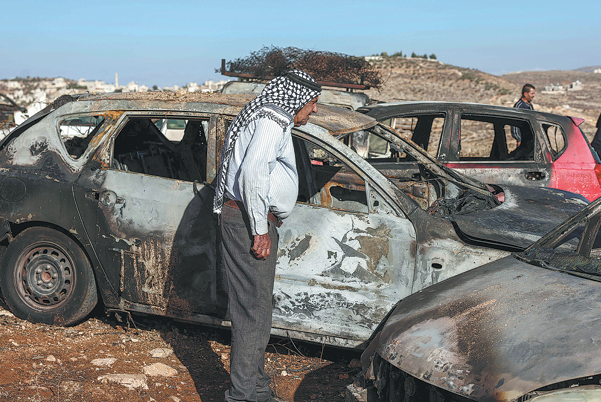
Palestinian men inspect the burned-out vehicles following a reported arson attack by Israeli settlers, in Kafr Malik, near the city of Ramallah, in the West Bank on Sunday. (Photo: AFP)
Such remarks are unusual for an Israeli politician, coming as Eisenkot is in post-election coalition talks to form a new administration to replace Benjamin Netanyahu's government.
"The night of arson … is Jewish terrorism in every sense of the word, and it must be called what it is," he said on Sunday. "Sabotage by extremist groups setting fire to vehicles and homes undermines regional stability, endangers lives, and severely damages the national security and foreign relations of the State of Israel."
The policies of Itamar Ben-Gvir and Bezalel Smotrich, ultranationalist ministers in Netanyahu's cabinet, he said, had "brought the area to the brink of anarchy, and the authorities have yet to address the crisis".
Images circulating on social media showed burning vehicles and graffiti scrawled on walls, including slogans such as "Revenge" and "Death to Arabs" in villages near Ramallah.
Israel has occupied the West Bank since 1967. More than 500,000 Israelis live in West Bank settlements, deemed illegal under international law, alongside roughly 3 million Palestinians.
Jihad al-Qaq, a local activist, said settlers attacked the northern area on the outskirts of his village at around 2 am on Sunday. "They set fire to around eight vehicles and daubed racist slogans on house walls," he told Agence France-Presse.
Israeli soldiers and police officers were deployed to the communities, and the Israel Defense Forces also condemned the attacks.
The assaults came as Physicians for Human Rights — Israel released a report on Monday warning that Palestinian medical workers in the West Bank were facing growing violence from Israeli soldiers and settlers.
The report recorded a 350-percent jump in such incidents between 2022 and 2024. It found emergency medical teams were regularly assaulted, threatened and intimidated — even when clearly identifiable as medical personnel.
"I was standing close to the wounded man. I could have reached him easily, but the soldiers stopped me. He lay there bleeding until he died. Only then did they leave, and we were able to reach him," said one paramedic from Nablus.
Nearly a month after the inconclusive election cost incumbent Netanyahu his parliamentary majority, Eisenkot was tasked with forming a government, though his chances of success remain uncertain.
Delegations from the two leaders' parties held another four-hour-long meeting on Sunday, but failed to strike a coalition deal, which would demand compromises from both sides.
The parties of Netanyahu and Eisenkot were due to resume coalition talks on Monday.
A former army chief of staff, Eisenkot has until Dec 6 to form a government, with the possibility of a 14-day extension, after October elections failed to give either camp an absolute majority. His 48-member bloc needs 61 lawmakers to secure a majority.
Netanyahu is pushing for a national unity government, which could see a rotation of the premiership between the two men, a mechanism already tried in Israel.