


Thailand's auto production plunges in Oct. as floods halt assembly lines
BANGKOK, Nov. 24 (Xinhua) -- Thailand's auto production dropped sharply in October as flooding cut off parts supplies and forced assembly plants to suspend operations temporarily, data from the Federation of Thai Industries (FTI) showed on Tuesday.
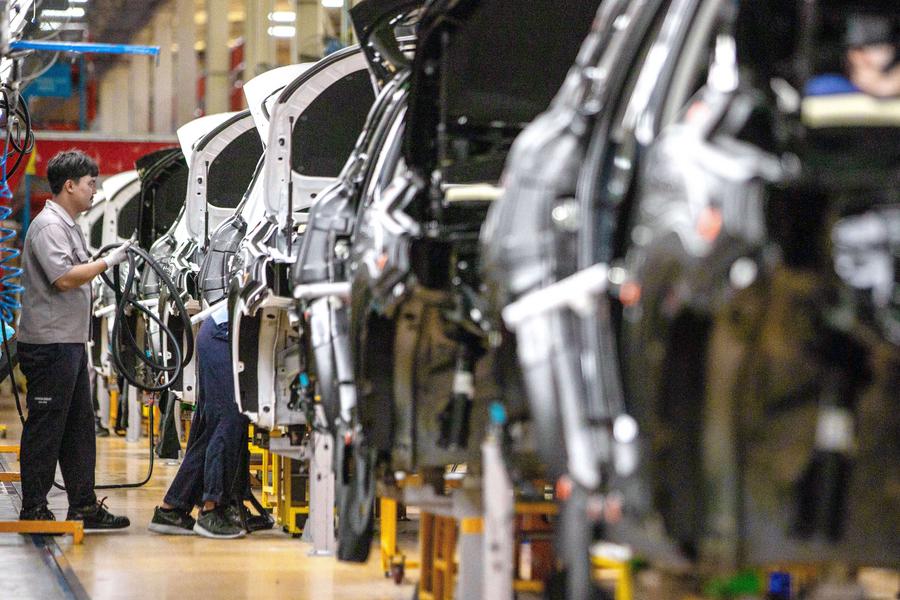
Workers work at the SAIC Motor-CP manufacturing plant in Chonburi, Thailand, Sept. 7, 2023. (Photo: Xinhua)
Automakers produced 87,938 vehicles in Thailand last month, down 35.19 percent from a year earlier and deepening from a 6.08 percent year-on-year decline in September, according to the FTI.
The federation said flooding from late September to mid-October stopped many parts makers from delivering components, and some workers could not get to work. All assembly lines were back in full operation from mid-October.
Output of internal-combustion-engine (ICE) passenger cars decreased 64.23 percent in October, and hybrid passenger car production fell 62.69 percent. Pure electric vehicle (EV) production grew 50.15 percent.
For the first 10 months of 2026, auto production fell 3.59 percent over the same period last year, said FTI Automotive Industry Club spokesperson Surapong Paisitpattanapong.
Domestic auto sales rose 8.71 percent year on year to 51,127 units in October. Deliveries of passenger battery EVs drove the gain, rising 94.46 percent to make up 32.25 percent of all vehicle sales, Surapong told a news conference.
He said demand was boosted by imported EVs, which are still taxed at a low excise rate of 10 percent. An estimated 14 percent of the passenger battery EVs sold in October were imported.
Thailand's cabinet has approved raising the excise tax on imported battery-electric and range-extended passenger cars to as much as 35 percent from Jan. 1, 2027.
Meanwhile, passenger ICE car sales dropped 37.53 percent, making up 11.66 percent of total sales. Diesel pickup sales kept falling because banks tightened lending and diesel prices rose, he said.
The Southeast Asian nation's finished car exports plunged 34.38 percent from the year before to 54,503 units in October.