


Germans 'want govt to pursue cautious foreign policy'
Rising fears of international conflict are pushing voters in Germany to favor a more cautious foreign policy, according to an annual survey of public attitudes commissioned by the Koerber Foundation.
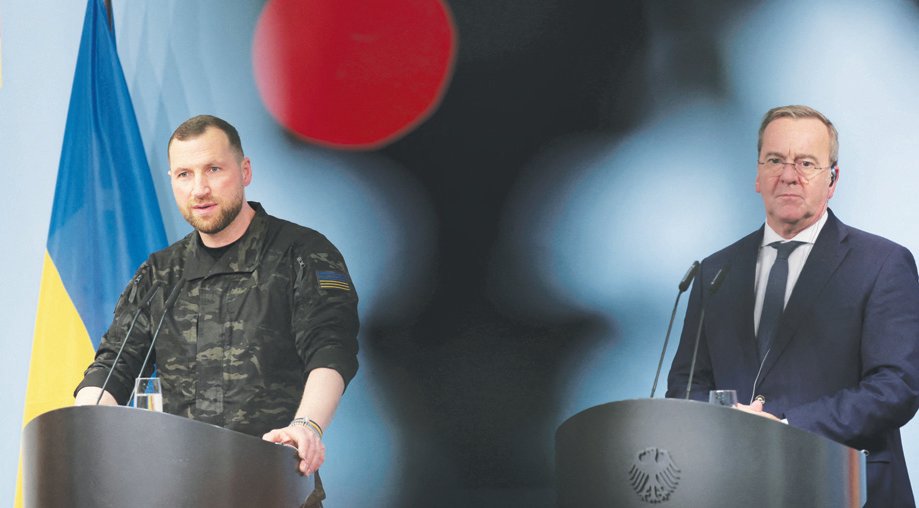
Germany's Defense Minister Boris Pistorius (right) and Ukraine's Defense Minister Yevhenii Khmara attend a news conference in Berlin, Germany on Monday. (Photo: Reuters)
The Berlin Pulse 2026/27 study, conducted by polling institute Forsa among 1,500 eligible voters in September, found that 65 percent of respondents worry military conflicts worldwide will escalate, Deutsche Welle News reported.
Nearly half — 48 percent — want Germany to exercise greater restraint in international affairs, a 5 percentage-point increase from last year.
Public backing for military aid to Ukraine has fallen sharply, with only 46 percent now supporting continued weapons deliveries, down from 59 percent in 2025. A slim majority of 53 percent favors halting the deliveries completely, and 77 percent of people want Germany to prioritize diplomacy over military action.
The findings suggest growing skepticism toward the current government's approach under Chancellor Friedrich Merz, which has sought influence in virtually every international conflict while leveraging Germany's position as the European Union's largest economy. Only 40 percent of respondents now favor greater international engagement, down from 48 percent in 2025.
Florian Bigge, who helped compile the study, noted the sharp changes in opinion.
"This is a significant decline, especially since we have been asking this question for years, with changes in the range of just 2 to 3 percentage points," Bigge said.
Opposition to military support for Ukraine runs especially high among supporters of the far-right Alternative for Germany, or AfD, party.
"Eighty-eight percent of AfD supporters oppose military assistance to Ukraine," said Jonathan Lehrer of the Berlin Pulse. "This is an interesting finding, especially considering political developments in Germany, including state elections in which the AfD gained support by campaigning against aid to Ukraine."
With the United States increasingly seen as uncertain on the global stage, transatlantic ties between the US and Germany face a stark challenge, according to the study's findings. It found 83 percent of respondents believe Germany should remain neutral, with only 15 percent saying they would side with Washington.
Bigge attributed this to a deep reluctance to choose sides.
"This sentiment is strong among Germans across all age groups and political parties," he said. "In eastern Germany, support for neutrality is at 92 percent, compared to 81 percent in the west. We interpret this as a desire for security but also reluctant commitment: Germans do not want to take sides in this conflict between the great powers."
While 82 percent view Russia as a military threat, respondents are divided on how forcefully Germany should push back against any provocations.
Sarah Pagung of the Koerber Foundation summed up the dilemma, saying, "The gap between external expectations and domestic support is the central challenge facing German foreign policy."