


German GDP growth slows to 0.1 pct in Q3
BERLIN, Nov. 25 (Xinhua) -- Germany's economy barely grew in the third quarter (Q3) amid falling exports and investment, final data showed Wednesday, raising fresh doubts over the strength of the recovery in Europe's largest economy.
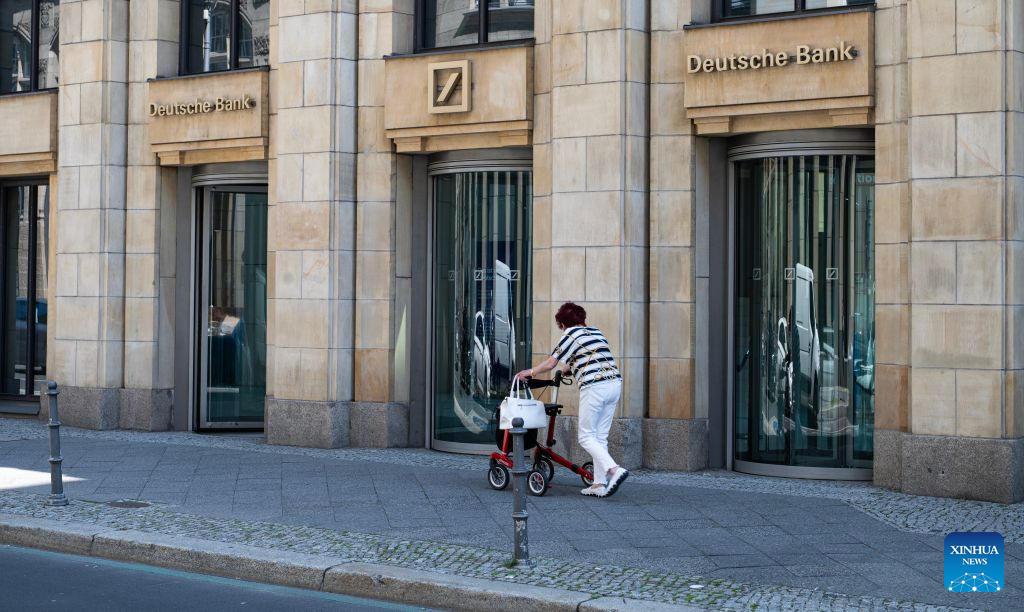
A woman walks past Deutsche Bank's building in Berlin, capital of Germany, July 30, 2026. (File photo: Xinhua)
Gross domestic product (GDP) expanded by 0.1 percent quarter-on-quarter, below the initial estimate of 0.2 percent and slowing from 0.3 percent in the second quarter, according to the Federal Statistical Office (Destatis).
Compared with the third quarter last year, three-month GDP grew 1.2 percent, mainly driven by a 3.1 percent increase in exports year-on-year, while imports also rose 1.3 percent after price adjustment.
During the same period, government consumption also rose 1.7 percent compared with the previous year, mainly supported by the central government's higher expenditure, particularly in intermediate consumption.
Destatis President Ruth Brand said the German economy showed resilience in the face of geopolitical crises in the first half of the year, but lost momentum in the third quarter.
While household and government consumption both rose slightly, investment contracted by 1.2 percent from the level of last quarter, led by a sharp drop in spending on machinery and equipment.
Exports of goods and services fell 1 percent from the previous quarter, with shipments of vehicles and auto parts, chemical products and metals among those declining, the figures showed.
After a solid first half of the year, German industrial exports came under renewed pressure as the boost from purchases brought forward in response to the Middle East conflict faded, while high energy costs and inland shipping disruptions compounded the difficulties.
In its monthly report last week, Germany's central bank said the economic recovery was continuing, despite a slowdown in the third quarter.
The bank expected growth to pick up in the fourth quarter, supported by expansionary fiscal policy and a recovery in industrial demand. However, higher interest rates and low capacity utilization were likely to weigh on business investment, while high energy prices continued to dampen private consumption.
Carsten Brzeski, global head of macro at ING Research, said improving business sentiment suggested the economic rebound could continue, with Germany on track for its strongest annual growth since 2022. But he warned that high gas prices, new U.S. tariffs and a lack of economic reforms posed downside risks to the recovery.
Commenting on the third-quarter slowdown, Brzeski said in a note: "This should not be the end of the rebound, but it's definitely not the start of a sustainable recovery either."